
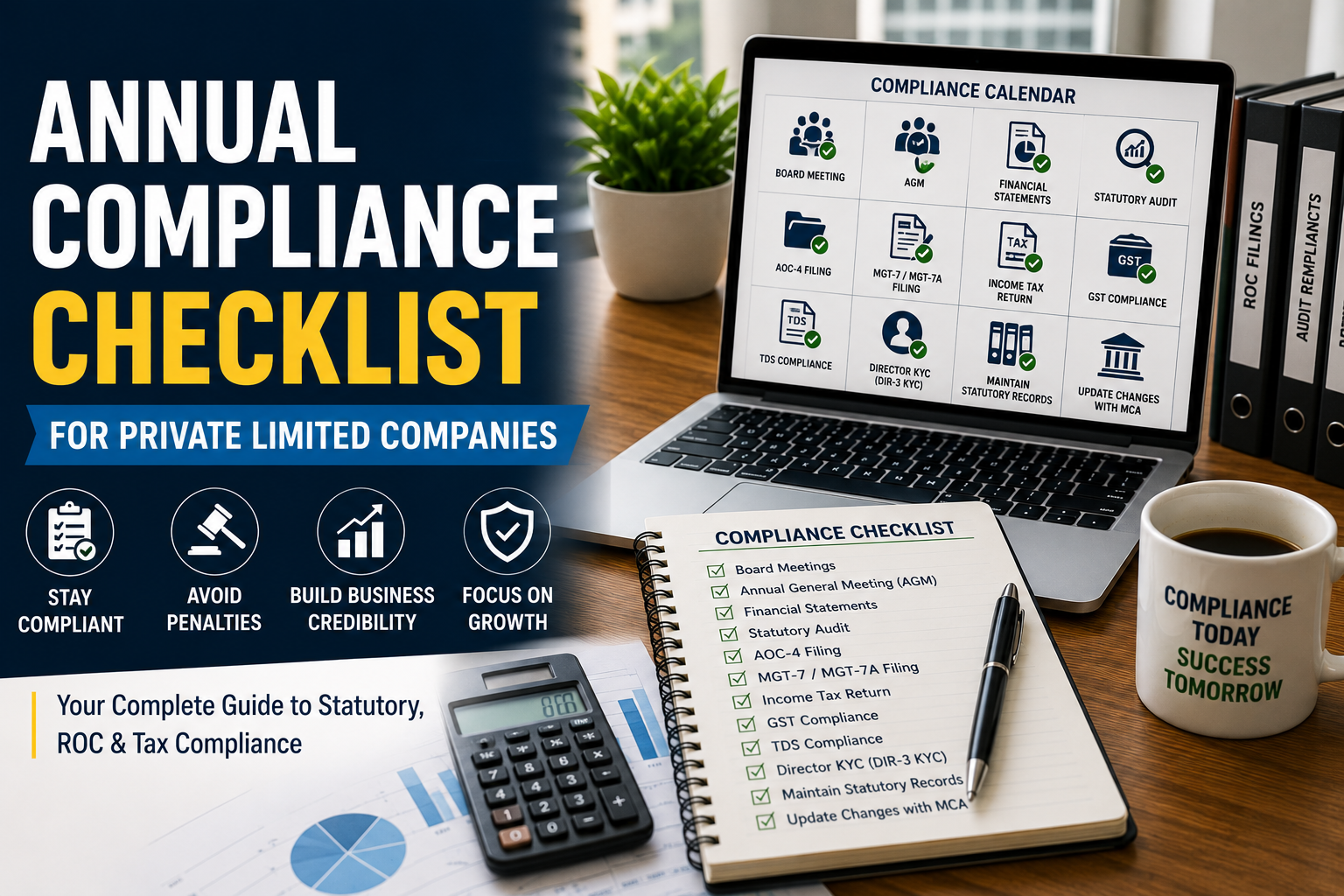
Registering a Private Limited Company is only the beginning of running a compliant business in India. Once a company is incorporated, it must continue to meet various requirements under the Companies Act, Income Tax Act, GST laws, and other applicable regulations.
These requirements are commonly referred to as annual compliance.
For founders and directors, keeping track of multiple forms, meetings, financial statements, tax filings, and deadlines can become challenging. Missing a filing can result in additional fees and may create unnecessary compliance issues.
The good news is that annual compliance becomes much easier when you follow a structured checklist throughout the year.
This guide covers the key annual compliance requirements for Private Limited Companies in India, along with practical tips for staying organized.
What Is Annual Compliance?
Annual compliance refers to the recurring legal, financial, tax, and regulatory obligations that a company must complete during a financial year.
Depending on the company's activities, these may include:
- Board meetings
- Annual General Meeting (AGM)
- Financial statement preparation
- Statutory audit
- Annual ROC filings
- Income Tax Return filing
- GST returns
- TDS returns
- Director KYC
- Auditor-related filings
- Maintenance of statutory records
Not every requirement applies in exactly the same way to every company. The company's size, turnover, business activity, financial position, and applicable exemptions can affect the compliance requirements.
Why Annual Compliance Is Important
Regular compliance helps a company:
- Maintain good legal standing
- Avoid unnecessary additional fees
- Keep MCA records updated
- Maintain accurate financial records
- Support business loans and investment discussions
- Build credibility with customers and stakeholders
- Reduce risks during due diligence
- Keep directors informed about statutory obligations
Compliance should therefore be treated as an ongoing business process rather than a year-end task.
Private Limited Company Annual Compliance Checklist
Here are some of the major compliance areas companies should monitor.
1. Maintain Proper Books of Accounts
Every company should maintain appropriate books and financial records as required under applicable law.
These records may include:
- Sales
- Purchases
- Expenses
- Bank transactions
- Receivables
- Payables
- Fixed assets
- Loans
- Investments
- Payroll
- Tax transactions
Maintaining accounts throughout the year makes statutory audit and annual filing significantly easier.
2. Prepare Financial Statements
At the end of the financial year, the company needs to prepare its financial statements in accordance with the applicable accounting requirements.
Financial statements generally include:
- Balance Sheet
- Statement of Profit and Loss
- Cash Flow Statement, where applicable
- Notes to Accounts
- Statement of Changes in Equity, where applicable
The exact financial statement requirements depend on the company and applicable accounting framework.
3. Conduct Statutory Audit
A Private Limited Company is generally subject to statutory audit requirements under the Companies Act.
The statutory auditor examines the company's financial statements and relevant accounting records before issuing the audit report.
The audit process may involve reviewing:
- Revenue
- Expenses
- Bank balances
- Loans
- Fixed assets
- Receivables
- Payables
- Tax balances
- Internal controls
Keeping accounting records updated throughout the year can make the audit process much smoother.
4. Hold Board Meetings
Companies are generally required to conduct Board Meetings at prescribed intervals under the Companies Act, subject to applicable exemptions.
Board meetings may cover matters such as:
- Financial performance
- Business decisions
- Borrowings
- Investments
- Appointment of key personnel
- Approval of financial statements
- Compliance matters
Minutes and relevant records should be properly maintained.
5. Hold the Annual General Meeting
The Annual General Meeting (AGM) is an important annual corporate compliance requirement for eligible companies.
At the AGM, shareholders may consider matters such as:
- Adoption of financial statements
- Board's report
- Auditor's report
- Appointment or continuation of auditors, where applicable
- Declaration of dividends, where applicable
- Other shareholder matters
The AGM must be conducted within the applicable statutory timeline.
6. File AOC-4
One of the key ROC filings is Form AOC-4, through which the company files its financial statements and related documents with the Registrar of Companies.
The filing generally follows the approval of the financial statements at the AGM.
The applicable due date and form depend on the company's circumstances and the financial year.
Incorrect or delayed filing can result in additional fees.
7. File MGT-7 or MGT-7A
Another important annual ROC filing is the company's annual return.
Depending on the company's category and applicable rules, the company may need to file:
- MGT-7, or
- MGT-7A for eligible companies.
The annual return contains information about the company's:
- Registered office
- Directors
- Shareholders
- Share capital
- Meetings
- Indebtedness
- Other prescribed corporate information
Always confirm which form applies to your company for the relevant financial year.
8. File Income Tax Return
A Private Limited Company must generally file an Income Tax Return irrespective of whether it has generated profit, subject to applicable law.
The company may need to report:
- Revenue
- Business expenses
- Depreciation
- Profit or loss
- Tax deductions
- Tax payments
- Other relevant financial information
The return should be prepared after properly reconciling the company's accounting and tax records.
9. Pay Advance Tax
Companies with applicable tax liabilities may need to pay advance tax during the financial year.
Advance tax planning helps avoid:
- Interest liabilities
- Cash-flow pressure
- Last-minute tax payments
The amount and payment schedule depend on the company's expected tax liability and applicable tax provisions.
10. Complete Director KYC
Directors holding a DIN are subject to annual KYC requirements under the applicable MCA rules.
Depending on the director's circumstances, this may involve:
- DIR-3 KYC
- DIR-3 KYC Web
The annual KYC requirement is generally due by 30 September following the relevant financial year.
Directors should ensure that their:
- Mobile number
- Email address
- Address
- PAN
- Other personal details
are accurate and updated where required.
11. Maintain GST Compliance
If the company is registered under GST, it must comply with the applicable GST filing requirements.
Depending on the company's business and filing frequency, this can include:
- GSTR-1
- GSTR-3B
- Annual GST return, where applicable
- Reconciliation and other applicable statements
Regular reconciliation between:
- Books
- Sales invoices
- Purchase records
- GST returns
can help identify discrepancies before they become larger compliance issues.
12. Complete TDS Compliance
If the company deducts Tax Deducted at Source (TDS), it needs to comply with applicable TDS requirements.
This may include:
- Deducting TDS correctly
- Depositing TDS within the prescribed timeline
- Filing TDS returns
- Issuing TDS certificates
- Reconciling TDS records
TDS compliance should be reviewed regularly rather than only at year-end.
13. Maintain Statutory Registers and Records
Companies are required to maintain various statutory records depending on their structure and activities.
These may include records relating to:
- Members
- Directors
- Share transfers
- Charges
- Board meetings
- General meetings
- Shareholding
- Loans and investments
Proper record maintenance is important during audits, inspections, due diligence, and corporate transactions.
14. Update Changes With the MCA
Whenever there is a significant change in the company's structure or management, the applicable MCA filing should be completed within the prescribed period.
Examples include changes in:
- Directors
- Registered office
- Share capital
- Shareholders
- Charges
- Key managerial personnel
Do not wait until annual filing season to report changes that have separate statutory deadlines.
15. Review Registered Office Compliance
A company must maintain a registered office and comply with applicable requirements relating to its address.
Make sure:
- The registered office details are current.
- Required documents and records are maintained appropriately.
- Statutory communications can be received.
- Any change of registered office is properly reported.
16. Review MSME and Other Applicable Filings
Certain companies may have additional compliance obligations based on their transactions and activities.
For example, companies with outstanding payments to eligible Micro and Small Enterprises may need to consider applicable MSME reporting requirements.
Other industry-specific registrations and filings may also apply.
Therefore, an annual compliance checklist should be customized to the company rather than treated as a universal list.
Important Annual Compliance Timeline
A simplified compliance calendar may look like this:
| Compliance | Typical Timing |
|---|---|
| Board Meetings | Throughout the year |
| Financial Statement Preparation | After financial year-end |
| Statutory Audit | Before financial statements are finalized/adopted |
| AGM | Within the statutory period |
| AOC-4 | Within prescribed period after AGM |
| MGT-7 / MGT-7A | Within prescribed period after AGM |
| Income Tax Return | As per applicable due date |
| DIR-3 KYC | Generally by 30 September |
| GST Returns | Monthly/Quarterly, as applicable |
| TDS Returns | Quarterly, where applicable |
Important: Due dates can vary based on the company's category, financial year, applicable exemptions, and changes notified by regulators. Always verify the current MCA, Income Tax, and GST requirements before filing.
Common Annual Compliance Mistakes
Private Limited Companies often face problems because of simple oversights.
1. Filing at the Last Minute
Waiting until the deadline increases the risk of:
- Technical issues
- Missing documents
- Incorrect information
- DSC problems
- Additional fees
2. Ignoring Director KYC
Directors sometimes focus on company filings and forget their individual DIN compliance.
3. Mismatch Between Books and Tax Returns
Differences between accounting records, GST returns, TDS records, and Income Tax filings can create unnecessary questions.
4. Not Maintaining Board Minutes
Corporate records should be maintained properly throughout the year.
5. Missing Additional Compliance
A company may have industry-specific or transaction-specific obligations beyond the standard annual filings.
How to Make Annual Compliance Easier
Use a Compliance Calendar
Maintain a calendar containing:
- Filing name
- Applicable entity
- Due date
- Responsible person
- Documents required
- Filing status
Maintain Monthly Accounts
Don't wait until March or the end of the financial year.
Monthly bookkeeping makes:
- Audits
- Tax filing
- GST reconciliation
- Financial reporting
- ROC compliance
much easier.
Keep Documents Organized
Maintain digital folders for:
- Invoices
- Bank statements
- Tax filings
- ROC filings
- Board minutes
- Agreements
- Financial statements
- Certificates
Review Compliance Quarterly
A quarterly compliance review can identify missed requirements before they become serious problems.
Why Professional Compliance Support Matters
Corporate compliance involves multiple laws, forms, deadlines, and documentation requirements.
Professional support can help companies:
- Track deadlines
- Prepare documents
- Reconcile financial information
- Complete MCA filings
- Handle tax compliance
- Maintain corporate records
- Identify additional compliance requirements
This allows directors and founders to focus more on business operations while reducing administrative risk.
How Clockwell Can Help
At Clockwell, we provide end-to-end compliance and financial support for Private Limited Companies and growing businesses.
Our services include:
- Private Limited Company Registration
- ROC Annual Filing
- AOC-4 Filing
- MGT-7 / MGT-7A Filing
- DIR-3 KYC
- Board & Corporate Compliance Support
- Statutory Audit Coordination
- Income Tax Filing
- GST Registration & Filing
- TDS Compliance
- Accounting & Bookkeeping
- Tax Advisory
- Business Advisory
- Virtual CFO Services
Our team can help you maintain a structured compliance calendar, prepare the required documents, complete applicable filings, and keep your company's statutory records organized.
Annual compliance is an essential part of operating a Private Limited Company in India. From maintaining books of accounts and conducting statutory audits to completing ROC filings, Income Tax compliance, GST filings, and Director KYC, companies need to manage several recurring obligations throughout the year.
The best approach is not to treat compliance as a once-a-year activity.
Maintain your accounts monthly, track deadlines throughout the year, reconcile tax records regularly, and review your compliance position periodically.
A structured compliance system reduces last-minute pressure, helps prevent avoidable additional fees, and gives directors greater confidence that the company is meeting its statutory responsibilities.
If you're unsure which annual compliances apply to your Private Limited Company, professional corporate compliance and tax advisory support can help you build a customized checklist and stay on track throughout the year.
Published on August 15, 2026