
Starting a business in the UAE can be an exciting opportunity for entrepreneurs. With access to international markets, modern infrastructure, investor-friendly policies and a strong business ecosystem, the UAE has become a popular destination for startups and SMEs.
However, registering a company is only the beginning. Once a startup is established, it must continue meeting various legal, tax, accounting, labour and regulatory compliance requirements.
Many startups make compliance mistakes because they focus heavily on sales, funding and growth while treating administrative and regulatory obligations as secondary. Unfortunately, even a small oversight can result in penalties, operational problems or difficulties when dealing with banks, investors and government authorities.
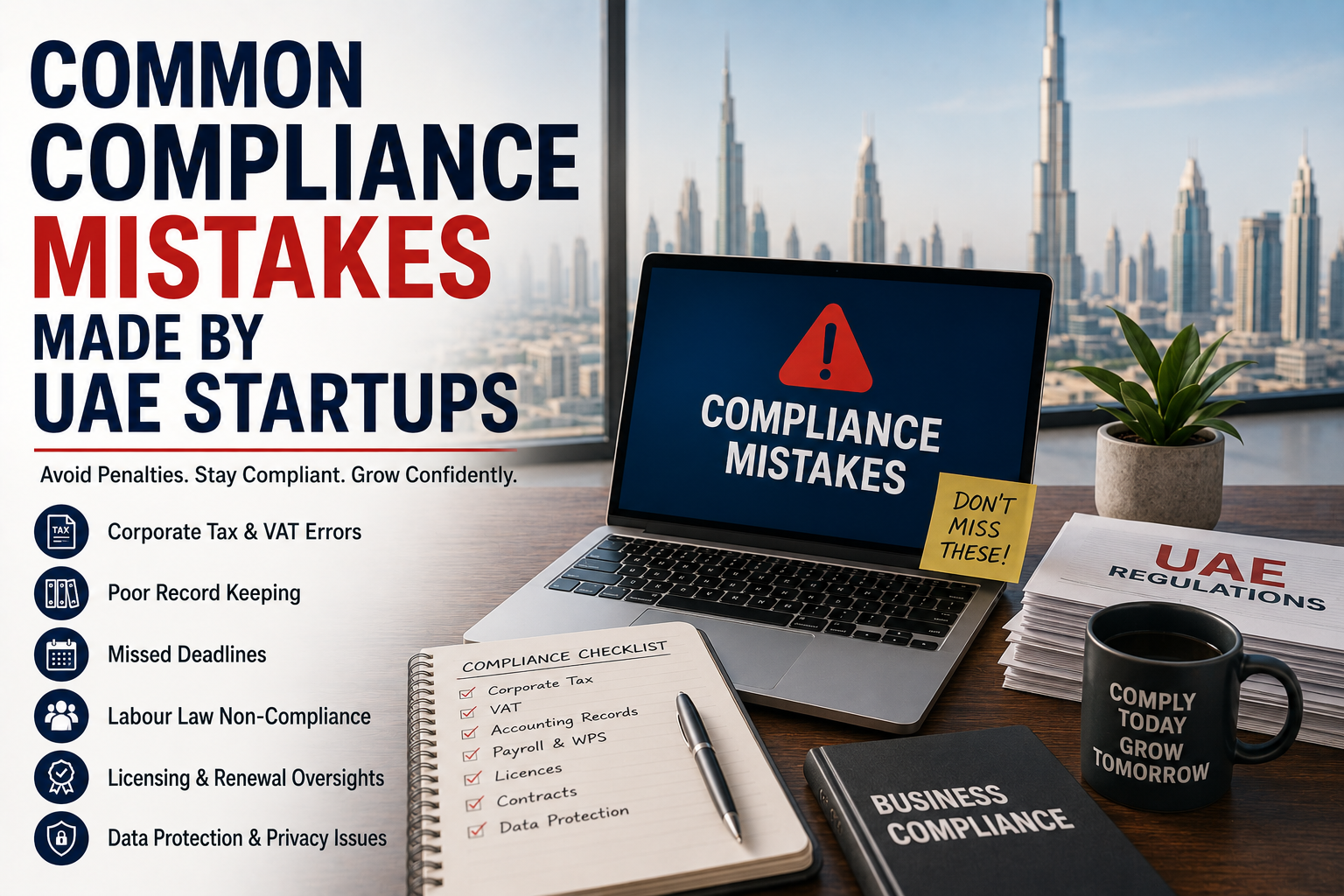
Here are some of the most common compliance mistakes made by UAE startups—and how to avoid them.
What Is Business Compliance in the UAE?
Business compliance means following the laws, regulations, licensing conditions and reporting requirements applicable to your company.
Depending on the nature and structure of the business, this can include:
- Maintaining a valid trade licence
- Corporate Tax registration and filing
- VAT registration and returns
- Maintaining proper accounting records
- Beneficial ownership information
- Employment and labour compliance
- Payroll and Wage Protection System requirements
- Consumer protection
- Data protection and privacy
- Industry-specific approvals
- Licence renewal and corporate records
The exact requirements depend on factors such as your business activity, legal structure, emirate, free zone or mainland status, turnover and number of employees.
1. Treating the Trade Licence as the Only Compliance Requirement
One of the biggest mistakes new founders make is assuming that once they receive their trade licence, their compliance obligations are complete.
A trade licence gives the business permission to conduct specified activities, but it does not automatically satisfy tax, accounting, labour or other regulatory requirements.
For example, a startup may still need to consider:
- Corporate Tax registration
- VAT registration, where applicable
- Tax return filing
- Accounting records
- Employee documentation
- Beneficial ownership information
- Licence renewals
- Sector-specific permits
The UAE Government notes that businesses are subject to different laws covering areas such as business operations, labour rights, consumer rights, intellectual property and free-zone regulations.
How to avoid this mistake
Create a compliance calendar immediately after incorporation. Record every registration, filing, renewal and reporting deadline applicable to your company.
2. Missing Corporate Tax Registration
Corporate Tax is one of the most important areas for UAE startups to understand.
A common misconception is that a startup does not need to register for Corporate Tax simply because it is small or has not generated significant profits.
The actual requirement depends on the company's status and applicable Corporate Tax rules. The Federal Tax Authority states that taxable persons are required to register for Corporate Tax and obtain a Corporate Tax Registration Number.
For natural persons conducting business activities, the FTA currently states that registration is required when business revenue exceeds AED 1 million in a calendar year, subject to the applicable rules and exclusions.
Why this matters
Missing the applicable registration deadline can result in an administrative penalty. The FTA currently lists an AED 10,000 penalty for late Corporate Tax registration, although a current waiver initiative may apply when specified conditions are satisfied.
How to avoid this mistake
Do not wait until your first tax return is due.
Determine your company's Corporate Tax registration obligations early and maintain documentation supporting your tax position.
3. Assuming VAT Does Not Apply to Small Startups
Another common mistake is ignoring VAT because the company is newly established.
For UAE-resident businesses, VAT registration becomes mandatory when taxable supplies and imports exceed AED 375,000 over the previous 12 months or are expected to exceed that threshold in the next 30 days.
Voluntary registration may be available once taxable supplies, imports or qualifying taxable expenses exceed AED 187,500, subject to the applicable rules.
There are also specific rules for non-resident businesses making taxable supplies in the UAE.
How to avoid this mistake
Monitor turnover every month rather than checking your VAT position once a year.
Your accounting system should help you track:
- Taxable sales
- Zero-rated supplies
- Imports
- Taxable expenses
- VAT collected
- Input VAT
- VAT filing deadlines
4. Registering for VAT but Failing to File Correctly
VAT registration is not the end of the process.
Once registered, a business needs to maintain appropriate records, issue compliant tax invoices where required, calculate VAT correctly and submit VAT returns within the applicable deadlines.
A startup can therefore be technically VAT-registered but still non-compliant because of poor bookkeeping or incorrect VAT treatment.
Common problems include:
- Incorrect VAT calculations
- Missing tax invoices
- Mixing business and personal expenses
- Incorrect treatment of imports
- Poor documentation for input VAT
- Missing VAT return deadlines
- Not reconciling VAT accounts
How to avoid this mistake
Use accounting software and reconcile your VAT accounts before every VAT return.
Do not wait until the filing deadline to reconstruct several months of transactions.
5. Thinking VAT Registration Covers Corporate Tax
This is another important misconception.
Being registered for VAT does not mean the company is automatically registered for UAE Corporate Tax.
The FTA specifically states that taxpayers must register for Corporate Tax even if they are already registered for VAT.
Better approach
Maintain separate compliance checklists for:
VAT
- Registration
- Tax invoices
- VAT accounting
- VAT returns
- VAT payments
Corporate Tax
- Registration
- Accounting records
- Taxable income calculation
- Corporate Tax return
- Tax payment
- Supporting documentation
6. Poor Accounting and Record Keeping
Some founders view accounting as something that can be handled once a year.
This is risky.
Accurate accounting is essential for understanding the company's financial position and supporting tax compliance. The FTA has also issued rules concerning the maintenance of information contained in accounting records and commercial books.
Poor bookkeeping can create problems when calculating:
- Revenue
- Expenses
- Profit
- VAT
- Corporate Tax
- Accounts receivable
- Accounts payable
- Inventory
- Cash flow
It can also make due diligence much more difficult when seeking investors or selling the business.
How to avoid this mistake
Maintain your books monthly.
A basic monthly accounting routine should include:
- Bank reconciliation
- Sales reconciliation
- Expense verification
- Receivables review
- Payables review
- VAT reconciliation
- Payroll reconciliation
- Management reporting
7. Mixing Personal and Business Finances
Startup founders often use personal cards or bank accounts to pay business expenses, particularly during the early stages.
While this may seem convenient, it can create accounting and compliance problems.
It becomes harder to determine:
- Which expenses belong to the company
- How much the founder has invested
- Whether an amount is a business expense or personal withdrawal
- The company's actual cash position
Best practice
Open and maintain a dedicated corporate bank account and establish clear procedures for:
- Founder investments
- Salary
- Reimbursements
- Business expenses
- Dividends or distributions
- Loans from shareholders
8. Ignoring Beneficial Ownership Requirements
Startups sometimes focus on shareholders and directors but overlook beneficial ownership information.
UAE beneficial ownership regulations require legal persons to maintain information concerning their ultimate beneficial owners. UAE regulations define a beneficial owner based on ultimate ownership or control, including through chains of ownership or other means of control.
Certain free-zone rules may also require beneficial ownership declarations as part of ongoing corporate compliance.
Why this matters
Incorrect or outdated ownership information can create problems during:
- Licence renewal
- Banking procedures
- Corporate restructuring
- Investor due diligence
- Regulatory reviews
How to avoid this mistake
Keep shareholder, director and beneficial ownership records updated whenever there is a change in ownership or control.
9. Forgetting Licence Renewal
A startup may be busy with customers, employees and growth and accidentally allow its trade licence to expire.
This can create operational problems and may affect activities such as:
- Banking
- Invoicing
- Visa processing
- Government transactions
- Business operations
- Corporate documentation
How to avoid this mistake
Set reminders well before the expiry date.
Do not treat licence renewal as an administrative task to handle at the last minute.
10. Hiring Employees Without Proper Documentation
Growing startups often hire quickly.
However, employment compliance should grow alongside the team.
The UAE Labour Law governs private-sector employment relationships and covers areas including contracts, working hours, leave, employee records, termination and end-of-service benefits.
Employment contracts should clearly establish important terms such as the role, workplace, salary, duration and other applicable conditions.
Common startup mistakes
- Hiring without completing required employment procedures
- Incomplete employment contracts
- Incorrect salary records
- Poor employee documentation
- Ignoring leave entitlements
- Incorrect termination procedures
- Failing to maintain employee records
How to avoid this mistake
Create a proper employee onboarding checklist covering:
- Job offer
- Employment contract
- Work permit requirements
- Visa/residency procedures where applicable
- Payroll setup
- Employee records
- Leave records
- End-of-service calculations
11. Ignoring Wage Protection System Requirements
For businesses subject to the applicable UAE labour requirements, payroll compliance is an important responsibility.
The Wage Protection System (WPS) is an electronic wage-transfer system designed to ensure workers receive their contractual wages accurately and on time.
A startup should therefore establish a reliable payroll process instead of treating salary payments as informal transfers.
Better practice
Maintain a monthly payroll checklist covering:
- Employee salary
- Allowances
- Deductions
- Payroll approval
- WPS processing
- Bank reconciliation
- Leave records
12. Ignoring Employee Leave and End-of-Service Obligations
Some startups concentrate on salary payments but overlook employee benefits and statutory entitlements.
For example, UAE private-sector employees are generally entitled to annual leave under the Labour Law, with the standard entitlement reaching 30 days for each year of service after completing one year.
Companies should also properly track:
- Annual leave
- Public holidays
- Sick leave
- Other applicable leave
- Notice periods
- End-of-service benefits
How to avoid this mistake
Maintain an employee HR file and update leave and benefit records monthly.
13. Collecting Customer Data Without a Privacy Framework
Modern startups collect large amounts of personal information through:
- Websites
- Mobile applications
- Online stores
- Payment systems
- CRM platforms
- Marketing campaigns
This information needs to be handled carefully.
The UAE Personal Data Protection Law establishes a framework for protecting personal data and includes requirements concerning processing, security, privacy and cross-border transfers.
Common mistakes
- Collecting unnecessary customer information
- Weak data security
- No privacy policy
- Sharing information without appropriate legal basis
- Poor access controls
- Keeping customer data indefinitely
How to avoid this mistake
Review what personal information your business collects and establish appropriate:
- Privacy policies
- Data retention practices
- Access controls
- Security procedures
- Vendor agreements
- Customer consent mechanisms where applicable
14. Ignoring Consumer Protection Rules
Startups selling products or services directly to consumers should not focus only on marketing and sales.
Consumer-facing businesses need to consider applicable consumer protection requirements, including information provided to customers, pricing, product/service representations and applicable refund or warranty obligations.
This becomes particularly important for:
- E-commerce businesses
- Retail startups
- Subscription businesses
- Online service providers
- Consumer apps
The UAE Government identifies consumer rights as part of the regulatory framework businesses must comply with.
15. Assuming Free Zone Companies Have No Compliance Obligations
Free zones offer attractive advantages, but being established in a free zone does not mean the company is outside UAE regulatory requirements.
A free-zone company may still have obligations relating to:
- Corporate Tax
- VAT
- Accounting
- Beneficial ownership
- Licence renewal
- Employees
- Customs
- Data protection
- Industry-specific regulations
The exact requirements depend on the company's activities and free-zone rules.
Key lesson
Free zone does not mean compliance-free.
Founders should understand both the free-zone regulations and the UAE federal requirements applicable to their business.
16. Ignoring Related-Party and Transfer Pricing Rules
Startups sometimes have transactions involving:
- Founders
- Parent companies
- Sister companies
- Related businesses
- Shareholders
- Connected persons
These transactions should not automatically be treated as ordinary third-party transactions.
The FTA confirms that UAE transfer pricing rules can apply to transactions with Related Parties and Connected Persons, including transactions involving parties in the UAE, free zones or foreign jurisdictions.
How to avoid this mistake
Maintain proper documentation for related-party transactions and obtain professional advice where transfer pricing rules apply.
17. Failing to Monitor Regulatory Changes
UAE business regulations continue to develop.
Tax rules, accounting requirements, labour regulations, e-invoicing requirements and sector-specific rules can change over time.
For example, the FTA's legislation portal currently includes new 2026 decisions covering areas such as accounting records, registration timelines and e-invoicing-related matters.
A startup that relies on information received when it incorporated may eventually be operating under outdated assumptions.
Better approach
Review your compliance framework at least quarterly and whenever there is a significant regulatory change affecting your industry.
18. Waiting Until There Is a Problem
Perhaps the biggest compliance mistake is treating compliance as something to address only after receiving a notice.
By that point, the business may already have:
- Missed deadlines
- Incorrect records
- Unpaid taxes
- Expired documents
- Payroll issues
- Incomplete contracts
- Incorrect filings
Compliance is much easier when it is built into normal business operations.
UAE Startup Compliance Checklist
Use this checklist as a starting point:
Corporate Setup
-
Valid trade licence
-
Correct business activities
-
Licence renewal tracking
-
Corporate documents maintained
-
Shareholder records updated
-
Beneficial ownership information updated
Tax Compliance
-
Corporate Tax registration reviewed
-
VAT registration requirement reviewed
-
VAT returns filed where applicable
-
Corporate Tax return requirements tracked
-
Tax invoices maintained
-
Accounting records maintained
Accounting
-
Monthly bookkeeping
-
Bank reconciliation
-
Expense documentation
-
Receivables and payables tracking
-
Payroll reconciliation
-
Financial statements
HR & Labour
-
Employment contracts
-
Work permits and employment procedures
-
Payroll process
-
WPS compliance where applicable
-
Leave records
-
End-of-service calculations
Data & Customers
-
Privacy policy
-
Data security controls
-
Customer data management
-
Consumer protection review
-
Website/app terms and conditions
Ongoing Compliance
-
Compliance calendar
-
Regulatory updates monitored
-
Annual renewals tracked
-
Related-party transactions reviewed
-
Professional compliance review
How Startups Can Build a Better Compliance System
Compliance does not need to become a complicated process.
A startup can build a practical system by following five steps:
1. Identify Your Obligations
List every requirement applicable to your company based on its legal structure, business activity, location and employees.
2. Assign Responsibility
Every compliance task should have an owner.
For example:
| Compliance Area | Responsible Person |
|---|---|
| Accounting | Accountant/CFO |
| Tax | Tax adviser/Finance team |
| Payroll | HR/Finance |
| Licence | Admin/PRO |
| Corporate records | Company secretary/Admin |
| Data protection | Management/IT/Legal |
3. Create a Compliance Calendar
Record:
- Due date
- Responsible person
- Required documents
- Filing status
- Payment status
- Renewal date
4. Keep Documents Organised
Maintain digital copies of:
- Licences
- Tax registrations
- Tax returns
- Invoices
- Bank statements
- Contracts
- Employee records
- Corporate documents
- Government correspondence
5. Review Compliance Regularly
A quarterly compliance review can help identify issues before they become expensive problems.
Final Thoughts
The biggest compliance mistake UAE startups make is not necessarily failing to follow a particular rule. It is failing to build compliance into the business from the beginning.
A startup can have an excellent product, strong sales and significant growth—but poor compliance can still create financial, legal and operational risks.
Corporate Tax, VAT, accounting, licensing, beneficial ownership, employment, payroll, data protection and consumer requirements should therefore be treated as part of the company's operating system, not as paperwork to handle later.
If you are launching or growing a startup in the UAE, a structured compliance review can help you identify gaps, avoid unnecessary penalties and build a stronger foundation for long-term growth.
Need help with UAE accounting, tax and business compliance? Professional accounting and compliance support can help your startup stay organised while you focus on growth.
Published on September 3, 2026