

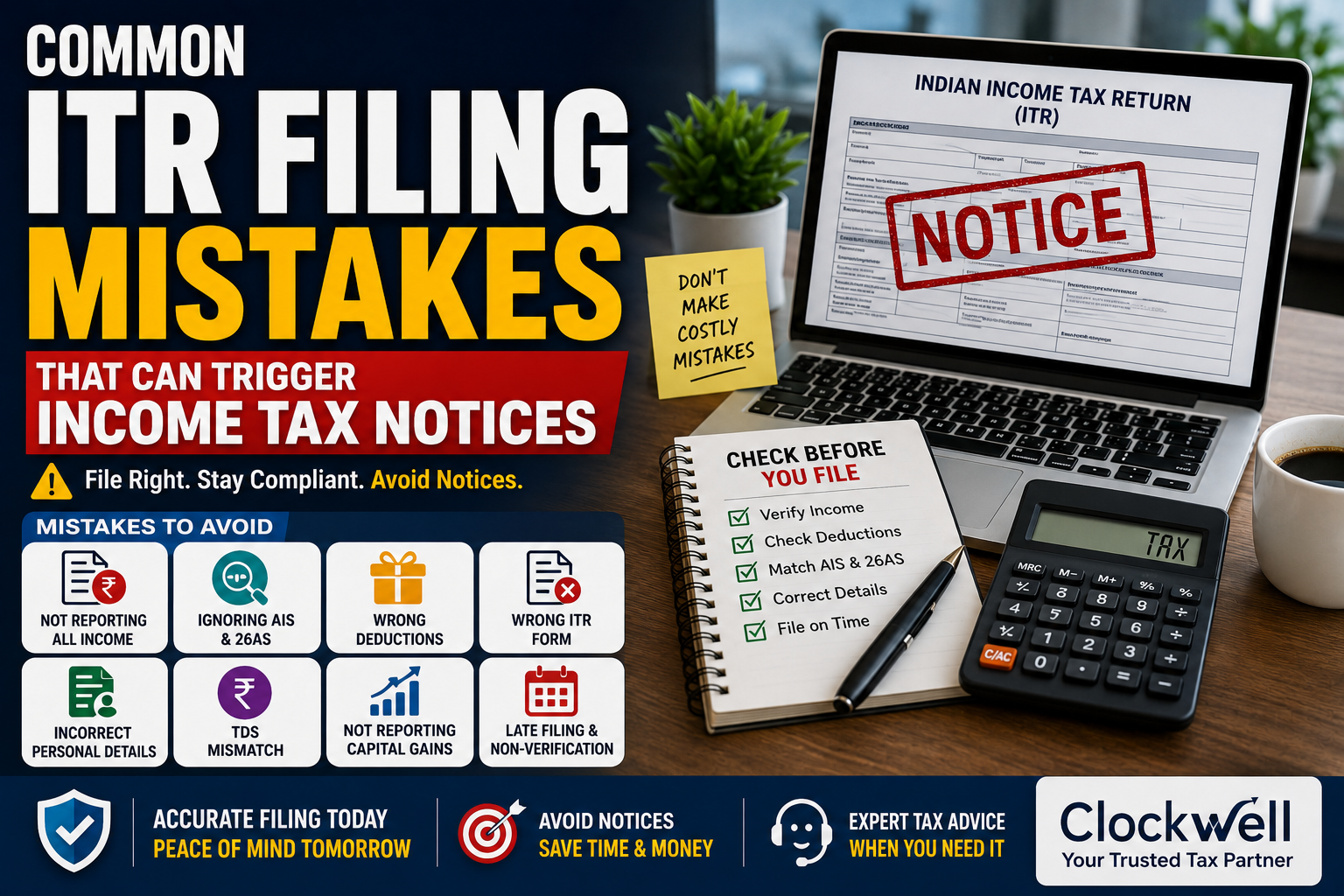
Filing your Income Tax Return (ITR) is an important annual responsibility for taxpayers. Whether you're a salaried employee, freelancer, business owner, consultant, or professional, filing an accurate return helps you remain compliant and avoid unnecessary issues with the Income Tax Department.
However, many taxpayers unknowingly make mistakes while filing their ITR. Even small errors—such as reporting incorrect income, claiming ineligible deductions, or ignoring information in official tax statements—can result in an Income Tax Notice.
The good news is that most of these notices are preventable with careful preparation and accurate reporting.
In this guide, we'll discuss the most common ITR filing mistakes, explain why they trigger tax notices, and share practical tips to help you file your returns confidently.
Why Accuracy Matters in ITR Filing
The Income Tax Department now relies heavily on technology and data analytics to verify tax returns.
Information from various sources is automatically matched, including:
- Employers
- Banks
- Mutual Funds
- Stock Brokers
- GST Records
- Property Registrations
- Financial Institutions
- Annual Information Statement (AIS)
- Form 26AS
- TDS Returns
If any mismatch is detected, the department may issue an Income Tax Notice requesting clarification.
1. Not Reporting All Sources of Income
One of the most common mistakes is reporting only salary income while ignoring other taxable income.
Taxpayers often forget to include:
- Interest from savings accounts
- Fixed deposit interest
- Rental income
- Freelance income
- Capital gains
- Dividend income
- Business income
- Foreign income (where applicable)
Even if tax has already been deducted, the income usually still needs to be reported correctly in the ITR.
2. Ignoring Form 26AS and AIS
Before filing your return, always compare your records with:
- Form 26AS
- Annual Information Statement (AIS)
These statements contain information such as:
- TDS
- Tax payments
- Bank interest
- Securities transactions
- High-value transactions
- Other reported financial information
Ignoring these records can lead to mismatches and notices.
3. Claiming Incorrect Deductions
Many taxpayers claim deductions without verifying eligibility.
Common examples include:
- Incorrect deductions under Section 80C
- Unsupported medical insurance deductions
- Wrong education loan claims
- Ineligible HRA exemptions
- Incorrect home loan benefits
Always retain supporting documents for every deduction claimed.
4. Selecting the Wrong ITR Form
Different taxpayers must use different Income Tax Return forms depending on their income and business activities.
Choosing the wrong form may result in:
- Defective returns
- Processing delays
- Additional notices
- Re-filing requirements
Always verify that you're using the correct ITR form for your financial situation.
5. Incorrect Personal Details
Simple mistakes like incorrect:
- PAN
- Aadhaar details
- Bank account number
- IFSC code
- Email address
- Mobile number
can delay processing or create unnecessary complications.
Always double-check personal information before submission.
6. Mismatch in TDS Claims
Many taxpayers claim TDS that doesn't match the amount reported by employers or deductors.
Common reasons include:
- Employer filing delays
- Incorrect PAN
- Data entry errors
- Wrong TDS amount claimed
Compare your records with Form 26AS before filing.
7. Forgetting to Report Capital Gains
Income from:
- Shares
- Mutual Funds
- Property sales
- Gold
- Bonds
may attract capital gains tax.
Many taxpayers wrongly assume that if money is reinvested, reporting isn't required.
Always disclose applicable capital gains transactions accurately.
8. Not Reporting Bank Interest
Interest earned from:
- Savings accounts
- Fixed deposits
- Recurring deposits
is often reflected in AIS and Form 26AS.
Even small amounts should be considered while preparing your return, subject to applicable exemptions and deductions.
9. Wrong Calculation of Business Income
Small businesses and freelancers frequently make errors while calculating:
- Revenue
- Expenses
- Profit
- Depreciation
- GST adjustments
Incorrect business income reporting is a common reason for notices.
Maintaining proper books of accounts greatly reduces this risk.
10. Incorrect GST and Income Tax Reconciliation
Business owners sometimes report different turnover figures in:
- GST Returns
- Income Tax Return
- Financial Statements
Such inconsistencies can attract scrutiny.
Regular reconciliation between GST records and accounting books helps maintain consistency.
11. Filing Returns After the Due Date
Late filing may result in:
- Interest
- Late fees
- Delayed refunds
- Carry-forward restrictions for certain losses
- Increased chances of compliance issues
Filing on time is always the best approach.
12. Not Verifying the ITR
Submitting the return is only part of the process.
The return generally needs to be verified using the prescribed method.
Failure to complete verification within the applicable time may result in the return being treated as invalid.
13. Incorrect Bank Account Details
Wrong bank information may lead to:
- Refund delays
- Refund failures
- Additional communication from the department
Always confirm bank account details before filing.
14. Poor Record Keeping
Many taxpayers cannot respond properly to notices because they fail to maintain:
- Salary slips
- Invoices
- Bank statements
- Investment proofs
- Rent receipts
- Loan documents
- Tax payment records
Good documentation makes future compliance much easier.
15. Filing Without Reviewing the Return
Rushing through the filing process often leads to:
- Typing mistakes
- Incorrect income reporting
- Missing schedules
- Wrong deduction claims
- Incorrect calculations
A final review before submission can prevent many errors.
Common Reasons These Mistakes Trigger Income Tax Notices
These mistakes often result in:
- Income mismatches
- TDS discrepancies
- High-value transaction verification
- Incorrect deduction claims
- Defective return notices
- Tax demand notices
- Scrutiny assessments
- Requests for clarification
Most notices are issued because the department's records don't match the information reported in the return.
How to Avoid ITR Filing Mistakes
Follow these best practices:
Review AIS and Form 26AS
Ensure all reported information matches your records.
Report Every Source of Income
Don't omit interest, dividends, capital gains, or freelance income.
Choose the Correct ITR Form
Use the form applicable to your income sources and business activity.
Verify Deductions
Claim only deductions for which you are eligible and have supporting documents.
Maintain Proper Records
Organize financial documents throughout the year rather than waiting until tax season.
File Before the Deadline
Avoid last-minute filing to reduce the risk of mistakes.
Verify Your Return
Complete the verification process promptly after submission.
Practical Example
Consider a salaried employee who files an ITR using only Form 16.
Later, the Income Tax Department notices additional interest income from fixed deposits reflected in the Annual Information Statement.
Since the interest wasn't reported in the return, the taxpayer receives an Income Tax Notice seeking clarification.
This situation could have been avoided by reviewing AIS before filing and including all taxable income.
Benefits of Accurate ITR Filing
Correct filing helps you:
- Avoid unnecessary Income Tax Notices.
- Receive refunds faster.
- Maintain a clean tax compliance record.
- Reduce stress during assessments.
- Improve financial credibility.
- Save time and professional costs in the future.
Why Professional Tax Assistance Matters
Tax laws evolve regularly, and even experienced taxpayers may overlook important details.
Professional tax advisors can help with:
- Income Tax Return Filing
- Tax Planning
- Income Reconciliation
- AIS & Form 26AS Review
- Business Income Computation
- Capital Gains Calculation
- GST Reconciliation
- Notice Response
- Compliance Advisory
Professional guidance minimizes errors and ensures accurate filing.
How Clockwell Can Help
At Clockwell, we provide comprehensive tax and compliance services for individuals, professionals, freelancers, startups, and businesses.
Our services include:
- Income Tax Return Filing
- Tax Planning
- Income Tax Notice Assistance
- GST Registration & Filing
- Accounting & Bookkeeping
- Business Advisory
- Audit & Assurance
- Virtual CFO Services
- Company Registration
- Financial Compliance
Our experienced team carefully reviews your financial information, reconciles tax records, and ensures your returns are filed accurately and on time.
Filing your Income Tax Return accurately is one of the simplest ways to avoid unnecessary notices and maintain a strong compliance record. Most ITR filing mistakes—such as omitting income, claiming incorrect deductions, choosing the wrong return form, or failing to reconcile AIS and Form 26AS—are entirely preventable with proper preparation.
A careful review of your financial information before filing can save significant time, cost, and stress later. Whether you're a salaried employee, freelancer, professional, or business owner, investing in accurate tax compliance today helps protect you from avoidable issues tomorrow.
If you're unsure about your return or want expert assistance with tax filing, Clockwell can help you file confidently, stay compliant, and respond effectively to any tax-related queries.
Published on August 5, 2026