

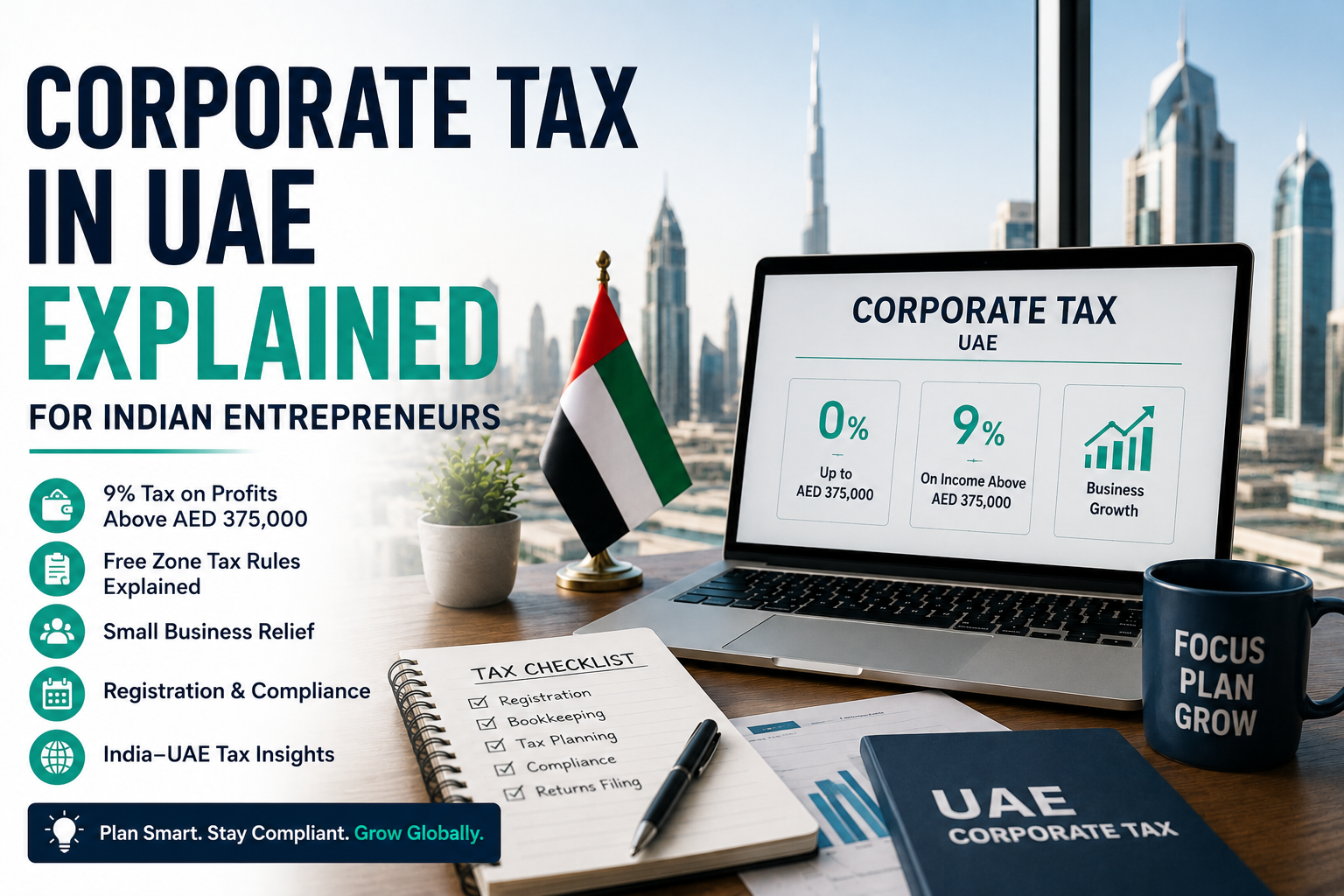
Corporate Tax (CT) is a federal direct tax imposed on the taxable income or profits of businesses operating within the scope of the UAE Corporate Tax regime.
The UAE Corporate Tax framework applies across the Emirates and is not limited to Dubai or Abu Dhabi.
This means an Indian entrepreneur establishing a UAE company should consider Corporate Tax as part of the initial business-planning process—not as something to deal with only after the business starts generating significant profits.
What Is the UAE Corporate Tax Rate?
For most businesses, the standard UAE Corporate Tax structure is:
| Taxable Income | Corporate Tax Rate |
|---|---|
| Up to AED 375,000 | 0% |
| Above AED 375,000 | 9% |
The 9% rate applies to the portion of taxable income exceeding AED 375,000, rather than automatically taxing the entire profit at 9%.
Example
Suppose an Indian entrepreneur owns a UAE company with:
Taxable income = AED 1,000,000
The simplified calculation would be:
- First AED 375,000 → 0%
- Remaining AED 625,000 → 9%
Corporate Tax = AED 56,250
This illustrates why entrepreneurs should understand the distinction between revenue, accounting profit and taxable income.
Is UAE Corporate Tax Based on Revenue or Profit?
Generally, Corporate Tax is based on Taxable Income, not simply gross sales.
The FTA explains taxable income as the accounting net profit or loss, after making the adjustments required under the Corporate Tax Law.
For example:
Revenue: AED 5,000,000
Allowable business expenses: AED 3,800,000
Accounting profit: AED 1,200,000
The taxable income may then require specific tax adjustments before the final Corporate Tax liability is determined.
Therefore, maintaining proper accounting records is critical.
Does Corporate Tax Apply to Indian-Owned UAE Companies?
Yes.
The nationality of the founder does not automatically exempt a UAE company from Corporate Tax.
The FTA states that UAE juridical persons that are incorporated or resident in the UAE can fall within the Corporate Tax regime irrespective of the nationality or residence of their founders or ultimate owners.
For example:
An Indian entrepreneur establishes a Dubai mainland LLC.
The fact that the shareholder is Indian does not by itself make the company exempt from UAE Corporate Tax.
The company needs to assess its UAE Corporate Tax obligations based on the applicable rules.
What About UAE Free Zone Companies?
This is one of the biggest areas of confusion for Indian entrepreneurs.
You may hear:
“Free Zone companies don't pay Corporate Tax.”
That statement is incomplete.
A Qualifying Free Zone Person (QFZP) can benefit from a 0% Corporate Tax rate on Qualifying Income, while taxable income that does not meet the qualifying-income conditions can be subject to 9%.
Therefore:
Free Zone ≠ automatically 0% tax.
The company needs to satisfy the relevant requirements.
What Is a Qualifying Free Zone Person?
Among other requirements, a Free Zone entity must:
- Maintain adequate substance in the UAE
- Earn Qualifying Income
- Comply with applicable transfer-pricing requirements
- Maintain the required documentation
- Not elect to be subject to Corporate Tax under the standard regime
The FTA specifically identifies these conditions for QFZP status.
This makes Free Zone tax planning more complex than simply choosing a Free Zone because it advertises a low-tax environment.
Do Free Zone Companies Need Corporate Tax Registration?
Yes.
The FTA has clarified that all Free Zone Persons must register for Corporate Tax, regardless of whether they qualify for the 0% rate on Qualifying Income.
This is an important distinction:
Tax registration ≠ necessarily tax payment.
A company may have a Corporate Tax registration obligation even when certain income ultimately qualifies for the 0% rate.
What Is Small Business Relief?
The UAE Corporate Tax regime provides a Small Business Relief mechanism for qualifying businesses.
Under the current FTA guidance, a Resident Person may elect for Small Business Relief where revenue is AED 3 million or less in the relevant Tax Period and in all previous Tax Periods, subject to the applicable conditions.
A valid election can result in the business being treated as having no taxable income for that Tax Period.
However, the relief is not available to everyone.
For example, the FTA states that a Qualifying Free Zone Person and a member of a multinational enterprise group meeting the specified criteria cannot elect for this relief.
Important
Don't assume:
“My revenue is below AED 3 million, so I don't need to worry about Corporate Tax.”
The business may still have registration and compliance obligations, and eligibility for Small Business Relief must be assessed under the current rules.
Does Corporate Tax Apply to Individual Indian Entrepreneurs?
Corporate Tax isn't limited to companies.
The UAE also has rules covering natural persons conducting a business or business activity in the UAE.
The FTA currently states that a natural person is required to register for Corporate Tax where total revenue from conducting business or business activities exceeds AED 1 million in a calendar year, subject to the exclusions and rules specified by the FTA.
For example, the FTA excludes certain income such as:
- Salary
- Private investment income
- Real estate investment income
from the revenue calculation for this purpose.
This distinction matters for Indian entrepreneurs operating as individuals, freelancers or sole proprietors rather than through a company.
What Is the Difference Between Revenue and Taxable Income?
This is one of the most important concepts to understand.
Revenue
Money generated from business activities.
Accounting Profit
Revenue minus accounting expenses.
Taxable Income
Accounting profit after applying the relevant UAE Corporate Tax adjustments.
The Corporate Tax calculation is based on taxable income, not simply the amount appearing in the company's bank account.
Which Business Expenses Can Be Deducted?
The UAE Corporate Tax framework generally allows legitimate business expenses incurred to generate taxable income, subject to the specific rules and limitations.
The FTA explains that legitimate business expenses are generally deductible, although timing and other rules can affect the deduction.
Examples may include:
- Employee salaries
- Office rent
- Professional fees
- Business software
- Marketing expenses
- Certain travel expenses
- Utilities
- Business-related operating costs
However, entrepreneurs should not assume that every expense paid from the company account is automatically deductible.
Expenses with personal and business elements may need to be apportioned, and certain categories are subject to specific restrictions.
Why Proper Accounting Is Important
Corporate Tax makes accurate accounting even more important for UAE businesses.
Your accounting records should help you determine:
- Revenue
- Business expenses
- Net profit
- Tax adjustments
- Related-party transactions
- Assets
- Liabilities
- Receivables
- Payables
Poor bookkeeping can result in an incorrect Corporate Tax calculation.
For Indian entrepreneurs running UAE businesses remotely, this can become a particular challenge when UAE and India transactions are mixed.
UAE Corporate Tax vs VAT
Corporate Tax and VAT are two separate taxes.
VAT
Generally applies to taxable supplies and is currently charged at the standard rate of 5% where applicable.
Corporate Tax
Generally applies to taxable income/profits under the Corporate Tax regime.
The FTA explicitly confirms that Corporate Tax does not replace VAT. Both can apply to the same business.
So a UAE company may need to manage:
VAT + Corporate Tax + Accounting + Other Regulatory Compliance
What About an Indian Company Opening a UAE Branch?
An Indian business expanding to the UAE may establish a branch or another form of presence.
The tax treatment depends on the structure and whether the UAE presence creates a taxable presence under UAE rules.
The FTA states that a non-resident juridical person can fall within UAE Corporate Tax where it has a Permanent Establishment (PE) in the UAE.
This is where cross-border tax planning becomes important.
A business should not assume:
“We already pay tax in India, so the UAE branch cannot have UAE tax obligations.”
The UAE and India tax rules need to be considered together.
What Is Permanent Establishment?
Permanent Establishment is a key concept in international taxation.
A foreign business may create a taxable presence through factors such as:
- Fixed places of business
- Branches
- Offices
- Certain business activities
- Certain personnel arrangements
The precise definition depends on the applicable domestic law and, where relevant, the applicable Double Taxation Agreement.
For Indian entrepreneurs, this becomes particularly important when they continue operating their Indian business while establishing a UAE presence.
India-UAE Double Taxation Considerations
India and the UAE have a Double Taxation Agreement (DTA) framework.
The purpose of DTAs is broadly to address situations where the same income could otherwise be taxed in more than one jurisdiction.
The UAE Ministry of Finance notes that its DTA network is designed to reduce or eliminate double taxation and facilitate cross-border investment.
The UAE Corporate Tax framework also recognizes the role of international agreements. Where an applicable DTA conflicts with UAE Corporate Tax law on the right to tax a particular item of income, the relevant international agreement may limit the UAE's taxing rights.
Why this matters
An Indian entrepreneur should consider:
India tax position → UAE tax position → DTA → Permanent Establishment → Transfer Pricing → Foreign tax credits
rather than looking at UAE Corporate Tax in isolation.
Can Double Taxation Be Avoided?
Potentially, yes, depending on the facts and the applicable rules.
The UAE Corporate Tax framework provides for foreign tax credits in certain circumstances. The FTA explains that foreign taxes paid on relevant foreign-source income can potentially reduce UAE Corporate Tax payable, subject to the applicable conditions and limitations.
The relevant DTA can also provide its own mechanism for eliminating double taxation.
This is particularly relevant where an Indian entrepreneur has:
- Indian operations
- UAE operations
- Shared employees
- Cross-border services
- Intercompany transactions
- Royalties
- Dividends
- Management fees
Professional cross-border tax advice is strongly recommended in such situations.
What About Transfer Pricing?
Indian entrepreneurs operating businesses in both countries should also understand transfer pricing.
Suppose:
Indian Company → provides services → UAE Company
or:
UAE Company → provides management services → Indian Company
The pricing of transactions between related parties should be properly documented and supported under the applicable transfer-pricing rules.
The UAE Corporate Tax regime incorporates the arm's-length principle, and qualifying Free Zone Persons have specific transfer-pricing compliance requirements.
This is especially important for businesses with common ownership in India and the UAE.
Example: Indian Entrepreneur With a UAE Company
Consider an Indian entrepreneur who establishes a UAE company.
During the year:
Revenue: AED 4,000,000
Business expenses: AED 2,800,000
Accounting profit: AED 1,200,000
Assume, purely for illustration, that after all relevant tax adjustments the taxable income remains AED 1,200,000.
The simplified Corporate Tax calculation would be:
AED 375,000 × 0% = AED 0
AED 825,000 × 9% = AED 74,250
Therefore:
Estimated Corporate Tax = AED 74,250
This is only an illustrative calculation. Actual taxable income and applicable reliefs can change the result.
Common Corporate Tax Mistakes Indian Entrepreneurs Make
1. Assuming UAE Means Zero Tax
The UAE now has a federal Corporate Tax regime.
The standard rate is 9% on taxable income above AED 375,000.
2. Assuming Free Zone Means Zero Tax on Everything
A QFZP can receive 0% on Qualifying Income, but other income can be subject to 9%.
3. Ignoring Corporate Tax Registration
All taxable persons need to assess their registration obligations.
The FTA currently states that taxable persons must register and obtain a Corporate Tax Registration Number, subject to the applicable rules.
4. Mixing India and UAE Accounts
Using the same accounting records for both jurisdictions without proper segregation can create reconciliation and tax issues.
Maintain clear:
- UAE books
- Indian books
- Intercompany accounts
- Related-party records
5. Ignoring Permanent Establishment Risk
An Indian company may create UAE tax exposure through its activities in the UAE.
Likewise, a UAE company conducting substantial operations in India should consider its Indian tax position.
6. Treating Company Formation as Tax Planning
Choosing a Free Zone or mainland licence is a business structuring decision, not automatically a tax exemption.
The tax treatment depends on the actual activities, transactions and applicable rules.
7. Neglecting Transfer Pricing
Related-party transactions between India and UAE should be reviewed carefully.
8. Poor Financial Records
Corporate Tax calculations depend heavily on reliable financial statements and supporting documentation.
Corporate Tax Compliance Checklist for Indian Entrepreneurs
If you own or manage a UAE business, consider maintaining this checklist:
Business Structure
- Mainland or Free Zone?
- Company or individual business?
- UAE branch or separate entity?
- Ownership structure documented?
Tax
- Corporate Tax registration
- Taxable income calculation
- Small Business Relief eligibility
- Free Zone qualifying status
- VAT registration, if applicable
- Corporate Tax return
Cross-Border
- India-UAE DTA review
- Permanent Establishment assessment
- Transfer pricing
- Related-party transactions
- Foreign tax credit considerations
Accounting
- Monthly bookkeeping
- Bank reconciliation
- Receivables
- Payables
- Expense documentation
- Financial statements
Why Indian Entrepreneurs Should Plan Corporate Tax Before Incorporating
One of the biggest mistakes is:
Set up company → start transactions → think about tax later.
A better approach is:
Business plan → structure → tax analysis → registration → accounting system → operations
This is especially important when choosing between:
- UAE mainland
- Free Zone
- Branch
- Subsidiary
- Individual business structure
The right structure depends on your business model, customers, expected turnover, ownership, funding plans and India-UAE operations.
How Clockwell Can Help Indian Entrepreneurs in the UAE
For Indian entrepreneurs expanding into the UAE, managing accounting and tax obligations across two countries can become complicated.
Clockwell can support businesses with:
- UAE Company Formation
- Mainland & Free Zone Setup
- UAE Corporate Tax Registration
- Corporate Tax Compliance
- UAE VAT Registration
- VAT Return Filing
- Accounting & Bookkeeping
- Financial Reporting
- Tax Advisory
- India-UAE Tax Planning Support
- Transfer Pricing Coordination
- Business Advisory
- Virtual CFO Services
Whether you're a first-time entrepreneur setting up in Dubai or an established Indian business expanding into the UAE, a structured tax and accounting system can help you avoid costly compliance mistakes.
Corporate Tax in the UAE is no longer something Indian entrepreneurs can ignore.
For most businesses, the standard UAE Corporate Tax structure is 0% on taxable income up to AED 375,000 and 9% on the portion exceeding AED 375,000.
Free Zone businesses can potentially benefit from 0% Corporate Tax on Qualifying Income, but they must satisfy the applicable conditions.
Small businesses may also have access to Small Business Relief, subject to the current eligibility conditions.
For Indian entrepreneurs, however, the bigger picture is important.
Your tax position may involve:
UAE Corporate Tax + UAE VAT + India Tax + DTA + Permanent Establishment + Transfer Pricing
That's why UAE business setup should be approached as a tax and business-structuring exercise, not simply as a company-registration exercise.
The earlier you establish proper accounting, documentation and tax processes, the easier it becomes to scale your UAE business with confidence.
Published on August 27, 2026