

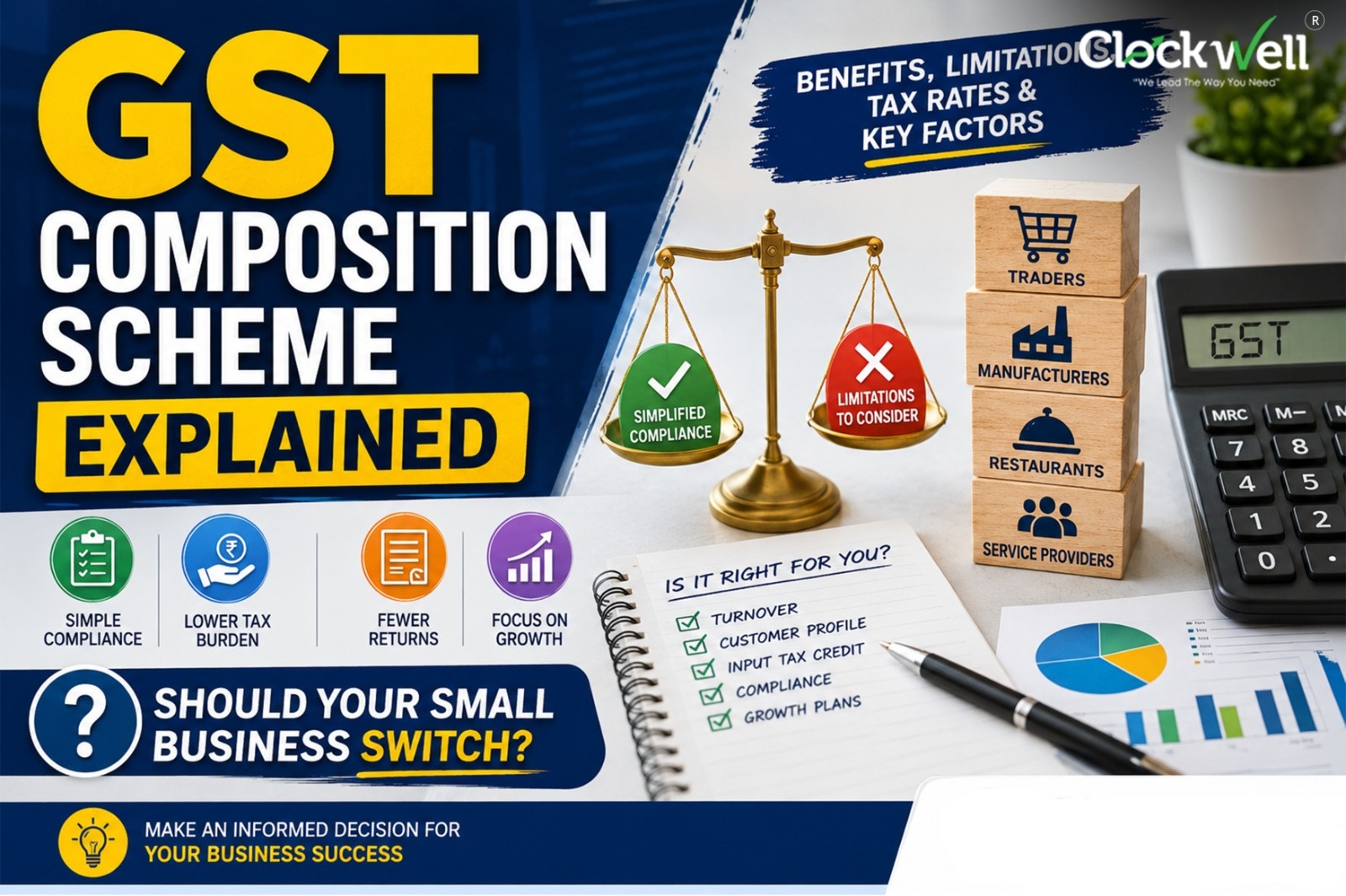
The GST Composition Scheme was introduced to reduce the compliance burden on small businesses. Many traders, retailers, and small service providers struggle with monthly GST filings, complex record keeping, and tax calculations.
The Composition Scheme offers a simpler alternative by allowing eligible businesses to pay GST at a fixed rate on turnover while enjoying simplified compliance requirements.
But is switching to the Composition Scheme the right decision for your business?
This guide explains the GST Composition Scheme, eligibility criteria, benefits, limitations, and factors to consider before making the switch.
What is the GST Composition Scheme?
The GST Composition Scheme is a simplified taxation scheme available to eligible small taxpayers under GST.
Instead of paying GST at normal rates and filing multiple returns, businesses under the Composition Scheme pay tax at a fixed percentage of their turnover.
The primary objective is to make GST compliance easier for small businesses.
Who Can Opt for the GST Composition Scheme?
The scheme is generally available to businesses with turnover below the prescribed limit under GST law.
Common Eligible Businesses:
- Retail traders
- Small shop owners
- Restaurants (without alcohol)
- Manufacturers
- Certain service providers
Eligibility conditions may change based on government notifications and amendments.
GST Composition Scheme Tax Rates
Composition taxpayers pay GST at a fixed percentage of turnover.
Common Rates:
- Traders and Retailers – Approximately 1%
- Manufacturers – Prescribed composition rate
- Restaurants – Approximately 5%
- Certain Service Providers – Prescribed composition rate
The exact rate depends on the nature of the business and applicable GST provisions.
Benefits of the GST Composition Scheme
1. Simple Compliance
Businesses under the scheme have fewer GST compliance requirements.
Benefits include:
- Reduced paperwork
- Simplified record keeping
- Easier return filing
This saves valuable time and administrative effort.
2. Lower Tax Burden for Some Businesses
Depending on profit margins and customer profile, the Composition Scheme may result in lower tax costs.
This can improve overall business efficiency.
3. Fewer GST Returns
Regular taxpayers often file multiple GST returns.
Composition taxpayers generally enjoy simplified filing requirements.
This makes compliance easier for small businesses.
4. Better Focus on Business Operations
Instead of spending excessive time on compliance, business owners can focus on:
- Sales
- Customer service
- Inventory management
- Business growth
Limitations of the GST Composition Scheme
While the scheme offers benefits, it also has limitations.
1. No Input Tax Credit (ITC)
Composition taxpayers cannot claim Input Tax Credit.
This is one of the biggest disadvantages.
Businesses purchasing significant inventory may lose valuable GST credits.
2. Cannot Collect GST Separately
Composition dealers cannot collect GST separately from customers.
The tax becomes part of their cost structure.
3. Restrictions on Interstate Sales
Certain interstate business activities may not qualify under the Composition Scheme.
Businesses operating across multiple states should review eligibility carefully.
4. Limited Growth Flexibility
As turnover grows beyond prescribed limits, businesses must shift to the regular GST scheme.
Growing businesses should evaluate long-term implications.
GST Composition Scheme vs Regular GST Scheme
| Particulars | Composition Scheme | Regular GST |
|---|---|---|
| GST Rate | Fixed Rate | Standard GST Rates |
| Input Tax Credit | Not Available | Available |
| Compliance | Simplified | More Detailed |
| GST Collection | Not Allowed Separately | Allowed |
| Return Filing | Simpler | More Frequent |
| Best For | Small Businesses | Growing Businesses |
When Should a Business Consider Switching?
The Composition Scheme may be suitable if:
✔ You operate locally
✔ Your turnover falls within eligibility limits
✔ Most customers are end consumers
✔ You want simplified compliance
✔ Input Tax Credit is not a major concern
When Should a Business Avoid Switching?
The regular GST scheme may be better if:
✔ You make interstate sales
✔ You need Input Tax Credit benefits
✔ You deal primarily with GST-registered customers
✔ Your business is growing rapidly
✔ You expect higher turnover in the near future
Common Mistakes Businesses Make
Choosing Based Only on Tax Rate
Many businesses focus only on lower tax rates and ignore ITC loss.
Ignoring Customer Type
B2B customers often prefer suppliers who can provide Input Tax Credit benefits.
Not Considering Future Growth
Businesses may need to switch later if turnover increases.
Lack of Professional Advice
Choosing the wrong scheme can increase costs instead of reducing them.
How to Decide if the Composition Scheme Is Right for You
Before switching, evaluate:
- Annual turnover
- Customer profile
- Purchase volume
- Input Tax Credit benefits
- Growth plans
- Compliance requirements
A professional GST review can help identify the best option.
How Clockwell Can Help
Clockwell provides:
- GST Registration Services
- GST Composition Scheme Advisory
- GST Return Filing
- Accounting and Bookkeeping
- GST Compliance Support
- Business Tax Planning
Our experts help businesses choose the most suitable GST structure based on their operations and growth goals.
The GST Composition Scheme offers significant compliance benefits for eligible small businesses, traders, and retailers. However, the decision to switch should not be based solely on lower tax rates.
Businesses must carefully consider Input Tax Credit loss, customer expectations, growth plans, and operational requirements before opting for the scheme.
A proper evaluation can help determine whether the Composition Scheme supports your business objectives or whether remaining under the regular GST system is the better choice.
Published on June 22, 2026