

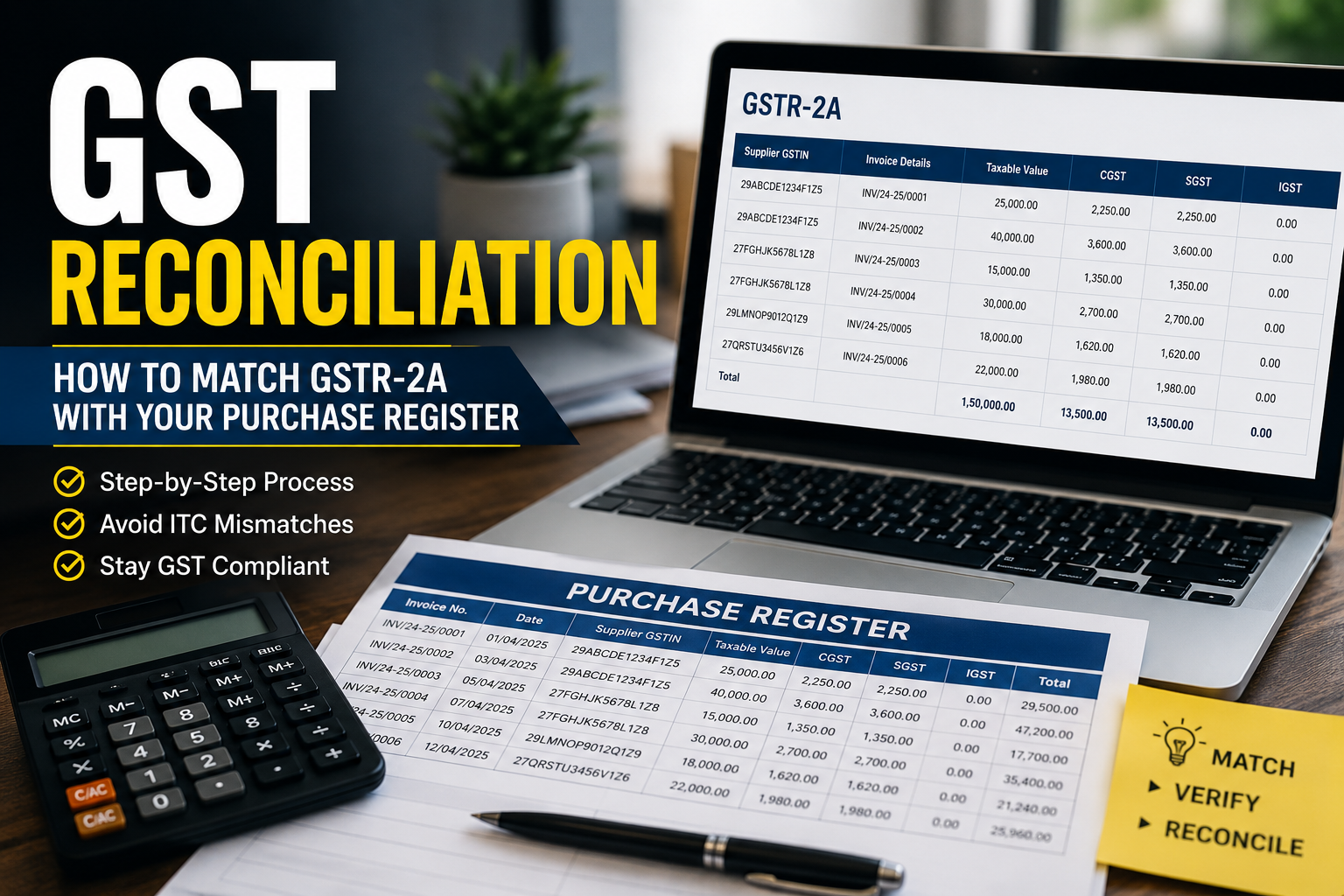
GST compliance is no longer limited to filing monthly or quarterly returns. One of the most important tasks every business owner and accountant should perform is GST reconciliation. Reconciling your purchase register with GSTR-2A helps ensure that your Input Tax Credit (ITC) claims are accurate and compliant with GST laws.
Many businesses lose eligible ITC or receive notices from the GST department simply because they fail to reconcile purchase data regularly. Whether you run a small business, a trading company, a manufacturing unit, or a service-based business, GST reconciliation should be a part of your monthly accounting process.
In this guide, we'll explain everything you need to know about GST reconciliation, including why it matters, how to match GSTR-2A with your purchase register, common reconciliation issues, and best practices to avoid costly mistakes.
What is GST Reconciliation?
GST reconciliation is the process of comparing your internal accounting records (purchase register) with the purchase details available on the GST portal through GSTR-2A.
The objective is to ensure that:
- Every purchase invoice is correctly recorded.
- Suppliers have uploaded invoices correctly.
- GST has been paid by suppliers.
- Eligible Input Tax Credit (ITC) is correctly claimed.
- No invoices are missed or duplicated.
Without reconciliation, businesses may end up claiming incorrect ITC or missing genuine credits.
What is GSTR-2A?
GSTR-2A is an auto-generated statement available on the GST portal.
It contains details of purchases uploaded by your suppliers through:
- GSTR-1
- IFF (Invoice Furnishing Facility)
It includes:
- Supplier GSTIN
- Invoice Number
- Invoice Date
- Taxable Value
- CGST
- SGST
- IGST
- Cess (if applicable)
Unlike GSTR-2B, GSTR-2A is dynamic and keeps updating whenever suppliers upload or amend invoices.
What is a Purchase Register?
A purchase register is your company's internal record of all purchase transactions.
It generally contains:
- Invoice Number
- Invoice Date
- Supplier Name
- Supplier GSTIN
- Taxable Amount
- GST Amount
- Total Invoice Value
- ITC Eligibility
- Accounting Reference
The purchase register is maintained in accounting software like:
- Tally
- Zoho Books
- Busy
- Marg ERP
- QuickBooks
- SAP
- Oracle
- Microsoft Dynamics
Why is GST Reconciliation Important?
GST reconciliation helps businesses:
1. Claim Correct ITC
Only eligible invoices should be claimed for Input Tax Credit.
2. Avoid GST Notices
Mismatches between books and GST returns often trigger departmental scrutiny.
3. Detect Supplier Errors
Sometimes suppliers:
- Upload incorrect GSTIN
- Upload wrong invoice numbers
- Upload incorrect invoice values
- Forget to upload invoices
Reconciliation identifies these issues quickly.
4. Prevent Financial Loss
If suppliers fail to upload invoices, businesses may lose valuable ITC.
5. Improve Accounting Accuracy
Regular reconciliation ensures your books remain accurate throughout the financial year.
Documents Required for GST Reconciliation
Before starting reconciliation, keep the following ready:
- GSTR-2A Download
- Purchase Register
- Vendor Master
- Tax Invoice Copies
- Debit Notes
- Credit Notes
- GST Returns Filed
- Supplier Communication Records
Step-by-Step Process to Match GSTR-2A with Purchase Register
Step 1: Download GSTR-2A
Login to the GST portal.
Download GSTR-2A for the relevant tax period.
Choose Excel or JSON format.
Step 2: Export Purchase Register
Export the purchase register from your accounting software.
Prefer Excel format for easy comparison.
Ensure the register contains:
- GSTIN
- Invoice Number
- Invoice Date
- Tax Amount
Step 3: Standardize Data
Before matching:
- Remove duplicate entries.
- Check date formats.
- Verify GSTIN formats.
- Remove unnecessary spaces.
- Standardize invoice numbering.
Example:
ABC-1001
ABC1001
ABC/1001
These may represent the same invoice.
Step 4: Match Supplier GSTIN
The supplier GSTIN should exactly match in both records.
Incorrect GSTIN leads to mismatch.
Step 5: Match Invoice Number
Invoice numbers should be identical.
Even small differences like:
INV-1001
INV1001
can create mismatches.
Step 6: Match Invoice Date
Ensure invoice dates are correct.
Incorrect dates may affect ITC eligibility.
Step 7: Match Taxable Value
Compare taxable amounts in both records.
Differences may arise due to:
- Data entry mistakes
- Partial invoices
- Amendments
Step 8: Match GST Amount
Compare:
- CGST
- SGST
- IGST
Any variation should be investigated immediately.
Step 9: Identify Missing Invoices
There are two possible scenarios.
Present in Purchase Register but Missing in GSTR-2A
Possible reasons:
- Supplier has not filed GSTR-1.
- Invoice uploaded in a different month.
- Incorrect GSTIN used.
- Invoice omitted.
Action:
Contact the supplier immediately.
Present in GSTR-2A but Missing in Purchase Register
Possible reasons:
- Invoice not recorded.
- Duplicate supplier entry.
- Accounting omission.
Action:
Verify and record if genuine.
Step 10: Reconcile Debit and Credit Notes
Ensure all adjustments are correctly reflected.
Mismatch here directly impacts ITC.
Step 11: Prepare Reconciliation Report
Summarize:
- Total Purchase Register Value
- Total GSTR-2A Value
- Matched Invoices
- Missing Invoices
- Value Differences
- Tax Differences
- Action Required
This report helps management and auditors.
Common GST Reconciliation Mismatches
Missing Supplier Filing
Supplier has not filed GSTR-1.
Wrong GSTIN
Supplier entered an incorrect GST number.
Incorrect Invoice Number
Invoice number mismatch between books and portal.
Duplicate Invoices
Same invoice recorded multiple times.
Incorrect Tax Amount
GST values differ.
Invoice Uploaded Next Month
Supplier uploaded the invoice in a later return period.
Credit Notes Not Updated
Credit notes reduce ITC and must be matched carefully.
Practical Example of GST Reconciliation
Suppose your purchase register contains:
| Invoice | Taxable Value | GST |
|---|---|---|
| INV001 | ₹50,000 | ₹9,000 |
| INV002 | ₹30,000 | ₹5,400 |
| INV003 | ₹20,000 | ₹3,600 |
But GSTR-2A shows:
| Invoice | Taxable Value | GST |
|---|---|---|
| INV001 | ₹50,000 | ₹9,000 |
| INV002 | ₹30,000 | ₹5,400 |
Invoice INV003 is missing.
You should:
- Contact the supplier.
- Ask them to upload the invoice.
- Claim ITC only after compliance with applicable GST provisions.
Best Practices for GST Reconciliation
Reconcile Every Month
Don't wait until year-end.
Monthly reconciliation keeps issues manageable.
Follow Up with Suppliers
Create a process for supplier reminders before GST return due dates.
Use Accounting Software
Most modern accounting software offers GST reconciliation features.
Automation reduces manual errors.
Maintain Proper Documentation
Always keep:
- Purchase invoices
- Vendor confirmations
- Email communications
- Reconciliation reports
Verify High-Value Transactions First
Prioritize invoices involving significant GST amounts.
Train Your Accounting Team
Regular GST updates help accountants avoid compliance mistakes.
Review Before Filing GSTR-3B
Never claim ITC without proper verification.
Difference Between GSTR-2A and GSTR-2B
| GSTR-2A | GSTR-2B |
|---|---|
| Dynamic | Static |
| Updates continuously | Fixed for a tax period |
| Changes whenever supplier uploads invoices | Generated once each month |
| Useful for tracking supplier uploads | Commonly used for ITC determination |
Many businesses use both reports together for better compliance.
Consequences of Poor GST Reconciliation
Failure to reconcile regularly can lead to:
- Wrong ITC claims
- GST notices
- Interest liability
- Penalties
- Blocked Input Tax Credit
- Increased audit risk
- Cash flow issues
- Financial reporting errors
How Clockwell Can Help
Managing GST reconciliation manually can be time-consuming, especially for businesses handling hundreds of purchase invoices every month.
At Clockwell, our GST experts help businesses:
- Monthly GST reconciliation
- GSTR-2A and GSTR-2B matching
- Purchase register verification
- Input Tax Credit review
- Vendor reconciliation
- GST return filing
- GST compliance support
- Notice response assistance
- Accounting and bookkeeping services
With professional reconciliation support, you can reduce compliance risks and maximize eligible Input Tax Credit while keeping your business GST-compliant.
GST reconciliation is one of the most critical monthly activities for every GST-registered business. Matching GSTR-2A with your purchase register ensures accurate Input Tax Credit claims, strengthens financial records, and minimizes the risk of notices and penalties.
Instead of treating reconciliation as a year-end exercise, make it part of your monthly accounting routine. A structured reconciliation process not only improves compliance but also protects your working capital and business reputation.
If your business needs expert assistance with GST reconciliation, purchase register verification, or GST return filing, Clockwell can provide end-to-end support to keep your GST compliance accurate, timely, and stress-free.
Published on July 11, 2026