

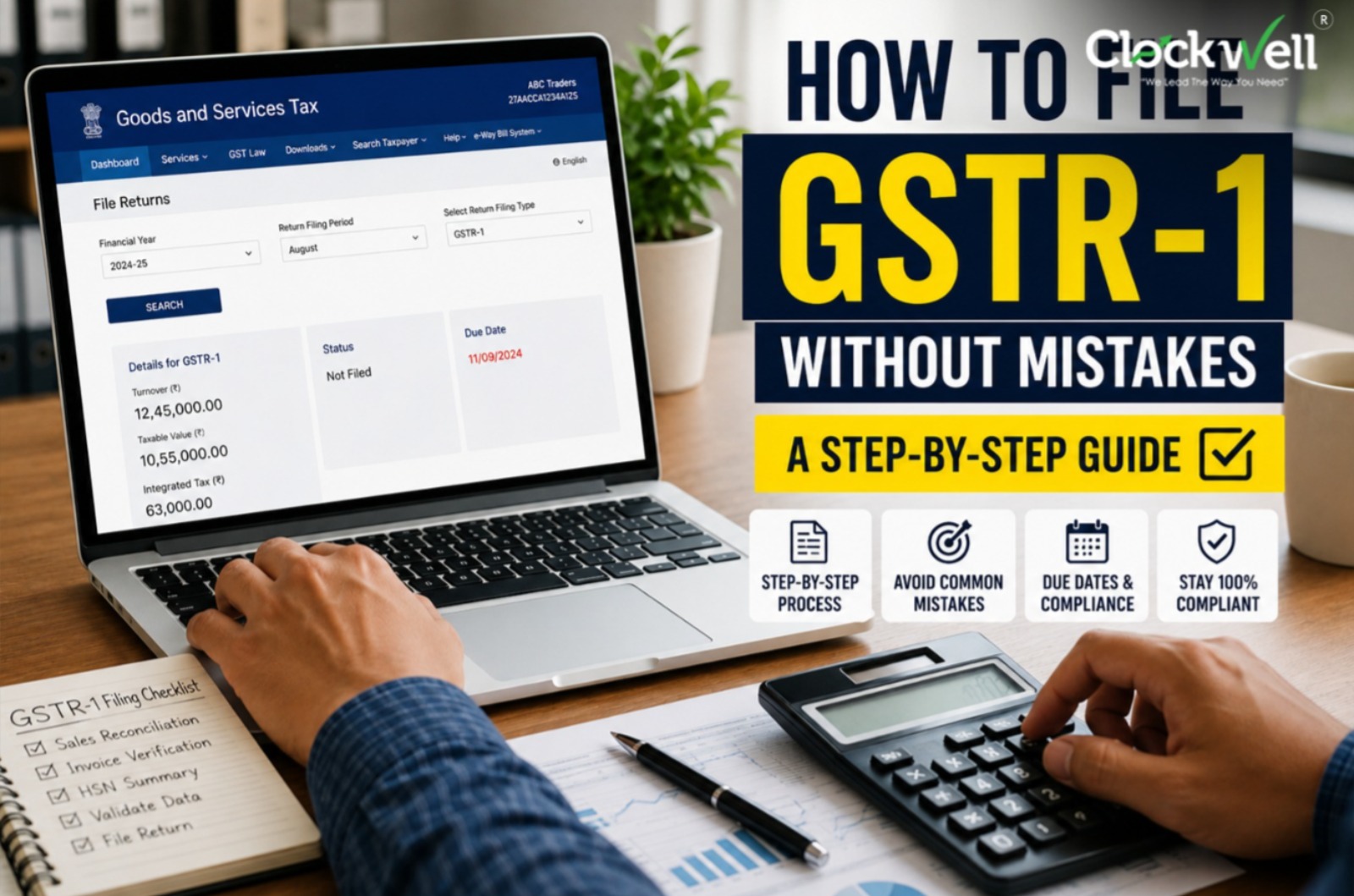
GST compliance has become an integral part of running a business in India. However, many businesses still struggle with return filing errors, invoice mismatches, and notices from tax authorities. One of the most crucial GST returns is GSTR-1.
A single mistake in GSTR-1 can lead to mismatched Input Tax Credit (ITC), delayed compliance, penalties, and even strained business relationships. Therefore, understanding how to file GSTR-1 correctly is essential for every registered taxpayer.
Whether you are a startup founder, MSME owner, trader, manufacturer, freelancer, or service provider, this detailed guide will help you file GSTR-1 accurately and avoid costly errors.
In this comprehensive article, you will learn the complete GSTR-1 filing process, documents required, common mistakes, latest updates, expert tips, and practical solutions.
What is GSTR-1?
GSTR-1 is a monthly or quarterly GST return that contains details of all outward supplies (sales) made by a registered taxpayer during a particular tax period.
Simply put, it is a statement of all sales transactions reported to the GST department.
The return includes:
- B2B invoices
- B2C sales
- Export invoices
- Debit notes
- Credit notes
- Advances received
- Nil-rated supplies
- Exempt supplies
- HSN-wise summary
Every GST-registered taxpayer, except a few exempt categories, is required to file GSTR-1.
Example
Suppose ABC Traders sold:
- ₹5 lakh worth of goods to another registered business.
- ₹2 lakh worth of goods to retail customers.
- Issued one credit note of ₹25,000.
All these transactions must be disclosed in GSTR-1.
The information furnished in GSTR-1 forms the basis for:
- Recipient ITC claims.
- Auto-population of GSTR-3B.
- GST reconciliation.
- Annual return preparation.
Why is GSTR-1 Important?
Understanding how to file GSTR-1 accurately is important because it directly impacts GST compliance.
1. Enables Input Tax Credit
Your customers can claim ITC only when invoices appear correctly in their GST records.
2. Avoids Notices
Incorrect invoice details often trigger GST notices and scrutiny.
3. Improves Vendor Relationships
Timely filing ensures customers receive eligible ITC without delays.
4. Prevents Penalties
Late filing may attract penalties and late fees.
5. Ensures Accurate Tax Liability
Sales declared in GSTR-1 influence GSTR-3B liability.
6. Supports Financial Reporting
GSTR-1 data is useful for audits and annual accounts.
7. Reduces Reconciliation Issues
Accurate filing minimizes year-end mismatches.
8. Builds Business Credibility
Consistent compliance improves business reputation.
9. Helps During GST Audits
Well-maintained returns simplify departmental audits.
10. Essential for Annual Return
GSTR-9 preparation largely depends on GSTR-1 data.
Who Needs GSTR-1?
The following taxpayers generally need to file GSTR-1.
Regular GST Registered Taxpayers
Businesses registered under the normal GST scheme.
Casual Taxable Persons
Temporary businesses operating in exhibitions or trade fairs.
E-Commerce Sellers
Suppliers selling through online marketplaces.
Exporters
Businesses involved in exports.
Service Providers
Consultants, agencies, IT companies, freelancers, etc.
Manufacturers
Factories and production units.
Exempt Categories
The following generally do not file GSTR-1:
- Composition scheme taxpayers
- Non-resident taxable persons
- ISD taxpayers
- TDS deductors
- TCS collectors
When Should You Consider Filing GSTR-1?
You must file GSTR-1 after every tax period.
Monthly Filers
Due date: 11th of the following month
Example:
Sales made in June → File by 11th July.
Quarterly Filers (QRMP)
Due date:
13th of the month following the quarter.
Example:
April–June quarter → File by 13th July.
Businesses should begin reconciliation immediately after month-end rather than waiting until the due date.
Key Features of GSTR-1
Invoice-Wise Reporting
B2B transactions are reported invoice-wise.
HSN Reporting
Taxpayers must provide HSN-wise details.
Amendment Facility
Errors can be corrected in subsequent returns.
Online Filing
Returns can be filed through the GST portal.
Auto-Population
Data flows into recipients' GST statements.
Multiple Filing Methods
Businesses may use:
- Online portal
- Offline utility
- GST software
- ERP integrations
Step-by-Step Process: How to File GSTR-1
Step 1: Collect and Reconcile Sales Data
Before starting GSTR-1 filing:
- Download sales register.
- Verify invoice sequence.
- Match invoices with accounting software.
- Check GSTIN of customers.
- Verify tax rates.
Checklist
✔ Sales register
✔ E-invoices
✔ Credit notes
✔ Debit notes
✔ Export invoices
✔ E-commerce sales
Reconciliation at this stage eliminates most filing errors.
Step 2: Log in to GST Portal
Visit the GST portal.
Enter:
- Username
- Password
- Captcha
Navigate:
Services → Returns → Returns Dashboard
Select:
- Financial Year
- Return Filing Period
Click:
Prepare Online
or
Upload using JSON/Offline Utility
Step 3: Enter Invoice Details Carefully
This is the most important step in how to file GSTR-1 correctly.
A. B2B Invoices
Report:
- Customer GSTIN
- Invoice number
- Invoice date
- Invoice value
- Taxable value
- GST rate
B. B2C Large Invoices
Inter-state invoices exceeding prescribed limits must be reported separately.
C. B2C Small Supplies
State-wise consolidated details are required.
D. Exports
Provide:
- Shipping bill details
- Port code
- Invoice details
E. Credit Notes/Debit Notes
Report all revisions accurately.
F. Nil Rated Supplies
Disclose exempt and non-GST supplies.
Step 4: Validate Data
Before submission:
Verify:
- GSTIN accuracy.
- Duplicate invoices.
- Invoice dates.
- HSN codes.
- Tax rates.
- Tax amounts.
Many businesses skip validation and later receive notices.
Always perform:
Books vs GSTR-1 reconciliation
and
GSTR-1 vs GSTR-3B reconciliation
Step 5: Submit and File Return
After verification:
- Click Generate Summary.
- Review auto-generated figures.
- Click Submit.
- File using:
- DSC
- EVC
Once filed successfully, an ARN is generated.
Download and save:
- Filed return copy
- ARN acknowledgement
Documents Required for GSTR-1 Filing
Proper documentation ensures smooth filing.
1. Sales Register
Contains all outward supply details.
2. Tax Invoices
Primary source for reporting transactions.
3. Credit Notes
Required for sales adjustments.
4. Debit Notes
Used for upward revisions.
5. Customer GSTIN Details
Necessary for B2B reporting.
6. Export Documents
Includes shipping bills and port details.
7. HSN Code List
Required for HSN summary.
8. E-Invoice Records
Helps reconcile auto-populated invoices.
9. Accounting Software Reports
Useful for bulk validation.
10. Previous GSTR Filings
Required for comparison and amendments.
Benefits of GSTR-1
Filing GSTR-1 correctly offers numerous benefits.
1. Smooth ITC Flow
Customers receive input tax credit promptly.
2. Avoids GST Notices
Reduces compliance risk.
3. Enhances Business Reputation
Reliable suppliers are preferred.
4. Better Cash Flow Management
Prevents tax disputes.
5. Simplifies Annual Return Filing
Year-end compliance becomes easier.
6. Accurate Financial Statements
Sales records remain synchronized.
7. Reduces Litigation
Lower chances of departmental disputes.
8. Improves Internal Controls
Encourages better accounting systems.
9. Strengthens Audit Readiness
Documents remain organized.
10. Saves Time
Proper monthly filing reduces correction work.
Common Mistakes to Avoid While Filing GSTR-1
Understanding these errors is crucial when learning how to file GSTR-1.
1. Incorrect GSTIN Entry
Wrong GSTIN blocks customer ITC.
Example
Entering one digit incorrectly may result in invoice rejection
2. Duplicate Invoices
Uploading the same invoice twice inflates turnover.
3. Wrong Tax Rates
Incorrect GST rates lead to tax short payment.
4. Incorrect HSN Codes
Wrong HSN reporting can attract notices.
5. Missing Credit Notes
Failure to report credit notes causes tax mismatches.
6. Mismatch with GSTR-3B
Sales reported in GSTR-1 should align with GSTR-3B.
7. Late Filing
Delays may impact recipient ITC.
8. Ignoring Amendments
Past errors should be corrected immediately.
9. Not Reconciling Books
Books and GST returns must match.
10. Failing to Save Working Papers
Maintain reconciliation files for future audits.
Challenges and Solutions
Challenge 1: Large Invoice Volume
Solution
Use ERP or GST software integration.
Challenge 2: Frequent Amendments
Solution
Implement strong invoice review procedures.
Challenge 3: GSTIN Errors
Solution
Validate GSTIN before invoice generation.
Challenge 4: Complex HSN Reporting
Solution
Maintain updated HSN master records.
Challenge 5: Data Mismatch
Solution
Conduct monthly reconciliation.
Challenge 6: Last-Minute Filing
Solution
Prepare data at least five days before due date.
Cost, Fees, or Investment Required
Filing GSTR-1 through the GST portal is free.
However, businesses may incur costs for:
Professional Fees
CA or GST consultant fees:
Approximately ₹500 to ₹10,000+ per month depending on:
- Business size
- Invoice volume
- Complexity
GST Software Cost
Software subscription:
₹2,000 to ₹50,000 annually.
ERP Integration
Large businesses may incur additional implementation costs.
Factors Affecting Cost
- Number of invoices
- Industry type
- Multi-state operations
- E-commerce transactions
- Export activity
Latest Updates, Rules, or Trends (2026)
Businesses filing GSTR-1 should stay updated with evolving GST rules.
1. Increased Dependence on GSTR-1 Data
Tax liability in GSTR-3B is increasingly linked with GSTR-1 data, making accurate reporting more critical than ever. Errors in GSTR-1 may directly affect tax liability calculations.
2. Enhanced HSN Validation
GSTN has strengthened HSN reporting requirements. Manual HSN entry has largely been replaced with system-driven dropdown selections to improve accuracy.
3. Separate B2B and B2C HSN Reporting
Table 12 now requires separate HSN-wise reporting for B2B and B2C supplies, increasing reporting precision.
4. Mandatory Document Reporting
Additional validation checks and document reporting requirements have been introduced in GSTR-1 and GSTR-1A.
5. Three-Year Filing Restriction
Taxpayers cannot file GSTR-1 returns older than three years from their due date. Businesses should avoid long-pending compliances.
Frequently Asked Questions (FAQ)
1. What is the due date for filing GSTR-1?
Monthly filers must generally file by the 11th of the following month, while QRMP taxpayers file quarterly by the 13th following the quarter.
2. Is GSTR-1 mandatory?
Yes, for most regular GST taxpayers.
3. Can GSTR-1 be revised?
No. It cannot be revised directly. Corrections can be made through amendments in subsequent returns.
4. What happens if GSTR-1 is not filed?
Late fees, penalties, and compliance issues may arise.
5. Can nil returns be filed?
Yes, if there are no outward supplies.
6. Is GSTR-1 required for service providers?
Yes, regular registered service providers must file it.
7. Can GSTR-1 be filed without GSTR-3B?
Generally, GSTR-1 filing may be restricted if prior returns remain pending.
8. What is the late fee for delayed filing?
Late fees are prescribed under GST law and may vary depending on the type of return and taxpayer category.
9. Can mistakes be corrected after filing?
Yes, using amendment tables in subsequent returns.
10. Should small businesses reconcile monthly?
Absolutely. Monthly reconciliation significantly reduces errors.
Expert Tips for Error-Free GSTR-1 Filing
- Reconcile books every month.
- Validate GSTINs before invoicing.
- Maintain updated HSN master data.
- Use GST-compliant accounting software.
- File at least 2–3 days before due dates.
- Download filed returns for records.
- Review amendment tables carefully.
- Train accounting staff regularly.
- Conduct internal GST audits quarterly.
- Consult a GST expert for complex transactions.
Learning how to file GSTR-1 accurately is essential for maintaining smooth GST compliance and avoiding unnecessary notices, penalties, and ITC disputes.
Businesses should adopt a disciplined approach by reconciling sales data regularly, validating invoices, checking HSN codes, and reviewing returns before submission. Accurate and timely filing not only ensures compliance but also strengthens customer relationships and improves overall business credibility.
If you are unsure about any aspect of how to file GSTR-1, it is advisable to consult an experienced GST professional or tax consultant. Expert guidance can help your business remain fully compliant while minimizing risks and saving valuable time.
Published on June 23, 2026