
Running a small business in India involves more than finding customers and generating revenue. Business owners must also manage operating expenses, employee salaries, cash flow, GST compliance, and income tax obligations. When these responsibilities compete for attention, tax planning can easily become an afterthought.
Many small business owners pay more tax than necessary simply because they do not understand the deductions, tax schemes, and planning opportunities available to them. Others make the mistake of claiming expenses without proper documentation, which can create problems during an assessment or tax audit.
The good news is that you do not need complicated financial strategies to manage your tax liability effectively. A clear understanding of your business income, eligible expenses, applicable tax regime, and filing requirements can help you make better financial decisions.
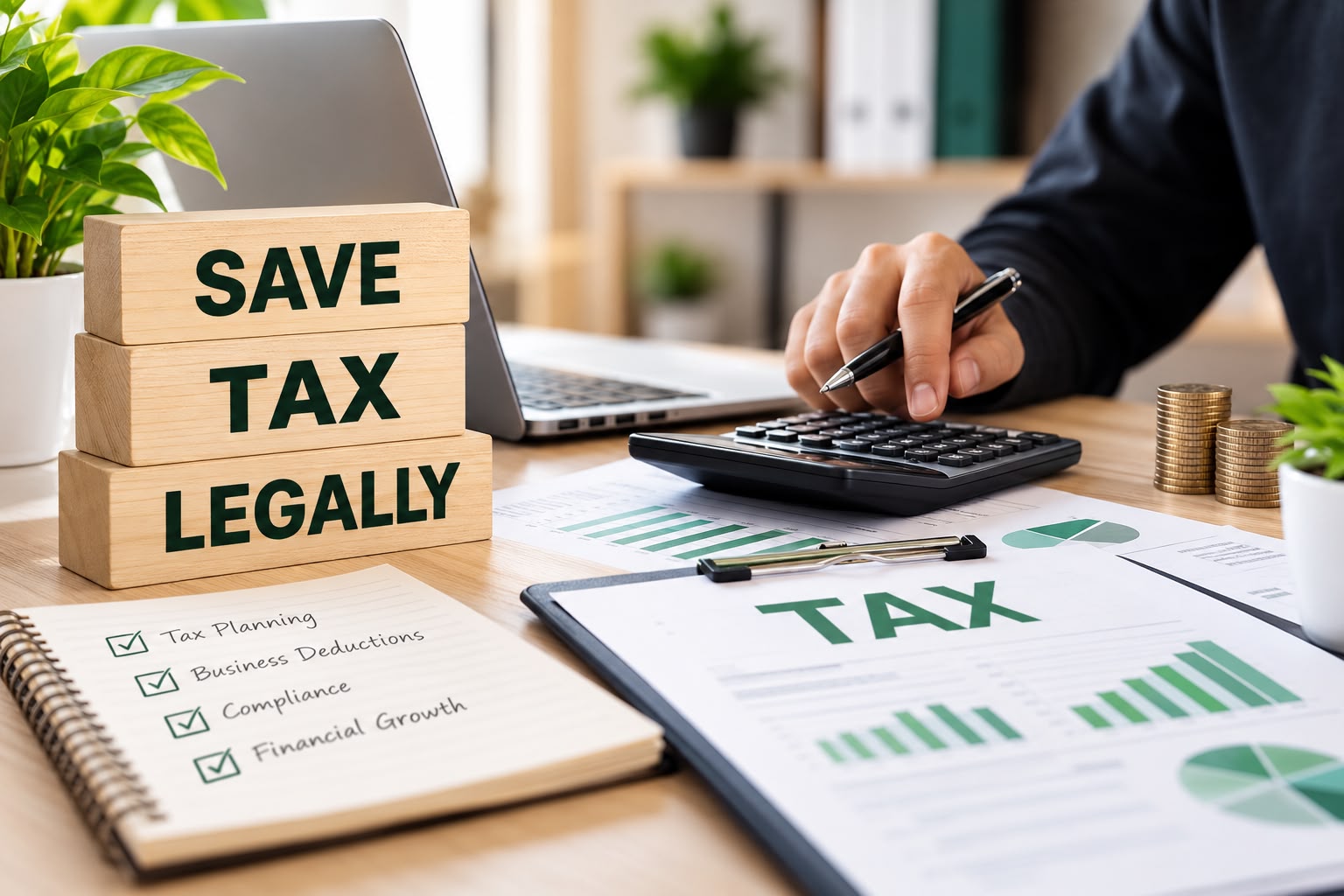
In this guide, we explore practical tax saving tips for small business owners in India to help you reduce your tax burden legally, maintain accurate financial records, and build a financially healthier business.
Whether you operate a retail shop, consultancy, digital agency, trading business, or small service company, these strategies can help you understand the available options. Since tax rules depend on your business structure and circumstances, always verify the provisions applicable to your relevant tax year before making a decision.
1. Understand How Business Income Is Taxed
Before exploring tax-saving strategies, it is important to understand how your business income is calculated.
For a business using the regular method of computation, taxable business profit generally starts with business revenue and is adjusted for eligible expenses and other tax-law requirements.
For example, imagine that your business generates ₹20 lakh in annual revenue and incurs ₹12 lakh in eligible business expenses.
Your preliminary business profit would be:
-
Annual revenue: ₹20,00,000
-
Eligible business expenses: ₹12,00,000
-
Preliminary business profit: ₹8,00,000
This ₹8 lakh is an illustrative starting point, not necessarily your final taxable income. Tax adjustments, depreciation, other income, losses, deductions, and the applicable tax regime may affect the final calculation.
Your business structure also matters. A sole proprietorship, partnership firm, LLP, and private limited company may have different tax treatment and compliance obligations.
For example, a sole proprietor generally reports business income in their individual income tax return, whereas a company files its own return and is taxed under the rules applicable to companies.
Understanding these differences helps you select appropriate tax-planning strategies rather than following advice intended for a different type of business.
2. Claim All Eligible Business Expenses
One of the most practical ways to manage taxable business profit is to identify and claim legitimate business expenses.
Under the general deduction principles of Section 37(1) of the Income-tax Act, 1961, qualifying expenditure incurred wholly and exclusively for business purposes may be deductible, subject to the applicable law and specific restrictions.
Common examples of potentially deductible business expenses include:
Office rent and utilities
If you rent an office, shop, warehouse, or commercial workspace, eligible rental payments can generally be claimed as business expenses.
Electricity, internet, telephone, and other utility expenses may also qualify when they relate to business activities.
If you work from home, only the appropriately supportable business portion of shared expenses should be considered.
Employee salaries and wages
Salaries, wages, and qualifying employee-related expenses are important operating costs for many small businesses.
Maintain employment agreements, payroll records, salary statements, and payment evidence. Also comply with applicable tax deduction at source and other employment-related requirements.
Marketing and advertising
Businesses often spend money on online advertising, website development, promotional campaigns, branding, and marketing services.
Eligible revenue expenses incurred for business purposes may be deductible, depending on their nature and the applicable rules. Certain costs, particularly capital expenditure, may receive different treatment.
Professional and accounting fees
Payments to accountants, tax consultants, legal advisers, and other professional service providers may qualify as business expenses when incurred for legitimate business purposes.
These services can also help you identify compliance gaps and avoid preventable tax mistakes.
Software and technology
Subscriptions for accounting software, project management tools, business applications, and other operational software may qualify as business expenses, depending on the nature of the payment and the applicable tax rules.
The important principle is simple: claim genuine expenses that are permitted by law, not personal purchases disguised as business costs.
Keep invoices, receipts, contracts, bank statements, and other supporting documents. Proper records make it easier to substantiate your claims if questions arise.
3. Explore the Presumptive Taxation Scheme
Presumptive taxation is an important option for eligible small businesses and professionals in India.
Instead of calculating taxable profit by deducting every eligible expense from actual revenue, an eligible taxpayer can declare income using a prescribed percentage of turnover or gross receipts, subject to the relevant conditions.
This may reduce bookkeeping and compliance burdens, but it is not automatically the cheapest tax option for everyone.
Section 44AD: Eligible small businesses
Under the familiar Section 44AD framework of the Income-tax Act, 1961, eligible resident individuals, Hindu Undivided Families (HUFs), and partnership firms other than LLPs may be able to use presumptive taxation for qualifying businesses.
The standard turnover threshold is ₹2 crore, with an increased threshold of ₹3 crore where cash receipts do not exceed the prescribed 5% limit, subject to the other eligibility conditions.
The presumptive income rates are generally:
-
8% of eligible turnover or gross receipts for the applicable non-digital portion.
-
6% for qualifying receipts received through specified banking or electronic payment modes.
These rates and thresholds must be checked against the law applicable to the relevant tax year. Certain businesses and income types, including agency businesses and income in the nature of commission or brokerage, are excluded.
Section 44ADA: Eligible professionals
Certain specified resident professionals may qualify for presumptive taxation under Section 44ADA.
The general gross-receipt threshold is ₹50 lakh, which can increase to ₹75 lakh when cash receipts remain within the prescribed 5% limit, subject to eligibility conditions.
Presumptive professional income is generally calculated at 50% of gross receipts, or a higher amount if the taxpayer declares higher income.
Example of presumptive taxation
Suppose an eligible business has annual turnover of ₹30 lakh, with all relevant receipts qualifying for the 6% rate.
Its illustrative presumptive income would be:
₹30,00,000 × 6% = ₹1,80,000.
This is the presumptive business income, not the final tax payable. Other income, applicable tax rates, deductions, and eligibility requirements still need to be considered.
Under the presumptive scheme, the prescribed income is generally treated as final business income for the scheme, and separate deductions for ordinary business expenses are not allowed in the usual manner.
Before choosing this option, compare the result with the regular method and seek professional advice if your actual profit margin is low.
Official reference: Income Tax Department — Presumptive Taxation.
4. Maintain Accurate Books of Accounts
Good bookkeeping is not just an administrative task. It is an essential part of effective tax planning.
When your financial records are incomplete, you may overlook eligible expenses, misunderstand your actual profitability, or struggle to explain transactions during an assessment.
Create a consistent system for recording:
-
Sales invoices and customer receipts.
-
Purchases and supplier payments.
-
Employee salaries and reimbursements.
-
Rent, utilities, and other operating costs.
-
Business loans, interest, and repayments.
-
Asset purchases and depreciation records.
-
GST collected, input tax credit, and tax payments.
Separate business and personal bank transactions wherever possible. This makes it easier to understand cash flow and identify which expenses relate to the business.
Accounting software can help automate invoicing, expense categorisation, bank reconciliation, and financial reporting.
If your business is growing, consider monthly bookkeeping reviews rather than waiting until the end of the financial year. Regular reviews give you time to correct errors and make informed financial decisions.
Remember that maintaining books and claiming deductions are not the same thing. Your business must follow the record-keeping and audit requirements applicable to its structure, turnover, and chosen tax method.
5. Understand Depreciation on Business Assets
Businesses often invest in computers, machinery, furniture, equipment, and other assets to improve productivity.
Depending on the applicable tax rules, depreciation may be available on qualifying assets used for business purposes.
Depreciation recognises the permitted reduction in the value of an asset over time for tax computation purposes. It is different from simply claiming the entire purchase price as an expense in the year of purchase.
For example, a business purchases a computer for ₹1,00,000. If the applicable depreciation rate is 40% and all relevant conditions are satisfied, the illustrative depreciation amount would be ₹40,000.
The actual deduction depends on the prescribed rate, asset classification, date the asset was put to use, applicable restrictions, and the taxpayer's method of computing income.
Do not use this example as a universal depreciation rate for computers or other assets. Verify the rate and conditions applicable to your tax year.
Maintain purchase invoices, payment evidence, asset details, and records showing business use. Where an asset is used partly for personal purposes, the allowable claim may need adjustment.
Depreciation planning should be based on genuine business requirements. Buying unnecessary equipment solely to obtain a tax deduction can weaken your cash flow rather than improve it.
6. Choose the Right Business Structure and Tax Regime
The legal structure of your business can affect taxation, compliance costs, liability, and future growth.
For example, a sole proprietorship may be relatively simple to operate, while a private limited company may be more appropriate for certain businesses seeking external investment or a separate corporate structure.
However, incorporation does not automatically mean lower taxes.
Before choosing or changing a structure, consider:
-
Expected annual revenue and net profit.
-
Whether profits will be withdrawn or retained in the business.
-
Applicable tax rates and available deductions.
-
Compliance, accounting, and audit costs.
-
Personal liability and business continuity.
-
Future investment and expansion plans.
Individual taxpayers may also need to compare the applicable personal income tax regimes. Eligibility and deduction rules differ, and a deduction available under one regime may not be available under another.
Companies, LLPs, and partnership firms have their own tax treatment, so personal tax-regime comparisons should not be applied to them without checking the relevant provisions.
The best structure is the one that supports your business goals while remaining tax-efficient and legally compliant.
Consult a qualified chartered accountant before making major structural changes.
7. Plan GST Compliance Carefully
GST and income tax are separate systems, but both affect the financial management of a small business.
If your business is registered under GST, maintaining accurate sales invoices, purchase records, GST returns, and reconciliation statements is essential.
Eligible registered businesses may claim input tax credit for qualifying business purchases, subject to the GST Act, restrictions, documentation, and return-filing conditions.
For example, GST paid on certain business-related purchases may be available as input tax credit when the relevant requirements are satisfied. However, input tax credit is not available for every purchase, and some categories are specifically restricted.
To improve GST compliance:
-
Reconcile purchase records with available supplier invoice data.
-
Verify that eligible input tax credit is supported by the required documentation.
-
File applicable GST returns on time.
-
Track output tax collected and GST payments separately from revenue.
-
Review mismatches before they become larger compliance issues.
Do not treat GST collected from customers as ordinary business income available for unrestricted spending.
Also, remember that input tax credit and income tax deductions are different concepts. A GST credit does not automatically establish the deductibility of the underlying expense for income tax purposes.
8. Use Digital Payments and Banking Records Effectively
Digital transactions can improve financial transparency and simplify bookkeeping.
For eligible businesses using presumptive taxation, qualifying non-cash receipts may also affect whether the 6% presumptive rate applies to particular receipts under the relevant Section 44AD framework.
Using bank transfers, account-payee instruments, and supported electronic payment methods can help establish a clearer audit trail.
Consider using a dedicated business bank account, digital invoicing, and systematic payment references.
These practices make it easier to:
-
Match customer receipts with invoices.
-
Identify outstanding payments.
-
Reconcile supplier expenses.
-
Track business turnover accurately.
-
Maintain evidence for tax and GST compliance.
Digital payments do not guarantee a lower tax bill by themselves. Their benefits depend on the transaction, the applicable legal conditions, and the way your business maintains its records.
9. Avoid Common Tax Planning Mistakes
Even business owners who understand basic tax rules can make costly mistakes.
Mixing personal and business expenses
Using a business account for personal shopping or household expenses makes financial reporting harder.
Only the eligible business portion of an expense should be claimed. Keep personal transactions separate and document any legitimate mixed-use expenses.
Claiming expenses without proof
An expense should not be claimed simply because money left your bank account.
Keep supporting evidence that establishes the nature, amount, and business purpose of the expenditure.
Choosing presumptive taxation without comparing alternatives
Presumptive taxation may simplify compliance, but it may not be suitable for every eligible business.
Compare the tax implications and compliance requirements before selecting a method.
Ignoring advance tax obligations
Depending on your estimated tax liability and applicable exemptions, you may be required to pay advance tax in instalments.
Failure to pay the required amount on time can result in interest under the applicable provisions.
Review your expected profit and tax liability throughout the year instead of waiting until the return-filing deadline.
Missing filing and payment deadlines
Late returns, delayed payments, and missed statutory filings may result in interest, fees, penalties, or other consequences.
Maintain a calendar of income tax, GST, TDS, and other compliance deadlines relevant to your business.
Following outdated tax advice
Tax provisions can change between financial years and tax years. An article, video, or social media post may refer to an older rule.
Verify the current law before relying on a threshold, deduction, or filing deadline.
10. Start Tax Planning Before the Financial Year Ends
Effective tax planning should happen throughout the year, not only when you prepare your income tax return.
A practical approach is to review your financial position every month or quarter.
At the beginning of the year: Set a realistic revenue and expense budget, review your business structure, and identify the tax and compliance requirements applicable to you.
During the year: Record transactions regularly, reconcile accounts, review eligible expenses, and monitor your expected taxable income.
Before the year ends: Estimate your final profit, review eligible depreciation and other permitted deductions, check advance tax payments, and confirm whether your chosen tax method remains appropriate.
When filing your return: Reconcile your books, bank records, tax payments, and relevant statements. Verify that your return is complete and accurate before submission.
This approach makes tax planning more predictable and reduces the risk of last-minute errors.
11. Work With a Qualified Tax Professional
Tax planning can become complicated when a business has multiple income sources, employees, significant assets, loans, GST obligations, or cross-border transactions.
A qualified chartered accountant or tax professional can help you assess the rules applicable to your business and identify lawful ways to manage your tax liability.
Professional support may include:
-
Reviewing your business income and eligible expenses.
-
Comparing regular and presumptive taxation where available.
-
Assessing applicable depreciation and deductions.
-
Reviewing GST and TDS compliance.
-
Identifying record-keeping or filing gaps.
-
Preparing and filing applicable tax returns.
-
Planning advance tax payments.
-
Explaining changes in tax rules.
The goal is not simply to reduce the current year's tax bill. It is to create a reliable financial process that supports business growth and avoids unnecessary compliance risks.
For a small business owner, timely professional advice can be particularly valuable when making major purchases, changing business structures, or entering a new market.
Frequently Asked Questions (FAQs)
1. What are the best tax saving tips for small business owners in India?
Start by maintaining accurate books, claiming eligible business expenses, evaluating presumptive taxation if you qualify, reviewing depreciation on eligible assets, and meeting tax and GST deadlines. Your best option depends on your business structure, profit margin, and applicable tax rules.
2. Can small business owners claim office rent as a tax deduction?
Eligible rent paid for business premises can generally be claimed under the applicable provisions. You should maintain rent agreements, payment records, and other supporting documents. TDS requirements may also apply depending on the circumstances.
3. What is presumptive taxation in India?
Presumptive taxation allows eligible taxpayers to calculate business or professional income using prescribed rates rather than the regular method of calculating actual profit. Eligibility, turnover thresholds, rates, and compliance requirements vary according to the applicable scheme.
4. Can I claim personal expenses as business expenses?
No. Personal expenses are generally not deductible as business expenses. For costs shared between business and personal use, only the appropriately supportable eligible business portion may qualify, subject to the applicable rules.
5. Does GST input tax credit reduce income tax?
Not directly. GST input tax credit and income tax deductions are separate mechanisms. Input tax credit reduces eligible GST liability, while income tax deductions affect taxable income under the applicable income tax rules.
6. When should a small business owner start tax planning?
Ideally, tax planning should begin at the start of the financial or tax year and continue throughout the year. Regular reviews help you forecast tax liability, organise records, and avoid last-minute compliance problems.
7. Is presumptive taxation always better for small businesses?
No. It may reduce bookkeeping and compliance burdens for eligible taxpayers, but the prescribed taxable income may be higher than the profit calculated under the regular method for some businesses. Compare both approaches with professional advice before deciding.
Conclusion
Saving tax legally is an important part of running a financially sustainable small business. By understanding eligible expenses, evaluating the presumptive taxation scheme, maintaining accurate records, reviewing asset depreciation, and staying compliant with GST and income tax requirements, business owners can make better financial decisions.
The most effective tax saving tips for small business owners in India are not about hiding income or claiming questionable expenses. They are about understanding the law, documenting genuine transactions, selecting suitable tax options, and planning ahead.
Every business is different. A strategy that works for a retailer may not be appropriate for a consultant, partnership firm, or private limited company. Review your circumstances regularly and seek professional advice when necessary.
Clockwell can help businesses approach taxation, accounting, and compliance with greater clarity. With organised financial records and timely guidance, small business owners can spend less time worrying about tax compliance and more time building their businesses.
Published on October 21, 2026