

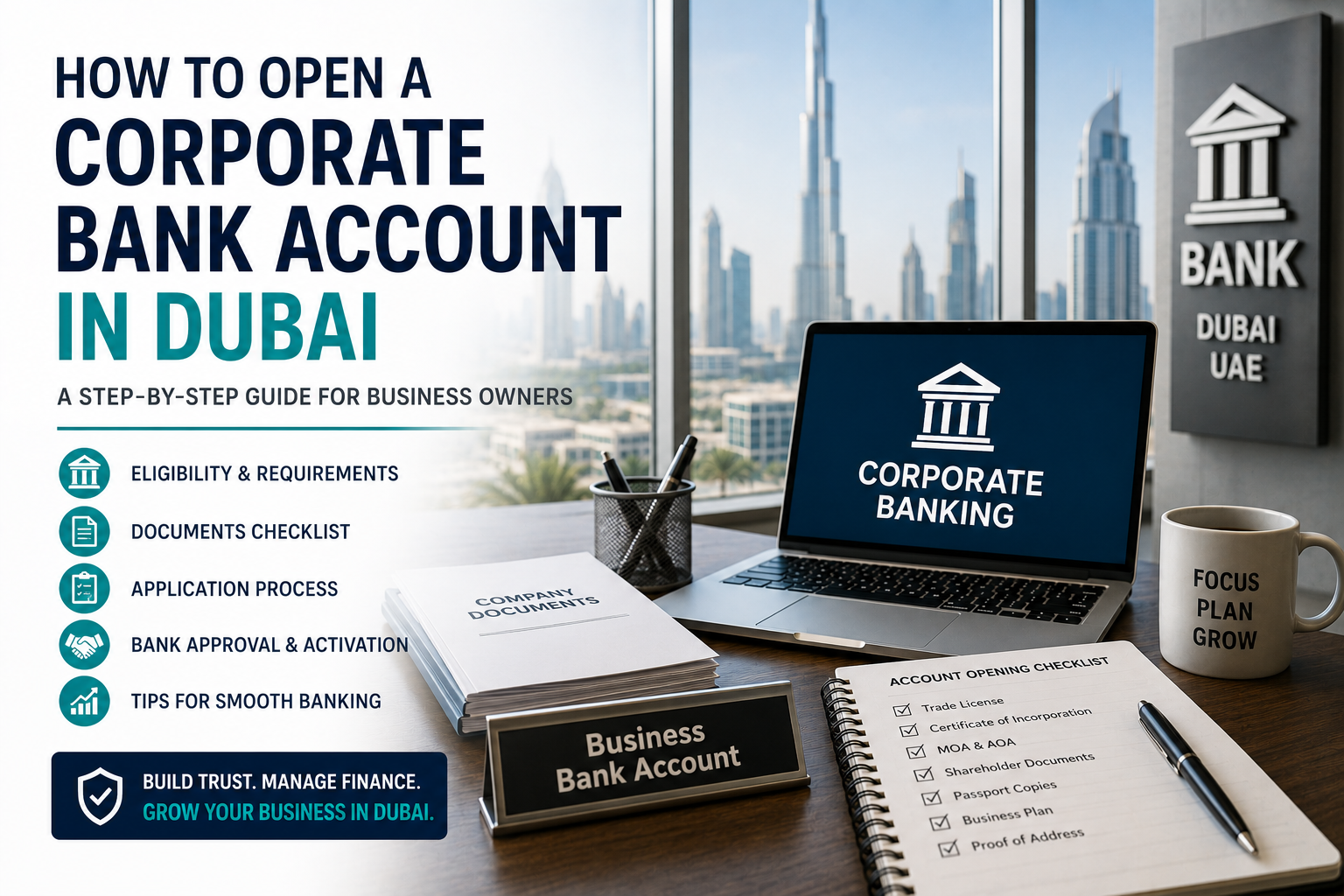
A corporate bank account allows a company to separate its business finances from personal finances.
This is important for proper financial management, accounting, tax compliance, and business operations.
A UAE business may use a corporate bank account to:
- Receive customer payments
- Pay suppliers and vendors
- Process employee salaries
- Pay office expenses
- Manage international transactions
- Maintain financial records
- Build banking history
- Support accounting and audit requirements
- Apply for business financing in the future
Mixing personal and business transactions can create accounting and compliance complications. For this reason, business owners should establish a dedicated banking structure as early as possible.
For many companies, opening a corporate bank account in Dubai is one of the most important steps after company incorporation.
Can Foreigners Open a Corporate Bank Account in Dubai?
Yes, foreign entrepreneurs can generally apply for corporate bank accounts for UAE-registered companies.
Dubai is an international business hub, and many companies are owned by foreign investors.
However, bank approval is not automatic.
Banks typically conduct compliance and due-diligence checks before opening an account. They may review:
- Company ownership
- Business activities
- Source of funds
- Expected transactions
- Customer locations
- Supplier locations
- Business model
- Shareholder background
- Country of residence
- Previous banking history
Therefore, having a valid UAE trade licence does not automatically guarantee that a bank account application will be approved.
The business should be prepared to clearly explain its commercial activities.
Types of Corporate Bank Accounts Available in Dubai
Businesses may have different banking requirements depending on their activities.
Common options include:
Current Account
A corporate current account is commonly used for day-to-day business transactions.
It may be used for:
- Receiving customer payments
- Supplier payments
- Business transfers
- Salary payments
- Operational expenses
This is generally the primary account used by many businesses.
Savings Account
Some banks may offer business savings options for companies that want to maintain surplus funds.
Availability and features can vary depending on the bank and business profile.
Multi-Currency Account
Companies involved in international trade may benefit from accounts that support multiple currencies.
This can be useful for businesses receiving payments in currencies such as:
- AED
- USD
- EUR
- GBP
- INR
Multi-currency facilities can reduce the need for frequent currency conversions.
Requirements to Open a Corporate Bank Account in Dubai
The exact requirements vary from bank to bank.
However, businesses are commonly asked to provide company and shareholder documentation.
Typical documents may include:
- Valid UAE trade licence
- Certificate of Incorporation
- Memorandum of Association
- Articles of Association
- Shareholder information
- Ultimate Beneficial Owner details
- Passport copies of shareholders
- Emirates ID copies, where applicable
- UAE visa copies, where applicable
- Board resolution
- Proof of company address
- Proof of shareholder address
- Business plan or company profile
- Expected annual turnover
- Expected monthly transactions
- Source of funds information
- Existing bank statements, where applicable
- Customer contracts
- Supplier contracts
- Invoices
- Purchase orders
- Website or business profile
The exact list can differ based on the company structure and the bank's internal compliance policies.
Step-by-Step Process to Open a Corporate Bank Account in Dubai
Opening a corporate bank account usually involves several stages.
Step 1: Establish Your UAE Company
Before applying for a corporate bank account, the business generally needs to be legally established.
This may involve:
- Choosing the business activity
- Selecting mainland or Free Zone
- Registering the company
- Obtaining the trade licence
- Completing ownership documentation
The company's legal structure can influence the documentation requested by the bank.
For example, requirements may differ for:
- LLCs
- Free Zone companies
- Branch offices
- Sole establishments
- Professional firms
- Holding companies
Step 2: Prepare Your Company Documents
Before contacting a bank, prepare all important corporate documents.
These should be valid, complete, and consistent.
For example, the company name appearing on the:
- Trade licence
- Memorandum
- Website
- Contracts
- Invoices
should generally be consistent.
Missing or inconsistent information can lead to additional questions during the application process.
Step 3: Prepare a Clear Business Profile
One of the most important parts of the application is explaining what the business actually does.
The bank may want to understand:
- What products or services you provide
- Who your customers are
- Where your customers are located
- How you generate revenue
- Who your suppliers are
- Which countries you transact with
- Expected transaction volume
- Expected monthly turnover
A simple but professional company profile can help explain the business model.
For example:
A Dubai-based digital marketing company provides SEO, social media marketing, and advertising services to clients in the UAE, India, and GCC countries.
This gives the bank a clearer understanding of the company's activities.
Step 4: Select the Right Bank
Different banks may have different requirements and onboarding processes.
When selecting a bank, consider factors such as:
- Minimum balance requirements
- Monthly account fees
- Online banking facilities
- International transfer options
- Multi-currency accounts
- Customer support
- Business banking services
- Branch accessibility
- Digital onboarding
- Transaction charges
The best bank for a trading company may not necessarily be the best choice for a consultancy, startup, or international service business.
Choose a banking solution based on your actual business model.
Step 5: Submit the Application
Once the documents are ready, the bank application can be submitted.
The bank may request information regarding:
- Company activities
- Shareholders
- Directors
- Beneficial owners
- Expected revenue
- Source of funds
- Countries involved in transactions
It is important to provide accurate information.
Do not exaggerate expected turnover or provide unclear explanations.
Banks may compare the information provided in the application with the company's:
- Website
- Trade licence
- Business profile
- Contracts
- Financial documents
Step 6: Compliance and Due Diligence Review
This is often the most important stage.
Banks are required to perform compliance checks and customer due diligence.
The bank may ask additional questions about:
- Business operations
- Ownership structure
- Source of wealth
- Source of funds
- International transactions
- High-risk countries
- Customers and suppliers
- Previous business activities
Some applications may require additional clarification before approval.
This does not necessarily mean the application will be rejected.
It simply means the bank requires more information to understand the business relationship.
Step 7: Interview or Verification
Depending on the bank and company profile, the shareholder or authorized signatory may need to participate in an interview or verification process.
Questions may include:
- What does your company do?
- Why did you establish the company in Dubai?
- Who are your customers?
- Where do your payments come from?
- What is your expected turnover?
- Which countries will you transact with?
- Who are your suppliers?
Business owners should be able to clearly explain their business model.
Step 8: Receive Account Approval
Once the application and compliance review are completed, the bank may approve the account.
The business can then activate online banking and begin using the account according to the bank's terms and conditions.
Some banks may require:
- Initial deposits
- Minimum balance maintenance
- Additional verification
The specific requirements depend on the banking institution and account type.
How Long Does It Take to Open a Corporate Bank Account in Dubai?
The timeline can vary significantly.
Some applications may be processed relatively quickly, while others can take several weeks.
The processing time can depend on:
- Company structure
- Business activity
- Shareholder nationality
- Residency status
- Completeness of documents
- Business model
- Compliance requirements
- International transaction profile
A simple UAE-based consultancy with clear documentation may have a different onboarding experience compared with an international trading company dealing with multiple countries.
Therefore, business owners should avoid making financial commitments based on the assumption that the bank account will be approved immediately.
Why Do Corporate Bank Account Applications Get Delayed?
There are several common reasons.
1. Incomplete Documentation
Missing documents are one of the most common reasons for delays.
Before submitting the application, ensure that all requested documents are available.
2. Unclear Business Activities
A vague description such as:
"General trading and services"
may not provide enough information.
Banks often want to understand the actual commercial activity.
Explain clearly:
- What you sell
- Who you sell to
- Where you operate
- How payments will be received
3. No Business Evidence
New companies sometimes struggle because they have no invoices, contracts, or transaction history.
In such cases, supporting documents may help demonstrate the legitimacy of the planned business.
Examples include:
- Business plans
- Customer proposals
- Signed contracts
- Purchase orders
- Supplier agreements
- Company website
4. Complex Ownership Structure
Companies with multiple shareholders, international holding companies, or complex ownership arrangements may require additional due diligence.
Banks may need to identify the ultimate beneficial owners.
5. High-Risk Transaction Profile
Transactions involving certain countries, industries, or business activities may require enhanced compliance checks.
Businesses should provide transparent information regarding their expected transactions.
Mainland vs Free Zone: Does It Affect Bank Account Opening?
Both mainland and Free Zone companies can generally apply for corporate bank accounts.
However, the company structure may influence the documents required.
Mainland Company
A mainland company may have:
- UAE commercial licence
- Office documentation
- Mainland registration documents
Free Zone Company
A Free Zone company may have:
- Free Zone licence
- Certificate of Incorporation
- Share certificate
- Lease agreement
- Free Zone registration documents
The key factor for banks is not simply whether the company is mainland or Free Zone.
The bank will also evaluate the company's actual business activities and compliance profile.
Can a New Company Open a Corporate Bank Account?
Yes, newly incorporated businesses can apply.
However, new companies may face more questions because they do not yet have:
- Transaction history
- Financial statements
- Previous bank statements
- Customer payment records
In such cases, the entrepreneur should be prepared to demonstrate the business's planned operations.
Useful supporting documents can include:
- Business plan
- Company profile
- Website
- Customer agreements
- Letters of intent
- Supplier agreements
- Purchase orders
- Expected financial projections
The goal is to provide a clear and credible picture of the business.
Importance of Maintaining a Professional Business Profile
Banks may review publicly available information about the company.
Before applying for a corporate bank account, ensure that your business has a professional presence.
Consider preparing:
Company Website
Your website should clearly explain:
- Company services
- Business activities
- Contact information
- Location
- Management profile
Company Profile
Prepare a professional PDF profile explaining:
- Company overview
- Services
- Target markets
- Management
- Business model
Professional Email Address
Using a company domain email can create a more professional impression.
Supporting Documents
Maintain organized copies of:
- Contracts
- Proposals
- Invoices
- Licences
- Agreements
A professional business profile can make the due-diligence process easier.
Common Mistakes Entrepreneurs Should Avoid
Mixing Personal and Business Transactions
Once the corporate bank account is operational, avoid using it for unrelated personal expenses.
Maintain a clear separation between personal and company finances.
Providing Inconsistent Information
The information provided to the bank should match the company's actual operations.
For example, if the trade licence says one thing but the website describes an entirely different business activity, the bank may request clarification.
Exaggerating Expected Turnover
Business owners should provide realistic estimates.
Overstating expected revenue without supporting evidence can create unnecessary questions.
Ignoring Compliance Questions
If the bank requests additional documents, respond clearly and promptly.
Ignoring requests can delay the application.
Applying Without Understanding the Business Model
Shareholders and authorized signatories should be able to explain:
- What the company does
- Why it was established
- Who the customers are
- Where funds come from
A clear understanding of your own business is important.
Tips to Improve Your Chances of Approval
If you are planning to open a corporate bank account in Dubai, the following steps can help improve your application quality.
Keep Documents Updated
Make sure all corporate documents are valid.
Prepare a Company Profile
Explain your services, customers, and business model clearly.
Maintain a Professional Website
A website can help demonstrate that the business has a genuine commercial presence.
Keep Ownership Transparent
Clearly disclose shareholders and beneficial owners.
Prepare Supporting Business Documents
Maintain contracts, proposals, invoices, and purchase orders where available.
Be Honest About Expected Transactions
Provide realistic information about turnover and payment flows.
Respond Quickly to Bank Queries
Delays in providing information can slow down the process.
Corporate Bank Account and Accounting Compliance
Once the account is operational, businesses should maintain proper accounting records.
The corporate bank account should be reconciled regularly.
A monthly accounting process should include:
- Recording bank transactions
- Reconciling bank balances
- Recording customer receipts
- Recording supplier payments
- Tracking business expenses
- Reviewing outstanding invoices
- Preparing financial reports
This becomes especially important for companies that have VAT and Corporate Tax obligations.
A properly managed bank account and accounting system can provide management with a clear picture of the company's financial position.
What Should You Ask Before Choosing a Bank?
Before proceeding with a corporate account application, consider asking:
- What is the minimum balance requirement?
- Are there monthly account maintenance fees?
- Does the account support international transfers?
- Are multi-currency facilities available?
- What documents are required?
- Is physical shareholder presence required?
- What are the online banking features?
- Are there transaction limits?
- What are the international transfer charges?
- Is a debit card available?
- Are cheque facilities available?
- What additional documents may be requested during compliance review?
Understanding these factors before applying can help businesses choose a banking solution that matches their operations.
Corporate Bank Account Checklist for Dubai Businesses
Before applying, prepare the following:
Company Documents
-
Valid Trade Licence
-
Certificate of Incorporation
-
Memorandum of Association
-
Articles of Association
-
Shareholder documents
-
Beneficial ownership details
Personal Documents
-
Passport copies
-
UAE visa, where applicable
-
Emirates ID, where applicable
-
Proof of address
Business Documents
-
Company profile
-
Business plan
-
Website
-
Customer contracts
-
Supplier agreements
-
Invoices or proposals
-
Purchase orders
Financial Information
-
Expected annual turnover
-
Expected monthly transactions
-
Source of funds information
-
Previous bank statements, where available
How Clockwell Can Help
Opening a corporate bank account can be a complex process for first-time entrepreneurs and international investors.
At Clockwell, we support businesses with:
- UAE Company Formation
- Mainland Business Setup
- Free Zone Company Setup
- Corporate Bank Account Assistance
- Business Documentation
- Accounting & Bookkeeping
- UAE VAT Registration
- VAT Return Support
- Corporate Tax Registration
- Corporate Tax Compliance
- Business Advisory
- Virtual CFO Services
Our team can help businesses prepare the necessary documentation, understand the banking process, and organize their financial and corporate records.
While final approval always remains subject to the bank's internal policies and compliance review, proper preparation can significantly improve the quality of the application.
Opening a corporate bank account in Dubai is an important step for any entrepreneur establishing a business in the UAE.
The process generally involves:
Company Setup → Document Preparation → Business Profile → Bank Selection → Application → Compliance Review → Approval
The key to a smoother application is preparation.
Banks want to understand who owns the company, what the business does, where the money comes from, and how the company expects to operate.
Entrepreneurs should therefore focus on maintaining:
- Clear company documentation
- Transparent ownership information
- A professional business profile
- Realistic financial information
- Supporting commercial documents
Whether you are starting a mainland company, Free Zone business, consultancy, trading company, or international startup, proper preparation can make the corporate banking process much easier.
A business bank account is more than just a place to receive payments. It forms an important part of your company's financial infrastructure and supports accounting, tax compliance, financial management, and long-term business growth.
Published on August 29, 2026