

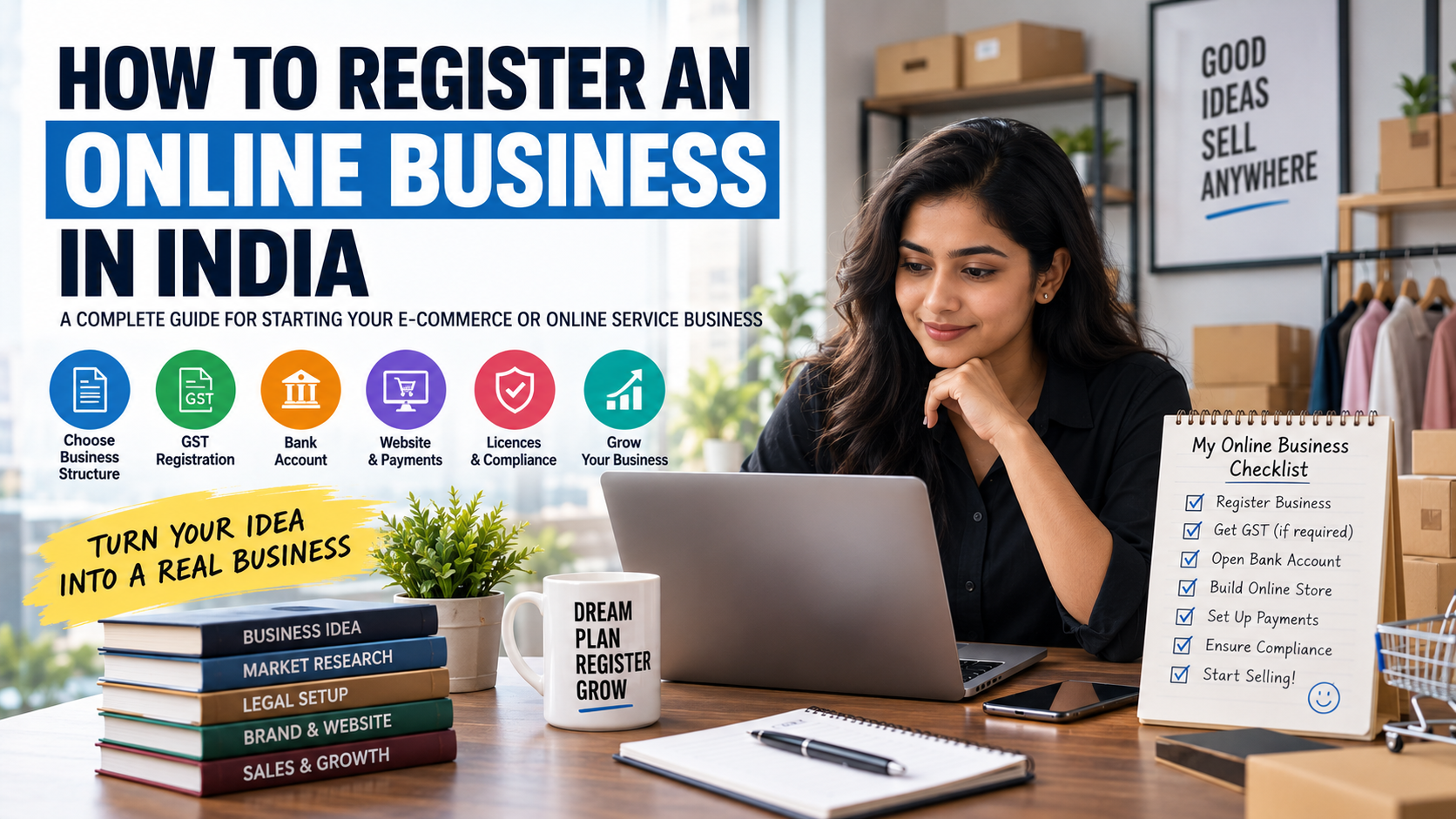
Starting an online business in India can be easier than ever. Entrepreneurs can sell products through their own websites, marketplaces, social media platforms or provide services entirely online.
However, starting an online business is not simply about creating a website or Instagram page. Depending on your business model, you may need the appropriate legal structure, GST registration, business licences, tax registrations, Udyam registration and other approvals.
The registration process also depends on whether you are operating as a sole proprietor, partnership, LLP, private limited company or another legal structure.
In this guide, we explain how to register an online business in India, which registrations may be required, how to choose the right business structure and what compliance responsibilities you should consider after starting.
What Is an Online Business?
An online business is a business that uses the internet as a primary channel for selling products, providing services, acquiring customers or conducting commercial transactions.
Examples include:
- E-commerce stores
- Online clothing brands
- Digital marketing agencies
- Software companies
- Freelance businesses
- Online education businesses
- Consulting services
- Online marketplaces
- Dropshipping businesses
- Subscription services
- Digital product businesses
- Online food and retail businesses
The legal requirements are not identical for all of these businesses.
For example, an online consultant may have very different registration requirements from an e-commerce seller importing and selling physical products.
Do You Need to Register an Online Business in India?
There is no single "online business registration" that applies to every internet-based business.
Instead, you need to determine which registrations and licences apply to your particular business.
Your requirements may depend on:
- Business structure
- Turnover
- State
- Business activity
- Whether you sell goods or services
- Whether you sell interstate
- Whether you use an e-commerce marketplace
- Whether you import or export
- Number of employees
- Industry-specific regulations
For example, a private limited company is incorporated through the Ministry of Corporate Affairs, while a sole proprietorship does not have a separate incorporation process in the same way. Startup India notes that the choice of entity can affect taxation, liability, compliance, funding and exit strategy.
Therefore, the first step is to identify the appropriate business structure and applicable registrations.
Step 1: Decide What Type of Online Business You Want to Start
Before registering anything, clearly define your business model.
Ask:
- What will I sell?
- Who are my customers?
- Will I sell products or services?
- Will I sell through my own website?
- Will I use Amazon, Flipkart or another marketplace?
- Will I sell through Instagram or WhatsApp?
- Will I sell to customers in other states?
- Will I sell internationally?
- Will I import products?
Your answers will influence the registrations and compliance requirements you need to consider.
Step 2: Choose the Right Business Structure
One of the most important decisions is choosing the legal structure.
Common options include:
1. Sole Proprietorship
A sole proprietorship is owned and controlled by one individual.
It is often considered by small businesses and individual entrepreneurs because the setup can be relatively simple.
However, the business does not have a separate legal personality from the owner, meaning the proprietor generally has unlimited personal liability for business obligations.
It may be suitable for certain small businesses but should be evaluated carefully before choosing it.
2. Partnership Firm
A partnership can be considered when two or more individuals want to operate a business together.
The partners generally share responsibilities, profits and liabilities according to the partnership arrangement.
A properly drafted partnership deed is important for defining:
- Capital contribution
- Profit-sharing ratio
- Responsibilities
- Decision-making
- Withdrawal rules
- Dispute resolution
3. Limited Liability Partnership (LLP)
An LLP combines elements of a partnership with limited liability.
It can be suitable for professional services and businesses where the founders want a formal structure without using a traditional private limited company.
Startup India identifies LLP as one of the recognised legal entity choices available to entrepreneurs in India.
4. Private Limited Company
A private limited company is often considered by entrepreneurs who plan to:
- Scale the business
- Raise external investment
- Add shareholders
- Build a larger organisation
- Create a formal corporate structure
Company incorporation is handled through the Ministry of Corporate Affairs.
MCA's SPICe+ process integrates several incorporation-related services, including company registration, DIN, PAN/TAN and optional GSTIN application.
5. One Person Company
An OPC can be an option for an individual entrepreneur who wants a corporate structure with a single member, subject to the applicable Companies Act requirements.
The appropriate structure should be selected based on your business objectives rather than simply choosing the easiest registration option.
Step 3: Choose Your Business Name
Once you have selected your structure, choose an appropriate business name.
Your name should ideally be:
- Unique
- Easy to remember
- Relevant to your business
- Suitable for online branding
- Available as a domain name where possible
- Not confusingly similar to another business
For a company or LLP, name availability needs to be considered as part of the incorporation process.
You should also consider trademark protection before investing heavily in:
- Logo design
- Packaging
- Advertising
- Website development
- Social media branding
A company name registration and trademark protection are not the same thing.
Step 4: Obtain PAN and Other Basic Documents
Your tax and business documentation depends on the structure you choose.
For example, a company incorporated through SPICe+ can receive PAN and TAN as part of the integrated incorporation process.
For an individual or proprietorship, the owner's PAN is generally central to the tax identity of the business.
You should maintain an organised document folder containing relevant:
- PAN
- Aadhaar
- Address proof
- Business address proof
- Incorporation documents
- Partnership/LLP documents
- Bank documents
- Tax registrations
- Licences
Step 5: Register the Company or Business Entity
If you choose a company structure, incorporation is completed through the MCA system.
The SPICe+ process provides an integrated route for company incorporation and related registrations. MCA states that companies incorporated from 23 February 2020 are required to apply for name reservation and incorporation through SPICe+.
Depending on the structure, you may need documents such as:
- Identity proof
- Address proof
- Registered office proof
- Utility bill
- Memorandum of Association
- Articles of Association
- Subscriber/director details
- Digital signatures where required
The exact documents vary according to the entity and circumstances.
Step 6: Open a Business Bank Account
Once your business structure and registrations are in place, open a dedicated business bank account where applicable.
Keeping business and personal finances separate makes it easier to manage:
- Sales
- Expenses
- Taxes
- Refunds
- Supplier payments
- Customer receipts
- Accounting
- Cash flow
For an online business, this becomes especially important because transactions can come from multiple channels.
For example:
Website → Payment Gateway → Bank Account
Marketplace → Marketplace Settlement → Bank Account
UPI → Business Account
Maintaining proper reconciliation across these channels can prevent accounting problems.
Step 7: Determine Whether GST Registration Is Required
GST is one of the most important registrations for online businesses.
However, the requirement depends on the business model and applicable GST provisions.
Do not assume that every online business automatically needs GST registration, but also do not assume that an online business is exempt simply because its turnover is small.
There are specific provisions affecting e-commerce operators and suppliers selling through certain e-commerce operators.
CBIC states that e-commerce operators covered by the relevant provisions are required to register, and suppliers making supplies through an e-commerce operator required to collect TCS can also be subject to compulsory registration provisions.
Example
Suppose you sell handmade products through an e-commerce marketplace.
Your GST position may be different from a consultant who provides services directly to clients through their own website.
Therefore, GST registration should be assessed based on:
- What you sell
- Where you sell
- Turnover
- Sales channel
- Interstate supplies
- E-commerce platform
- Applicable exemptions and notifications
Step 8: Understand GST for Your Own Website
Selling through your own website does not necessarily mean the same GST treatment as selling through a marketplace.
CBIC specifically explains that a person selling their own products through their own website is an electronic commerce operator under the definition, but Section 52 TCS is not required on those own-account supplies simply because they are made through that website. The supplies themselves remain subject to applicable GST rules.
This distinction is important.
Own website
You sell your own products directly to customers.
Marketplace
Multiple suppliers may sell through a platform operated by an e-commerce operator.
The GST responsibilities can differ significantly.
Step 9: Register for Udyam if Eligible
If your online business qualifies as an MSME, consider Udyam Registration.
The official Udyam portal states that registration is free, paperless and based on self-declaration. It provides a permanent registration number and an online certificate, with no renewal requirement.
Current MSME classification thresholds, applicable from 1 April 2025, are:
| Category | Investment | Annual Turnover |
|---|---|---|
| Micro | Up to ₹2.5 crore | Up to ₹10 crore |
| Small | Up to ₹25 crore | Up to ₹100 crore |
| Medium | Up to ₹125 crore | Up to ₹500 crore |
These classifications are based on the criteria stated by the Ministry of MSME.
Udyam registration can be useful for eligible businesses seeking access to MSME-related schemes and benefits.
Always use the official Udyam portal rather than private websites claiming to provide government registration for a fee.
Step 10: Check State and Local Registrations
Online does not mean that your business is exempt from local requirements.
Depending on where you operate, you may need to consider:
- Shops and Establishments registration
- Professional Tax
- Local trade licence
- Labour registrations
- Fire or safety approvals
- Industry-specific permissions
These requirements vary by state and business activity.
For example, a physical office, warehouse or retail operation can have additional local compliance requirements that a home-based online service provider may not have.
Step 11: Check Industry-Specific Licences
Some online businesses require additional approvals.
Examples include:
Food business
May require FSSAI registration/licensing.
Import/export business
May require an Importer Exporter Code (IEC), subject to the applicable rules.
Financial services
May be subject to regulatory requirements from authorities such as RBI or SEBI, depending on the activity.
Healthcare
Certain healthcare activities may require specific registrations or professional licences.
Cosmetics and certain consumer products
Product-specific rules may apply.
Education
Specific regulatory considerations may apply depending on the type of institution or service.
Therefore, before launching an online business, ask:
"Does my product or service require a special licence?"
Step 12: Set Up Your Website Properly
Once the legal foundation is ready, build your online presence.
Your website should clearly communicate:
- Business name
- Products/services
- Prices
- Contact information
- Payment methods
- Shipping information
- Return/refund policy
- Terms and conditions
- Privacy policy
For an e-commerce store, customers should understand exactly what they are purchasing and how the transaction works.
Step 13: Set Up a Payment Gateway
Online businesses need reliable payment infrastructure.
Depending on your business model, you may use:
- UPI
- Credit/debit cards
- Net banking
- Wallets
- Payment links
- Payment gateways
- Bank transfers
- Cash on delivery, where appropriate
Before selecting a payment provider, compare:
- Transaction fees
- Settlement time
- Refund process
- Payment methods
- Integration
- Customer support
- Security features
Make sure your business and banking documentation meets the provider's onboarding requirements.
Step 14: Set Up Accounting From Day One
One of the biggest mistakes online businesses make is postponing bookkeeping.
Online businesses can have transactions from multiple sources:
- Website
- Amazon
- Flipkart
- Social media
- Payment gateway
- UPI
- Bank transfer
- Cash on delivery
You should reconcile these transactions regularly.
Maintain records of:
- Sales
- Purchases
- Expenses
- Payment gateway fees
- Marketplace commissions
- Refunds
- Shipping charges
- GST
- Bank transactions
Good accounting makes tax filing and financial decision-making much easier.
Step 15: Understand Your Tax Obligations
Registering an online business does not automatically complete your tax responsibilities.
Depending on the business structure and activity, you may need to manage:
- Income tax
- GST
- TDS
- Advance tax where applicable
- Corporate tax provisions for companies
- Other applicable taxes
Your tax obligations depend on the legal structure, turnover, income and nature of transactions.
Maintain proper financial records from the beginning instead of trying to reconstruct them at the end of the financial year.
Step 16: Protect Your Brand
Your online business may be built around a:
- Brand name
- Logo
- Product name
- Website
- Domain
- Packaging
- Social media identity
Consider whether trademark protection is appropriate.
A registered company name does not automatically give you complete trademark protection over your brand.
Before investing significantly in branding, check whether similar trademarks already exist.
Startup India also highlights trademark protection as an important legal consideration for startups.
Step 17: Protect Customer Data
Online businesses often collect personal information such as:
- Names
- Phone numbers
- Email addresses
- Delivery addresses
- Payment-related information
- Customer preferences
Your website should therefore have appropriate privacy and data-handling practices.
Consider:
- Privacy policy
- Data security
- Access controls
- Secure payment processing
- Data retention
- Third-party service providers
- Customer communication
The specific legal requirements depend on the nature and scale of your data processing.
Step 18: Understand E-Commerce Consumer Responsibilities
If you operate an online store, customers should have access to clear information about:
- Product description
- Price
- Taxes
- Shipping
- Delivery
- Refunds
- Returns
- Warranty where applicable
- Customer support
Avoid misleading advertising or unclear pricing.
A professional online store should make the purchasing process transparent from product discovery through post-sale support.
Step 19: Keep Your Business Documents Organised
Create a digital compliance folder from the beginning.
Business documents
- Incorporation certificate
- Partnership deed/LLP agreement
- PAN
- TAN
- MOA/AOA where applicable
- Business licences
Tax documents
- GST certificate
- GST returns
- Tax invoices
- Income-tax records
- TDS records
Financial documents
- Bank statements
- Sales reports
- Expense records
- Payment gateway statements
- Marketplace settlement reports
Legal documents
- Customer terms
- Vendor agreements
- Employment contracts
- Privacy policy
- Refund policy
- Trademark documents
Good documentation can save significant time during audits, tax reviews, banking procedures and business expansion.
How Much Does It Cost to Register an Online Business in India?
There is no single fixed cost because the expense depends on the business structure and registrations required.
Potential costs can include:
- Government registration fees
- Professional fees
- Digital Signature Certificates
- Business licence fees
- GST-related professional support
- Trademark fees
- Accounting
- Website development
- Payment gateway setup
- Business bank account requirements
For example, Udyam Registration itself is officially free on the government portal.
Company incorporation, professional assistance and other registrations can involve separate costs.
Therefore, entrepreneurs should prepare a startup budget rather than relying on a single "business registration cost."
How Long Does It Take to Register an Online Business?
The timeline depends on the business structure and registrations involved.
A simple proprietorship-related setup may be relatively straightforward, while incorporation of a private limited company or LLP involves more formal documentation and government processing.
Additional licences can also extend the timeline.
The practical approach is to prepare your documents in advance and identify all registrations required for your business before starting the application process.
Common Mistakes When Registering an Online Business
1. Choosing the Wrong Business Structure
Do not choose a structure simply because someone told you it is "easy."
Consider:
- Liability
- Taxation
- Compliance
- Funding
- Ownership
- Future growth
2. Assuming GST Is Always Optional
Online selling can trigger specific GST registration provisions.
Review the rules applicable to your sales channel and business model.
3. Mixing Personal and Business Transactions
Use a dedicated business banking arrangement wherever appropriate.
4. Ignoring State-Level Requirements
Central registration does not automatically replace every state or local licence.
5. Starting Sales Before Understanding Compliance
Do not assume that creating a website means you can immediately conduct every type of commercial activity.
6. Ignoring Trademark Protection
Your company name and brand name may require separate consideration.
7. Poor Record Keeping
Save invoices, payment records, marketplace statements and expense documents from the beginning.
8. Using Fake Government Registration Websites
For Udyam registration in particular, the official portal explicitly warns businesses about fake websites and states that registration is free.
Online Business Registration Checklist
Before launching, use this checklist:
Business Setup
-
Define business activity
-
Choose legal structure
-
Select business name
-
Check name/trademark availability
-
Arrange registered/business address
-
Complete entity registration where applicable
-
Obtain PAN/TAN where applicable
Tax
-
Determine GST applicability
-
Apply for GST registration if required
-
Set up invoicing
-
Understand income-tax obligations
-
Set up bookkeeping
MSME
-
Check Udyam eligibility
-
Complete Udyam registration if appropriate
Online Operations
-
Buy domain
-
Build website/store
-
Add terms and conditions
-
Add privacy policy
-
Add refund/return policy
-
Configure payment gateway
-
Set up shipping/delivery
Compliance
-
Check state registrations
-
Check industry-specific licences
-
Maintain accounting records
-
Track GST/tax deadlines
-
Maintain customer records appropriately
Final Thoughts
Registering an online business in India involves more than creating a website and starting to sell.
The right process starts with understanding your business model, choosing an appropriate legal structure and identifying the registrations that apply to your specific activity.
For some entrepreneurs, a simple proprietorship-based setup may be sufficient. For others, an LLP or private limited company may be more appropriate, particularly when there are multiple founders, investment plans or long-term expansion goals.
GST is another important consideration, particularly for businesses selling through e-commerce platforms or making interstate supplies. The applicable rules depend on the business model and transaction structure.
Eligible MSMEs can also consider Udyam Registration, which the Government of India's official portal states is free, paperless and does not require renewal.
The key is to complete the right registrations—not simply as many registrations as possible.
A properly structured online business gives you a stronger foundation for accepting payments, managing taxes, working with suppliers, building customer trust and scaling over time.
Choose the right structure. Complete the right registrations. Keep proper records. Then focus on growing the business.
If you are planning to start an online business in India, professional assistance can help you identify the appropriate structure, registrations, tax obligations and ongoing compliance requirements before you launch.
Published on September 8, 2026