

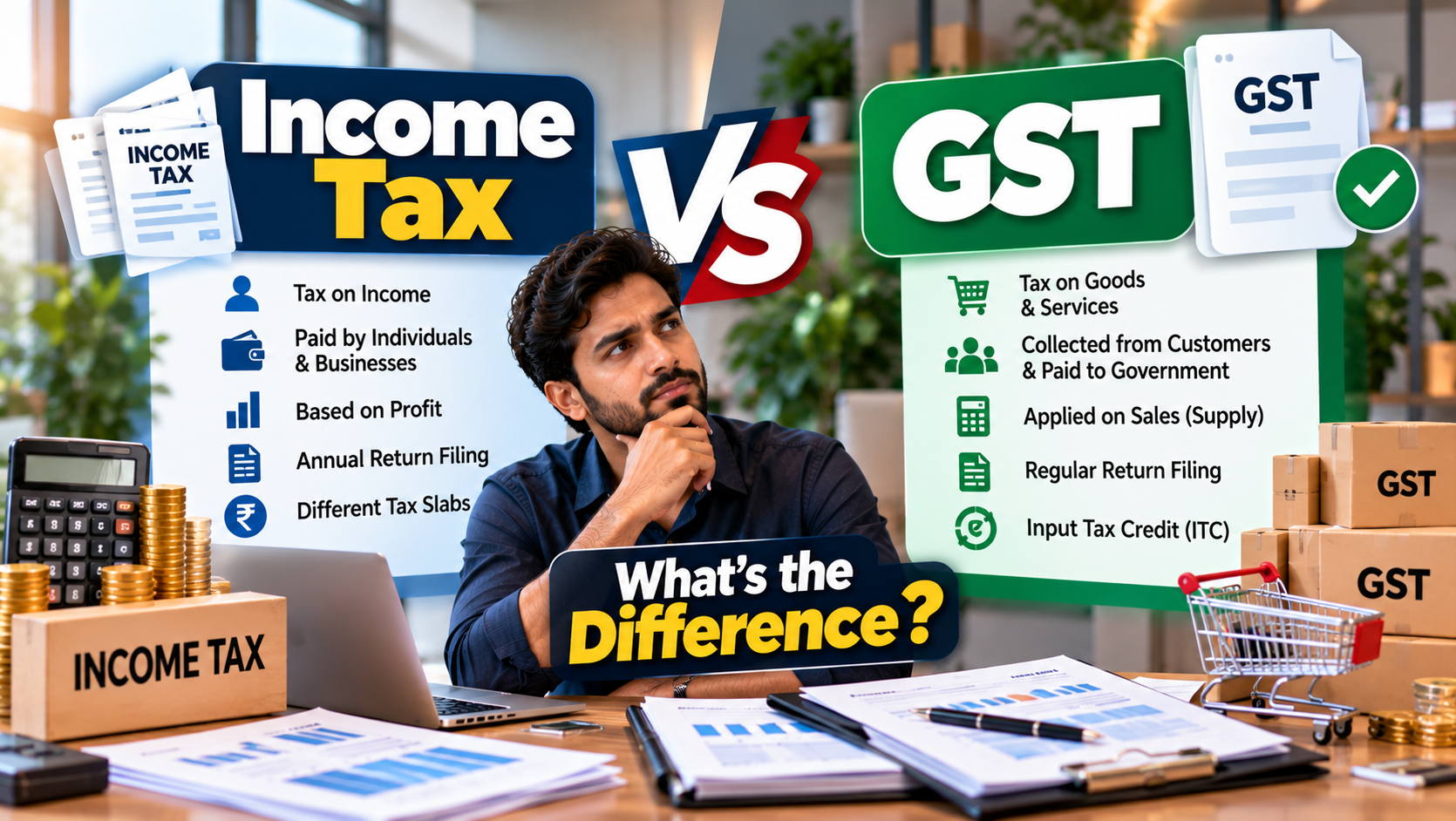
Every business in India needs to understand its tax responsibilities. Whether you operate a small shop in Kerala, run a service-based business in Kochi, manage a startup in Bengaluru or own an established company, two important taxes you may encounter are Income Tax and Goods and Services Tax (GST).
Although both are part of India's tax system, they work differently. Income tax is generally calculated on taxable income, while GST is an indirect tax associated with the supply of goods and services. Businesses may need to comply with both, depending on their circumstances.
Understanding Income Tax vs GST helps business owners manage cash flow, maintain accurate accounting records, file the appropriate returns and avoid compliance mistakes.
In this guide, we explain the key differences between income tax and GST, who needs to pay them, how they work, and what businesses should know about registration and filing.
1. What Is Income Tax?
Income tax is a direct tax imposed on taxable income under the applicable income-tax law. Depending on the taxpayer and the nature of the income, it may apply to profits from business or profession, salary, rent, capital gains, interest and other taxable sources.
For businesses, income tax compliance generally involves determining taxable income, calculating the applicable tax, paying any required tax instalments and filing the relevant income tax return.
For example, a company earns revenue from selling products. After accounting for allowable business expenses and making the adjustments required under tax law, the company determines its taxable income. Income tax is calculated using the applicable rules and rates.
The amount of income tax is not necessarily the same as the company's accounting profit because certain expenses, deductions, exemptions and adjustments may be treated differently for tax purposes.
For tax periods beginning on or after 1 April 2026, the Income-tax Act, 2025 applies. Earlier tax periods continue to be governed by the applicable provisions of the Income-tax Act, 1961, subject to transitional rules. The new law also introduces the term Tax Year for relevant periods. <Cite refs={["turn646889search1","turn646889search3"]} />
2. What Is GST?
GST stands for Goods and Services Tax. It is an indirect tax generally levied on the supply of goods and services, subject to applicable exemptions, rates and conditions.
GST is designed to tax consumption. A registered supplier generally collects GST from the customer and pays the applicable tax to the government. Eligible registered businesses may claim input tax credit for GST paid on qualifying business purchases, subject to legal conditions.
For example, a registered business sells taxable goods to a customer. The invoice may include the value of the goods and the applicable GST. The business reports the transaction through its GST compliance process and pays the tax due after accounting for eligible input tax credit.
GST can involve different components, including:
-
CGST: Central Goods and Services Tax.
-
SGST: State Goods and Services Tax, applicable to relevant intra-state supplies.
-
IGST: Integrated Goods and Services Tax, generally applicable to inter-state supplies and certain other transactions.
The correct treatment depends on the nature of the supply, place of supply and applicable GST provisions. <Cite refs={["turn646889search0","turn646889search4"]} />
3. Income Tax vs GST: Key Differences
The following table summarises the main differences between income tax and GST in India.
| Basis | Income Tax | GST |
|---|---|---|
| Type of tax | Direct tax | Indirect tax |
| Main basis | Taxable income | Taxable supply of goods or services |
| Who ultimately bears it? | The taxpayer on whose taxable income the tax is imposed | Generally the final consumer, subject to the tax structure and applicable rules |
| Who pays or remits it? | The taxpayer, through applicable payment mechanisms | Generally the supplier, with exceptions such as reverse charge |
| Registration | Depends on taxpayer category and applicable requirements | Depends on GST registration rules and the nature of business activities |
| Business calculation | Based on taxable income and applicable rates | Based on taxable supplies, applicable rates and eligible input tax credit |
| Common compliance | Income tax returns, advance tax and applicable TDS obligations | GST returns, tax payment and related reporting, where applicable |
| Input tax credit | GST-style input tax credit does not apply to income tax | Eligible input tax credit may reduce GST payable |
| Example | Tax on a company's taxable profits | GST charged on a taxable sale |
The exact obligations differ according to the legal structure, income, transaction type and relevant tax period.
4. What Is the Difference Between Direct Tax and Indirect Tax?
The distinction between direct and indirect taxes is central to understanding income tax versus GST.
Direct tax
A direct tax is generally imposed on the income or other tax base of the taxpayer who is legally liable for it. Income tax is a common example.
For a business, the amount payable may depend on its taxable income, the applicable tax regime, allowable deductions and other provisions.
Indirect tax
An indirect tax is generally imposed on a transaction or supply, with the tax burden commonly passed on to the customer through the price.
GST is an example. A registered supplier may collect GST on a taxable supply and remit it to the government after considering eligible input tax credit and other applicable rules.
However, the economic burden can vary according to market conditions, pricing and the specific transaction.
5. How Is Income Tax Calculated?
Income tax is calculated according to the applicable law and tax rates for the taxpayer and tax period.
A simplified illustration is:
Taxable income = Business income adjusted under tax rules − allowable deductions and adjustments
The final calculation must follow the relevant legal provisions. Accounting profit and taxable income can differ.
Example
Suppose a business has the following figures for a period:
-
Business revenue: ₹20,00,000
-
Accounting expenses: ₹14,00,000
-
Illustrative accounting profit: ₹6,00,000
The taxable income may be different from ₹6,00,000 after applying the tax rules, including the treatment of expenses, depreciation and other adjustments.
The applicable tax is then determined using the rules and rates relevant to the entity and tax period.
This example does not calculate the actual income tax liability. The final amount depends on the business structure and the provisions that apply.
Important points about income tax
-
Taxable income is not always equal to accounting profit.
-
Different taxpayer categories may have different tax rules.
-
Some expenses may be restricted or treated differently for tax purposes.
-
Advance tax may be payable when the applicable conditions are met.
-
Tax deducted at source (TDS) may provide credit against the recipient's tax liability, subject to the rules.
-
Filing an income tax return and paying tax are related but separate compliance responsibilities.
Businesses should maintain reliable financial records to support their income tax calculations.
6. How Is GST Calculated?
GST is generally calculated by applying the relevant GST rate to the taxable value of a supply.
A simplified calculation is:
GST amount = Taxable value × Applicable GST rate
The actual treatment depends on the classification of the goods or services, exemptions, place of supply and applicable rules.
Example
Suppose a business makes a taxable sale with a value of ₹10,000. For illustration, assume the applicable GST rate is 18%.
-
Taxable value: ₹10,000
-
Illustrative GST rate: 18%
-
GST amount: ₹1,800
-
Total invoice value: ₹11,800
If the supply is an eligible intra-state transaction, the tax may be divided into CGST and SGST. If it is an eligible inter-state supply, IGST may apply.
The 18% rate is only an example; it does not apply to every product or service.
What about Input Tax Credit?
Suppose the business has ₹1,000 of eligible input tax credit from qualifying business purchases. In a simplified example, if the output GST is ₹1,800 and the entire ₹1,000 credit is available and usable, the remaining GST payable would be ₹800.
Actual input tax credit claims are subject to eligibility conditions, restrictions, documentation and the applicable utilisation rules. Not all GST paid on purchases can be claimed as credit. <Cite refs={["turn646889search24","turn646889search26"]} />
7. Who Needs to Pay Income Tax?
Income tax obligations depend on the taxpayer's legal status, income and applicable filing conditions.
Potential taxpayers include:
-
Individuals earning taxable income
-
Sole proprietors earning taxable business income
-
Partnership firms and LLPs
-
Companies
-
Other persons covered by the applicable law
A business owner may have personal income tax obligations in addition to obligations associated with a business entity.
For example, a sole proprietor generally reports business income as part of their own income tax computation. A company is a separate legal entity and generally calculates and reports its own taxable income.
The requirement to file a return is not determined by profit alone. Some entities have filing obligations even when they report a loss, subject to the relevant law.
For official guidance, visit the Income Tax Department's e-Filing portal. <Cite refs={["turn646889search2","turn646889search3"]} />
8. Who Needs GST Registration?
GST registration requirements depend on factors such as aggregate turnover, the type of supply, the state, business activities and specific provisions that may require registration.
Some businesses may qualify for a turnover-based exemption, while others may need to register under specific circumstances. Different thresholds and conditions can apply to different categories of suppliers.
A business owner should consider:
-
The nature of goods or services supplied
-
Aggregate turnover under GST rules
-
The states in which the business operates
-
Whether supplies are intra-state or inter-state
-
E-commerce and other business arrangements
-
Any applicable exemption or compulsory-registration provision
Important: GST registration is not compulsory for every business from the first day of operations. Equally, low turnover does not automatically mean registration is unnecessary in every situation.
Businesses should verify the rules relevant to their activities before making a decision. The official GST Portal provides registration and compliance services.
9. Income Tax Return vs GST Return
Income tax returns and GST returns serve different purposes.
Income tax return
An income tax return reports relevant income and other prescribed information so the taxpayer's tax liability can be determined under the applicable law.
For businesses, this generally involves information about income, expenses, deductions, tax payments and other relevant details.
GST return
A GST return reports prescribed information about business supplies, tax liability, eligible input tax credit and other GST-related details for the relevant period.
The type and frequency of return depend on the taxpayer's registration, scheme and applicable rules.
| Feature | Income Tax Return | GST Return |
|---|---|---|
| Primary purpose | Report income and determine income tax liability | Report GST-related transactions and tax liability |
| Main records | Income, expenses, tax payments and deductions | Sales, purchases, invoices, GST and eligible ITC |
| Filing frequency | Depends on the taxpayer and applicable rules | Depends on the GST registration and applicable scheme |
| Main calculation | Taxable income and applicable tax | GST on taxable supplies, adjusted for eligible credits |
| Filing portal | Income Tax Department portal | GST Portal |
Filing a GST return does not replace the obligation to file an income tax return where required. Similarly, filing an income tax return does not satisfy GST return-filing obligations.
10. Can a Business Be Liable for Both Income Tax and GST?
Yes. Many businesses may have obligations under both systems.
Consider a business in Kerala that sells taxable products. It may need to comply with GST requirements on its sales and separately calculate income tax on its taxable profits.
The business therefore needs to maintain records for two distinct purposes:
-
GST records covering taxable supplies, invoices, eligible input tax credit, returns and payments.
-
Income tax records covering revenue, allowable expenses, taxable income, applicable deductions and tax payments.
These records are related but not interchangeable. GST collected from customers is not automatically the business's income, and GST paid on purchases is not automatically an income tax deduction in every circumstance.
Accurate bookkeeping helps the business reconcile these records and avoid errors.
11. Common Mistakes Businesses Should Avoid
Business owners can face difficulties when they treat income tax and GST as the same type of tax.
Mistake 1: Assuming GST is charged on profit
GST is generally linked to taxable supplies, not the net profit of a business. A profitable or loss-making business must assess GST based on its supplies and applicable obligations.
Mistake 2: Assuming income tax is calculated on total sales
Income tax generally depends on taxable income, which is determined under tax law. Sales revenue alone does not establish the final income tax liability.
Mistake 3: Ignoring GST registration requirements
Businesses should assess their registration obligations based on turnover, activities and specific provisions rather than relying on assumptions.
Mistake 4: Treating every purchase as eligible for ITC
Input tax credit is subject to conditions and restrictions. Businesses should verify eligibility and maintain the required documentation.
Mistake 5: Mixing business and personal expenses
Poorly maintained records make it harder to determine taxable income and substantiate business expenses.
Mistake 6: Missing filing deadlines
Income tax and GST have separate filing and payment requirements. Maintain a compliance calendar for both.
Mistake 7: Using the wrong tax-period rules
For income earned in periods before 1 April 2026, the relevant provisions of the Income-tax Act, 1961 generally continue to apply. For Tax Year 2026–27 onwards, the Income-tax Act, 2025 applies. Businesses should use the correct rules and forms for the period involved. <Cite refs={["turn646889search1","turn646889search3"]} />
12. How Can Businesses Manage Income Tax and GST Efficiently?
A structured accounting and compliance process can make both taxes easier to manage.
Maintain separate records: Keep sales, purchase, expense, tax and payment records organised.
Reconcile regularly: Compare invoices, bank transactions, accounting records and tax statements.
Review GST eligibility: Check the tax treatment of supplies and purchases before reporting them.
Track income tax obligations: Monitor taxable income, eligible deductions, advance tax and return-filing requirements.
Maintain supporting documents: Preserve invoices, contracts, bank statements and other records relevant to the business.
Plan deadlines in advance: Use a compliance calendar for GST returns, income tax returns and applicable tax payments.
Seek professional advice when needed: Complex transactions, multiple registrations, tax notices or changes in business structure may require expert review.
These practices can help business owners improve financial visibility and reduce avoidable compliance errors.
13. How Clockwell International Can Help
Managing GST, income tax and accounting responsibilities can take significant time, especially when business owners are also handling sales, employees and daily operations.
Clockwell International provides business-support services covering accounting, taxation, GST-related requirements, company registration and compliance support.
Depending on the business's needs, professional assistance may include:
-
GST registration and return-related support
-
Accounting and bookkeeping
-
Income tax return preparation and filing
-
Tax documentation and reconciliation
-
Guidance on applicable compliance responsibilities
-
Company registration and related statutory support
The appropriate services depend on the business structure and specific requirements. Businesses should confirm the scope and availability of individual services directly with Clockwell International.
Visit clockwell.in or email info@clockwell.in to discuss your requirements.
Understanding Income Tax vs GST is essential for business owners who want to maintain accurate accounts and meet their tax responsibilities.
Income tax generally applies to taxable income, while GST is generally associated with taxable supplies of goods and services. Their registration requirements, calculations, returns and payment processes differ, and businesses may need to comply with both.
The best approach is to maintain reliable financial records, understand the rules applicable to your business, review obligations regularly and seek professional guidance when necessary.
Frequently Asked Questions
1. What is the main difference between income tax and GST?
Income tax is generally based on taxable income, while GST is generally based on taxable supplies of goods and services.
2. Is GST a direct tax or an indirect tax?
GST is an indirect tax. It is generally collected by the supplier from the customer and remitted to the government, subject to applicable rules.
3. Can a business pay both income tax and GST?
Yes. A business may need to comply with GST requirements on its taxable supplies and pay income tax on its taxable income, depending on the applicable rules.
4. Is GST calculated on business profit?
Generally, no. GST is linked to taxable supplies, not net profit. Income tax, by contrast, is generally based on taxable income.
5. Can GST paid on purchases be claimed as input tax credit?
Eligible registered businesses may claim input tax credit on qualifying purchases, subject to the conditions and restrictions under GST law.
6. Does GST registration remove the need to file an income tax return?
No. GST registration and income tax return filing are separate matters. A business must assess its obligations under each applicable tax system.
7. Where can I check official tax information?
Visit the Income Tax Department for income tax guidance and the GST Portal for GST registration and compliance services.
Published on October 24, 2026