
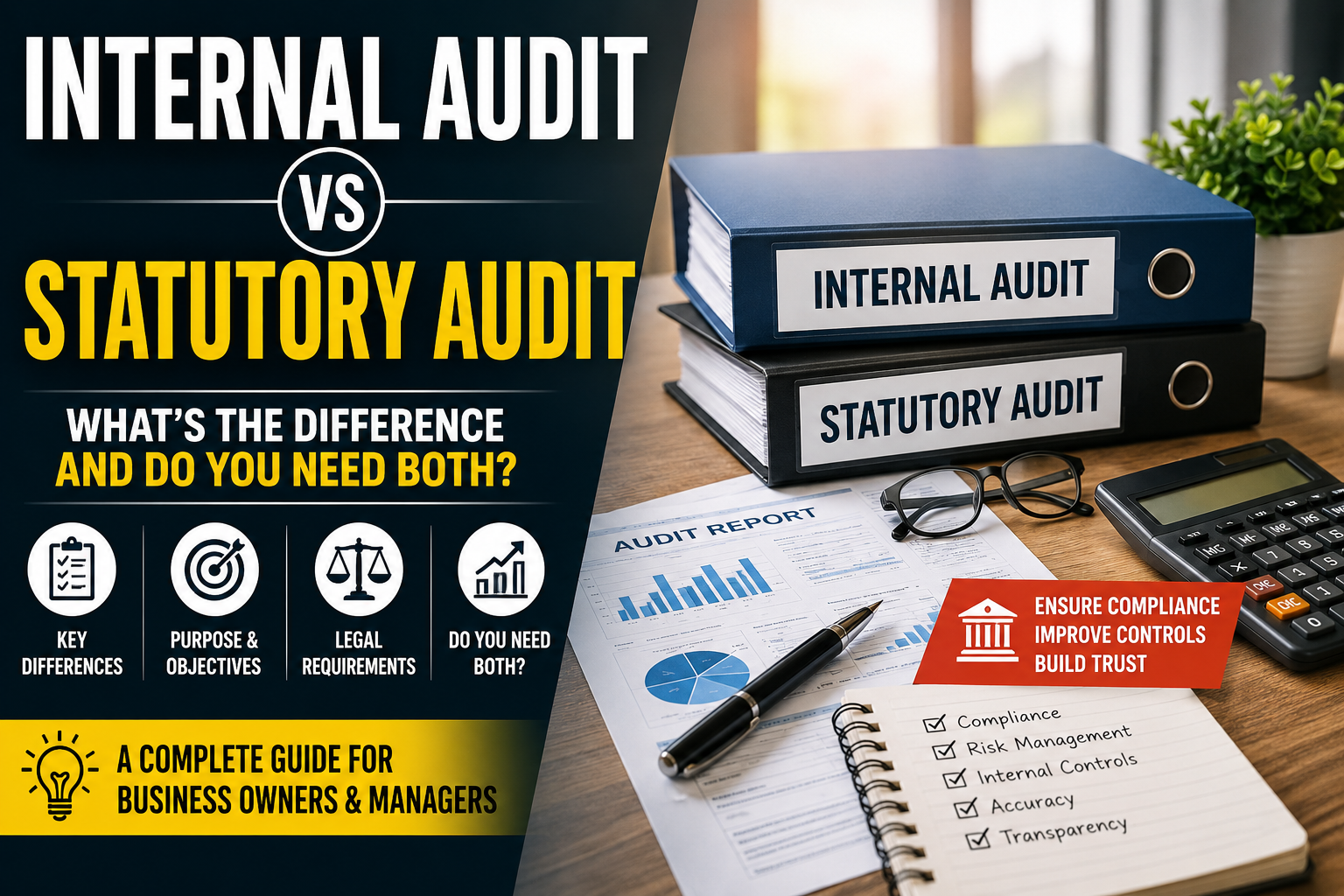
Every growing business reaches a point where financial transparency, compliance, and risk management become essential. At this stage, many business owners come across two important terms—Internal Audit and Statutory Audit. While both involve reviewing a company's financial and operational processes, they serve different purposes and are conducted differently.
Many entrepreneurs assume that these audits are the same or that having one eliminates the need for the other. In reality, Internal Audit vs Statutory Audit is one of the most misunderstood topics in business compliance.
Understanding the difference can help you strengthen your business operations, improve decision-making, maintain legal compliance, and build trust with investors, banks, and stakeholders.
In this guide, we'll explain the difference between Internal Audit and Statutory Audit, when each is required, their benefits, and whether your business needs both.
What is an Audit?
An audit is a systematic examination of a company's financial records, accounting practices, internal controls, and operational processes to verify their accuracy and compliance.
Audits help businesses:
- Improve financial accuracy
- Detect fraud and errors
- Strengthen internal controls
- Ensure legal compliance
- Build investor confidence
- Support informed business decisions
Depending on the objective, audits are classified into different types, with Internal Audit and Statutory Audit being the most common.
What is an Internal Audit?
An Internal Audit is an independent review conducted within an organization to evaluate its internal controls, operational efficiency, financial processes, compliance systems, and risk management practices.
Unlike statutory audits, internal audits are primarily conducted for management rather than government authorities.
The objective is continuous improvement rather than regulatory compliance.
Objectives of Internal Audit
Internal audits help management to:
- Identify operational inefficiencies
- Detect fraud and financial irregularities
- Strengthen internal controls
- Improve business processes
- Ensure policy compliance
- Reduce financial risks
- Enhance profitability
- Improve decision-making
Think of an internal audit as a regular health check-up for your business.
What is a Statutory Audit?
A Statutory Audit is a legally mandated examination of a company's financial statements by an independent Chartered Accountant or audit firm.
It is conducted to verify whether the financial statements present a true and fair view of the company's financial position.
Statutory audits are governed by applicable laws such as:
- Companies Act, 2013
- Income Tax Act
- LLP Act (where applicable)
- Other regulatory requirements
Objectives of Statutory Audit
A statutory audit aims to:
- Verify financial statements
- Ensure legal compliance
- Confirm accounting standards are followed
- Protect shareholders' interests
- Improve financial credibility
- Provide assurance to lenders and investors
Internal Audit vs Statutory Audit: Key Differences
| Particular | Internal Audit | Statutory Audit |
|---|---|---|
| Purpose | Improve internal processes and controls | Verify financial statements for legal compliance |
| Mandatory | Only for specified companies or voluntary | Mandatory for eligible entities under law |
| Conducted By | Internal auditor or external consultant | Independent Chartered Accountant |
| Reporting To | Management and Board | Shareholders and regulatory authorities |
| Focus | Operations, risks, controls, efficiency | Financial statements and statutory compliance |
| Frequency | Throughout the year | Usually once every financial year |
| Scope | Flexible and management-driven | Defined by law and auditing standards |
| Objective | Business improvement | Legal compliance and financial reporting |
Who Conducts an Internal Audit?
Internal audits may be conducted by:
- Internal audit department
- Chartered Accountants
- Professional audit firms
- Independent consultants
The auditor works closely with management to identify risks and recommend improvements.
Who Conducts a Statutory Audit?
A statutory audit must be conducted by an independent Chartered Accountant or a Chartered Accountant firm appointed according to applicable legal provisions.
The auditor should remain independent from management.
Is Internal Audit Mandatory?
Not every business is legally required to conduct an internal audit.
However, under the Companies Act, 2013, certain classes of companies meeting prescribed criteria are required to appoint an Internal Auditor.
Even where not mandatory, many businesses voluntarily conduct internal audits because they provide valuable insights into operational efficiency and risk management.
When is a Statutory Audit Mandatory?
Statutory audit requirements depend on the type of business entity and applicable laws.
Examples include:
- Companies registered under the Companies Act
- Businesses crossing prescribed turnover limits under relevant tax laws
- Certain LLPs and other entities where applicable
- Organizations receiving statutory funding or regulatory oversight
Businesses should consult qualified professionals to determine their audit obligations based on current legal provisions.
Benefits of Internal Audit
1. Improves Internal Controls
Internal audits identify weaknesses before they become major problems.
2. Detects Fraud Early
Regular reviews help identify suspicious transactions and unauthorized activities.
3. Enhances Operational Efficiency
Auditors recommend process improvements that save time and reduce costs.
4. Better Risk Management
Businesses can identify financial and operational risks before they affect growth.
5. Supports Better Decisions
Management receives accurate information for strategic planning.
Benefits of Statutory Audit
1. Legal Compliance
Ensures compliance with statutory requirements.
2. Builds Credibility
Audited financial statements increase confidence among:
- Banks
- Investors
- Customers
- Government authorities
3. Easier Loan Approvals
Financial institutions often prefer audited financial statements when evaluating loan applications.
4. Investor Confidence
Investors are more likely to trust businesses with professionally audited accounts.
5. Accurate Financial Reporting
Independent verification improves the reliability of financial statements.
Can a Business Have Both Audits?
Yes.
In fact, many successful businesses conduct both Internal Audit and Statutory Audit.
Internal Audit helps improve the business throughout the year.
Statutory Audit confirms that the final financial statements comply with legal requirements.
Together, they create a strong financial governance framework.
Practical Example
Consider a manufacturing company.
During an Internal Audit, the auditor discovers:
- Inventory shortages
- Weak approval processes
- Duplicate vendor payments
- Delayed GST reconciliations
Management fixes these issues before the financial year ends.
Later, during the Statutory Audit, the financial statements are found to be accurate because the earlier issues were already addressed.
This demonstrates how Internal Audit complements Statutory Audit rather than replacing it.
Common Misconceptions
"Internal Audit is only for large companies."
False.
Small and medium businesses also benefit from internal audits, especially as they grow.
"Statutory Audit detects all fraud."
Not always.
The primary objective of a statutory audit is to express an opinion on financial statements—not to investigate every instance of fraud.
"If I have a Statutory Audit, I don't need Internal Audit."
Incorrect.
Statutory audits focus on compliance.
Internal audits focus on improving business performance and strengthening controls.
"Internal Auditors and Statutory Auditors perform the same work."
They often review similar records but have different objectives, reporting structures, and responsibilities.
Signs Your Business Needs an Internal Audit
Consider conducting an Internal Audit if:
- Revenue is growing rapidly.
- You have multiple branches.
- Cash transactions are increasing.
- Inventory discrepancies occur frequently.
- GST mismatches are common.
- Employees handle financial approvals.
- You are planning to raise investment.
- You want stronger financial controls.
Signs You Need Professional Audit Support
Professional audit assistance becomes valuable when:
- Your business is expanding.
- Financial transactions have become complex.
- Investors request audited statements.
- Banks require audited accounts.
- Compliance requirements are increasing.
- You want to reduce financial and operational risks.
How Clockwell Can Help
At Clockwell, we provide comprehensive audit and assurance services tailored to businesses of all sizes.
Our services include:
- Internal Audit
- Statutory Audit Support
- Financial Statement Review
- Risk Assessment
- Internal Control Evaluation
- GST Audit Assistance
- Accounting & Bookkeeping
- ROC Compliance Support
- Tax Compliance Services
- Business Advisory
Our experienced professionals help businesses strengthen financial controls, improve operational efficiency, and stay compliant with applicable laws and regulations.
Understanding Internal Audit vs Statutory Audit is essential for every business owner. While a Statutory Audit helps you meet legal obligations and assures stakeholders that your financial statements are reliable, an Internal Audit goes a step further by improving business processes, identifying risks, and strengthening internal controls.
These audits are not competitors—they complement each other. Businesses that invest in both are often better prepared for growth, compliance, and long-term success.
Whether your organization is legally required to undergo an audit or simply wants to improve governance and financial discipline, choosing the right audit approach today can save significant time, cost, and risk in the future.
If you're looking for expert audit support, Clockwell can help you implement effective Internal Audit processes, prepare for Statutory Audits, and ensure your business remains financially sound and compliant.
Published on July 13, 2026