
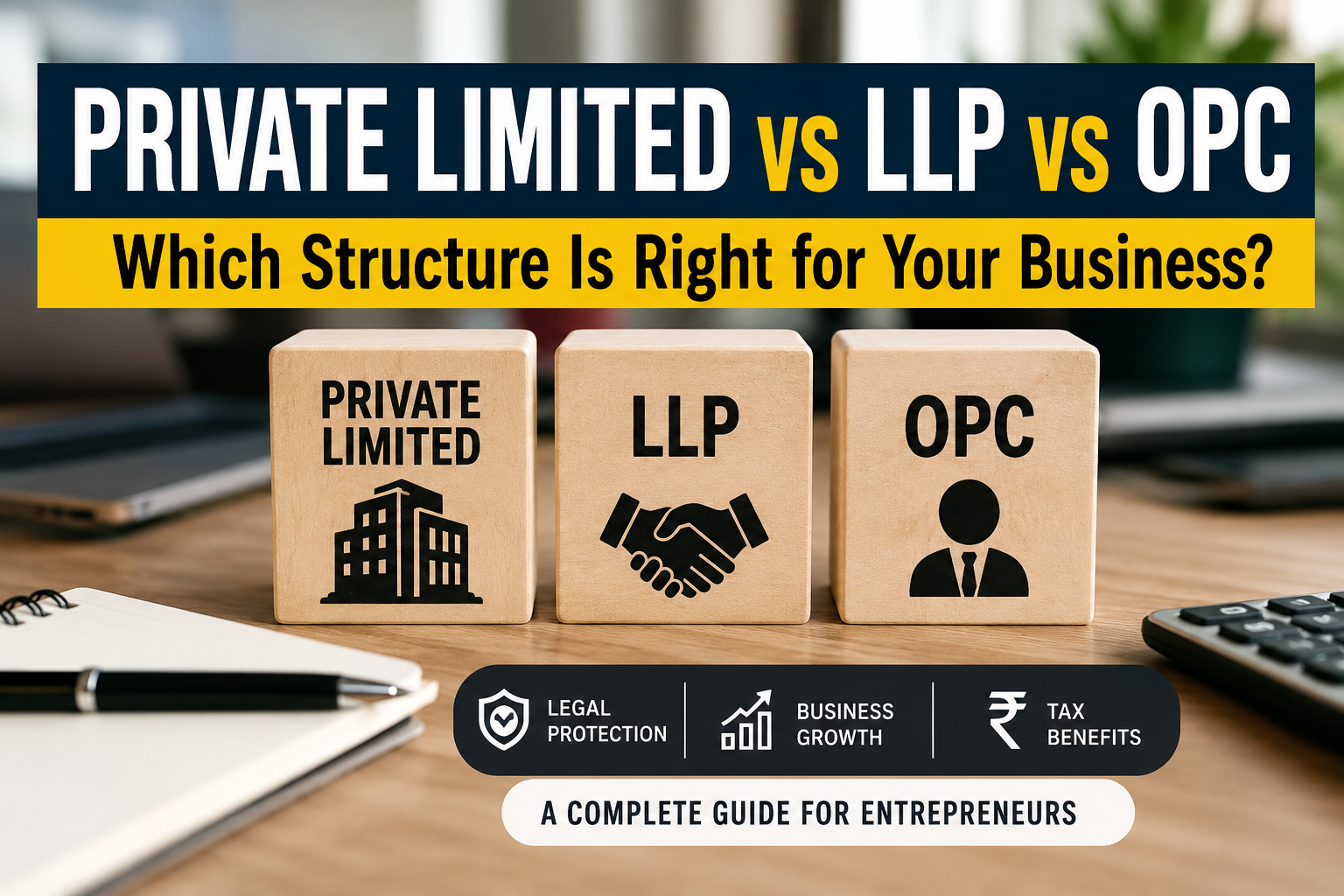
Starting a business is one of the biggest milestones in an entrepreneur's journey. Whether you're launching a technology startup, opening a retail store, starting a consultancy, or building an online business, one of the very first decisions you'll need to make is selecting the right legal structure.
Many first-time entrepreneurs in Kerala ask the same question:
Should I register my business as a Private Limited Company, a Limited Liability Partnership (LLP), or a One Person Company (OPC)?
The answer isn't always straightforward because every business has different goals, investment plans, ownership structures, and compliance requirements.
Choosing the wrong entity can lead to higher taxes, unnecessary compliance costs, difficulties in raising investment, or limitations when expanding your business. On the other hand, selecting the right structure can help protect your personal assets, improve your brand image, simplify banking, attract investors, and support long-term growth.
That's why understanding Private Limited vs LLP vs OPC is essential before registering your business.
In India, thousands of startups are registered every year under the Ministry of Corporate Affairs (MCA). While all three structures provide limited liability protection, each one is designed for different business needs.
For example:
- A tech startup planning to raise venture capital usually chooses a Private Limited Company.
- A professional consultancy or family business may benefit more from an LLP.
- A solo entrepreneur who wants the benefits of a company without partners may find an OPC to be the ideal choice.
This comprehensive guide will help you understand every aspect of Private Limited vs LLP vs OPC in simple language. Whether you're a freelancer, startup founder, trader, manufacturer, consultant, or small business owner in Kerala, you'll gain the clarity needed to make an informed decision.
By the end of this guide, you'll know:
- The differences between each business structure
- Their legal and tax implications
- Compliance requirements
- Investment opportunities
- Advantages and disadvantages
- Which option is best for your business goals
Let's begin by understanding what these business structures actually mean.
What is Private Limited vs LLP vs OPC?
The term Private Limited vs LLP vs OPC refers to a comparison of the three most popular legal business structures available for entrepreneurs in India.
Although they all offer limited liability protection, they differ significantly in ownership, compliance, taxation, management, fundraising capabilities, and legal obligations.
Understanding these differences is the first step toward building a successful business.
What is a Private Limited Company?
A Private Limited Company (Pvt Ltd) is one of the most preferred business structures for startups, growing businesses, and companies planning to raise investment.
It is incorporated under the Companies Act, 2013 and is treated as a separate legal entity from its owners.
This means the company itself can own property, enter into contracts, borrow money, and continue operating even if the shareholders change.
Key Characteristics
- Minimum 2 shareholders
- Minimum 2 directors
- Separate legal identity
- Limited liability protection
- Easy transfer of ownership
- Eligible for venture capital and angel investment
- Higher compliance requirements
Example
Imagine two software engineers in Kochi launch an AI-based SaaS company.
They expect to raise investment after one year.
Since investors generally prefer equity ownership, registering as a Private Limited Company becomes the ideal option.
What is a Limited Liability Partnership (LLP)?
An LLP (Limited Liability Partnership) combines the flexibility of a traditional partnership with the legal protection of a company.
It is governed by the Limited Liability Partnership Act, 2008.
Unlike a normal partnership, every partner enjoys limited liability, meaning personal assets remain protected if the business incurs losses or legal claims.
LLPs are particularly popular among professionals such as:
- Chartered Accountants
- Architects
- Lawyers
- Consultants
- Marketing agencies
- Design firms
- Family-owned businesses
Key Characteristics
- Minimum 2 partners
- Separate legal identity
- Limited liability
- Lower annual compliance than Private Limited
- Flexible internal management
- No shareholders
Example
Suppose two Chartered Accountants decide to open a tax consultancy in Kerala.
They don't plan to raise outside investment.
An LLP would generally provide a more practical and cost-effective structure.
What is a One Person Company (OPC)?
A One Person Company (OPC) is designed specifically for solo entrepreneurs who want the advantages of a company without needing partners.
Introduced under the Companies Act, 2013, an OPC allows a single individual to own and manage a company while enjoying limited liability protection.
This structure bridges the gap between a sole proprietorship and a Private Limited Company.
Key Characteristics
- Only one shareholder
- One director (can be the same person)
- Separate legal identity
- Limited liability
- Suitable for individual entrepreneurs
- Easier management compared to Private Limited
Example
Consider a freelance digital marketer in Kozhikode earning substantial annual revenue.
Instead of operating as a sole proprietor, registering as an OPC can improve business credibility, simplify banking, and provide better legal protection.
Quick Comparison
| Feature | Private Limited | LLP | OPC |
|---|---|---|---|
| Owners | Minimum 2 | Minimum 2 Partners | Only 1 |
| Separate Legal Entity | Yes | Yes | Yes |
| Limited Liability | Yes | Yes | Yes |
| Investors | Easy | Limited | Difficult |
| Annual Compliance | High | Moderate | Moderate |
| Suitable For | Startups & Growing Businesses | Professional Firms | Solo Entrepreneurs |
Why Choosing the Right Business Structure Matters
Choosing the correct business structure is not merely a legal formality—it is a strategic decision that can shape your company's future.
The choice you make today will influence everything from taxation and compliance to funding opportunities and business expansion.
Here are the key reasons why this decision is so important.
1. Protects Your Personal Assets
One of the biggest advantages of a registered business entity is limited liability.
If your business faces financial losses or legal disputes, your personal assets—such as your home, savings, or personal investments—are generally protected.
This is a major advantage over operating as a sole proprietorship.
2. Improves Business Credibility
Customers, banks, suppliers, and government agencies often place greater trust in registered entities.
Having "Private Limited," "LLP," or "OPC" in your business name demonstrates professionalism and commitment.
This can significantly improve your brand image.
3. Helps Raise Investment
If your long-term goal is to secure funding from angel investors, venture capital firms, or institutional investors, the right structure becomes critical.
Most investors prefer investing in Private Limited Companies because they can acquire equity shares and benefit from structured governance.
4. Affects Tax Planning
Different business structures come with different tax treatments, deductions, and compliance obligations.
Choosing wisely can help optimize tax efficiency while remaining fully compliant with Indian regulations.
5. Supports Long-Term Growth
As your business expands, you may hire employees, open new branches, enter new markets, or attract investors.
The right legal structure makes these transitions smoother and reduces the need for costly restructuring later.
6. Builds Customer Confidence
Many corporate clients prefer dealing with registered entities instead of unregistered businesses.
A recognized legal structure often becomes a deciding factor when bidding for contracts or partnering with larger organizations.
7. Ensures Legal Compliance
Registering under the appropriate business structure ensures compliance with applicable laws, reducing the risk of penalties and legal complications in the future.
Who Should Choose Which Structure?
Not every business has the same objectives.
Your ideal business structure depends on your ownership model, growth plans, funding requirements, and operational needs.
Private Limited Company is Best For
- Technology startups
- Manufacturing businesses
- Ecommerce companies
- SaaS startups
- Businesses seeking investors
- Companies planning rapid expansion
- Export-import businesses
- High-growth ventures
Example
A startup in Kochi developing AI software and planning to raise ₹2 crore in seed funding would typically benefit most from a Private Limited Company.
LLP is Best For
- Chartered Accountants
- Company Secretaries
- Lawyers
- Architects
- Doctors
- Marketing agencies
- Family businesses
- Consulting firms
Example
Two marketing professionals starting a branding agency in Malappuram can enjoy operational flexibility and lower compliance costs by registering as an LLP.
OPC is Best For
- Freelancers
- YouTubers
- Digital marketers
- Software developers
- Online sellers
- Coaches
- Trainers
- Individual consultants
- Small business owners
Example
A solo entrepreneur running a successful online education platform can establish an OPC to enhance credibility while maintaining complete ownership.
Final Thoughts for First-Time Entrepreneurs
Many entrepreneurs focus only on registration costs, but that's a short-term approach.
Instead, consider where you want your business to be in the next five years.
Ask yourself:
- Will I need investors?
- Will I add business partners?
- Will I expand across India?
- Will I require bank loans?
- Will I eventually sell my business?
Answering these questions will help determine whether a Private Limited Company, LLP, or OPC is the right fit.
Private Limited vs LLP vs OPC: Detailed Comparison
Choosing the right business structure isn't just about registration—it's about selecting a foundation that supports your business goals, protects your assets, and allows your company to grow.
In this section, we'll explore each business structure in detail and compare them across various parameters such as ownership, liability, taxation, compliance, fundraising, and suitability.
Private Limited Company Explained
A Private Limited Company (Pvt Ltd) is one of the most recognized and trusted business structures in India. It is the preferred choice for startups, technology companies, manufacturing businesses, and enterprises planning to scale rapidly.
Registered under the Companies Act, 2013, a Private Limited Company is considered a separate legal entity from its owners.
This means the company can:
- Own assets
- Sign contracts
- Borrow money
- Sue or be sued
- Continue operations even if shareholders change
Its separate legal identity provides better protection and credibility compared to unregistered businesses.
Key Features of a Private Limited Company
1. Separate Legal Entity
The company has its own legal identity, independent of its shareholders and directors.
This protects business continuity and simplifies ownership transfers.
2. Limited Liability Protection
Shareholders are liable only up to the amount they invest.
Their personal assets are generally protected from business debts.
3. Perpetual Succession
The company continues to exist even if shareholders or directors resign, retire, or pass away.
This ensures long-term stability.
4. Easy Fundraising
Private Limited Companies can issue shares to investors.
This makes them the preferred choice for:
- Angel investors
- Venture capital firms
- Private equity investors
- Startup accelerators
5. Better Business Reputation
Banks, suppliers, government agencies, and corporate clients often trust Private Limited Companies more than unregistered businesses.
This can improve business opportunities.
Advantages
- High credibility
- Easy investment opportunities
- Separate legal identity
- Limited liability
- Business continuity
- Better access to bank loans
- Easy ownership transfer
Limitations
- Higher annual compliance
- Mandatory ROC filings
- Annual financial statements
- Board meetings
- Audit requirements in many cases
- Professional accounting support is usually required
Best For
- Technology startups
- SaaS companies
- Ecommerce businesses
- Manufacturing firms
- Export businesses
- High-growth startups
- Businesses seeking investment
Example
Suppose three engineers in Kochi develop an AI-powered healthcare platform.
Within two years, they plan to raise ₹5 crore from venture capital investors.
A Private Limited Company provides the legal framework investors generally expect, making fundraising much easier.
Limited Liability Partnership (LLP) Explained
A Limited Liability Partnership (LLP) combines the flexibility of a partnership with the legal protection of a company.
It is governed by the Limited Liability Partnership Act, 2008.
Unlike traditional partnerships, LLP partners are not personally responsible for business debts beyond their agreed contribution.
This makes LLP one of the most popular business structures among professionals and service-based businesses.
Key Features of an LLP
Separate Legal Identity
The LLP is recognized as an independent legal entity.
It can own assets, enter contracts, and conduct business in its own name.
Limited Liability
Partners enjoy protection from personal liability.
If the LLP incurs losses, the partners' personal assets remain protected, except in cases of fraud or wrongful conduct.
Flexible Management
Unlike companies, LLPs offer significant flexibility in internal management.
Partners can decide:
- Profit-sharing ratio
- Decision-making process
- Management responsibilities
through the LLP Agreement.
Lower Compliance
Compared to Private Limited Companies, LLPs have fewer annual compliance requirements.
This helps reduce administrative costs.
Suitable for Professional Services
LLPs are especially popular among:
- Chartered Accountants
- Company Secretaries
- Architects
- Lawyers
- Doctors
- Marketing agencies
- Design firms
- Consultancy businesses
Advantages
- Lower compliance costs
- Flexible management
- Separate legal identity
- Limited liability
- Suitable for professional firms
- No requirement for board meetings
- Easier administration
Limitations
- Difficult to attract venture capital
- Cannot issue equity shares
- Ownership transfer is comparatively complex
- Less preferred by institutional investors
Best For
- Consulting firms
- Marketing agencies
- Accounting firms
- Family businesses
- Legal firms
- Architects
- Engineering consultants
- Small and medium enterprises
Example
Two Chartered Accountants start a tax consultancy in Malappuram.
Since they don't need outside investment and prefer minimal compliance, registering as an LLP offers the ideal balance of flexibility and legal protection.
One Person Company (OPC) Explained
A One Person Company (OPC) is designed specifically for entrepreneurs who want to run a company independently while enjoying the benefits of limited liability.
Introduced under the Companies Act, 2013, an OPC allows a single individual to incorporate a company without requiring partners.
It combines the simplicity of a sole proprietorship with the legal status of a company.
Key Features of an OPC
Single Owner
Only one shareholder is required.
This makes it perfect for solo entrepreneurs.
Separate Legal Entity
The company exists independently of its owner.
Business assets and personal assets remain separate.
Limited Liability
The owner's financial risk is limited to their investment.
Personal property generally remains protected.
Nominee Requirement
During incorporation, a nominee must be appointed.
The nominee takes over management if the sole owner becomes unable to continue.
Better Business Image
Many customers and financial institutions prefer dealing with registered companies rather than sole proprietorships.
An OPC can therefore improve credibility.
Advantages
- Single ownership
- Limited liability
- Better credibility
- Separate legal entity
- Easy incorporation
- Full management control
- Suitable for small businesses
Limitations
- Cannot have multiple shareholders
- Limited fundraising options
- Conversion may be needed when expanding ownership
- Less suitable for businesses planning rapid investment
Best For
- Freelancers
- YouTubers
- Digital marketers
- Software developers
- Trainers
- Coaches
- Online sellers
- Individual consultants
- Small business owners
Example
A freelance web developer in Kozhikode earns over ₹30 lakh annually.
Instead of operating as a sole proprietor, incorporating an OPC helps build credibility, separate personal and business finances, and prepare for future growth.
Private Limited vs LLP vs OPC: Complete Comparison Table
| Feature | Private Limited Company | LLP | OPC |
|---|---|---|---|
| Governing Law | Companies Act, 2013 | LLP Act, 2008 | Companies Act, 2013 |
| Minimum Owners | 2 | 2 Partners | 1 |
| Maximum Owners | 200 Shareholders | No fixed limit | 1 Shareholder |
| Separate Legal Entity | Yes | Yes | Yes |
| Limited Liability | Yes | Yes | Yes |
| Fundraising | Excellent | Limited | Limited |
| Equity Shares | Yes | No | No |
| Venture Capital Friendly | Yes | Rarely | Rarely |
| Compliance | High | Moderate | Moderate |
| Annual ROC Filing | Yes | Yes | Yes |
| Audit Requirements | Applicable as per law | Based on turnover/contribution thresholds | Applicable as per law |
| Business Credibility | Excellent | Very Good | Good |
| Ownership Transfer | Easy | Moderate | Difficult |
| Perpetual Succession | Yes | Yes | Yes |
| Best For | Startups & Growth Businesses | Professional Firms | Solo Entrepreneurs |
Eligibility Criteria for Each Business Structure
Private Limited Company
You should consider a Private Limited Company if:
- There are at least two promoters.
- You plan to raise investment.
- You expect rapid business growth.
- You need high credibility with customers and banks.
- You intend to issue shares in the future.
LLP
An LLP is suitable if:
- There are at least two partners.
- You operate a professional or service-based business.
- You prefer lower compliance.
- External investment is not an immediate priority.
- Partners want flexibility in management.
OPC
An OPC is ideal if:
- You are the sole owner.
- You want complete control over the business.
- You need limited liability.
- You want a more professional image than a sole proprietorship.
- You plan to expand gradually.
When Should You Choose Each Structure?
Selecting the right business structure depends on your long-term vision.
Choose a Private Limited Company if:
- You want investors.
- You expect rapid expansion.
- You plan to hire a large team.
- You intend to issue shares.
- You are building a scalable startup.
Choose an LLP if:
- You run a consultancy.
- You operate a professional firm.
- You want fewer compliance obligations.
- You don't require equity funding.
- You prefer flexible management.
Choose an OPC if:
- You're starting alone.
- You want complete ownership.
- You need legal protection.
- You plan to build credibility.
- You may convert into a Private Limited Company later as the business grows.
Which Business Structure is Best for Startups in Kerala?
There is no one-size-fits-all answer. The right choice depends on your business goals:
- Private Limited Company – Best for startups seeking investment, rapid expansion, and national or international growth.
- LLP – Ideal for professional services, agencies, consultancies, and family-run businesses that value flexibility and lower compliance.
- OPC – Perfect for solo entrepreneurs, freelancers, creators, and consultants who want company status without bringing in partners.
Before making a decision, evaluate your expected revenue, funding plans, operational complexity, and future expansion strategy. Choosing the right legal structure at the beginning can save significant time, money, and effort as your business grows.
Step-by-Step Registration Process: Private Limited vs LLP vs OPC
Registering a business in India has become much easier with the Ministry of Corporate Affairs (MCA) online registration system. While the registration process for a Private Limited Company, LLP, and OPC is similar in many respects, there are important differences in documentation, ownership requirements, and compliance.
Let's walk through the complete process.
Step 1: Decide the Right Business Structure
Before applying for registration, evaluate your business goals carefully.
Ask yourself:
- Will you start alone or with partners?
- Do you plan to raise investment?
- How quickly do you expect your business to grow?
- Do you prefer lower compliance?
- Will you require business loans in the future?
General Recommendation
- Private Limited Company – Best for startups seeking investors and long-term growth.
- LLP – Ideal for professional firms and service-based businesses.
- OPC – Best for solo entrepreneurs who want limited liability and complete ownership.
Choosing the correct structure at the beginning helps avoid costly conversions later.
Step 2: Obtain Digital Signature Certificate (DSC)
Since company registration is completed online, all proposed directors or designated partners must possess a Digital Signature Certificate (DSC).
The DSC is used to:
- Sign incorporation forms electronically
- Submit documents to MCA
- File annual compliance returns
- Authenticate legal documents
Without a valid DSC, the incorporation process cannot proceed.
Step 3: Apply for Director Identification Number (DIN)
A Director Identification Number (DIN) is mandatory for directors of a Private Limited Company and an OPC.
For LLPs, designated partners are allotted a Designated Partner Identification Number (DPIN) (now integrated with DIN through MCA processes).
The identification number remains valid for life and can be used across multiple companies or LLPs.
Step 4: Reserve the Business Name
Selecting a business name is an important step because it represents your brand identity.
The proposed name should:
- Be unique
- Not resemble an existing registered entity
- Avoid prohibited or sensitive words without approval
- Comply with MCA naming guidelines
A well-chosen name strengthens branding and reduces the chances of rejection.
Step 5: Prepare Incorporation Documents
Once the name is approved, incorporation documents must be prepared.
These include:
- Identity proofs
- Address proofs
- Registered office documents
- Consent declarations
- Constitutional documents (depending on the business structure)
Proper documentation ensures faster approval by MCA.
Step 6: File Incorporation Application
The incorporation application is filed online through the MCA portal.
Upon successful verification, the Registrar of Companies (ROC) issues:
- Certificate of Incorporation (COI)
- Corporate Identification Number (CIN) for companies
- LLP Identification Number (LLPIN) for LLPs
- PAN
- TAN
At this stage, your business becomes a legally registered entity.
Step 7: Open a Business Bank Account
After incorporation, open a dedicated current account in the business's name.
A separate business account helps:
- Maintain accurate financial records
- Build business credibility
- Simplify tax compliance
- Manage business expenses efficiently
Never mix personal and business finances.
Documents Required
Although documentation varies slightly between entities, the following documents are commonly required.
Identity Proof
Accepted documents include:
- PAN Card
- Passport (for foreign nationals, if applicable)
Why it is important:
Identity proof establishes the legal identity of directors, partners, or shareholders.
Address Proof
Accepted documents include:
- Aadhaar Card
- Passport
- Driving Licence
- Voter ID
Why it is important:
Confirms the residential address of the promoters.
Passport-Size Photographs
Recent photographs of all directors or partners are required for official records.
Registered Office Proof
Documents may include:
- Electricity Bill
- Water Bill
- Property Tax Receipt
- Rental Agreement (if rented)
- No Objection Certificate (NOC) from the property owner
Why it is important:
Verifies the official registered office address.
PAN and Aadhaar of Promoters
Mandatory for Indian residents during incorporation.
Email Address and Mobile Number
Required for:
- MCA communication
- OTP verification
- Compliance notifications
LLP Agreement (For LLP)
This document defines:
- Rights of partners
- Duties
- Profit-sharing ratio
- Capital contribution
- Management responsibilities
Memorandum of Association (MOA)
Applicable to Private Limited Companies and OPCs.
It specifies:
- Company objectives
- Authorized business activities
Articles of Association (AOA)
Defines:
- Internal rules
- Shareholder rights
- Director powers
- Company governance
Estimated Registration Costs
The total cost of registration depends on professional fees, government charges, digital signatures, and stamp duty.
Below is a general estimate:
| Business Structure | Approximate Cost (₹) |
|---|---|
| Private Limited Company | ₹8,000 – ₹20,000 |
| LLP | ₹6,000 – ₹15,000 |
| OPC | ₹7,000 – ₹18,000 |
Note: Costs vary based on:
- State stamp duty
- Number of promoters
- Authorized capital
- Professional service provider
- Additional registrations (GST, MSME, Startup India, etc.)
Annual Compliance Requirements
Compliance obligations differ significantly between business structures.
Private Limited Company
Typical annual requirements include:
- Annual Financial Statements
- Annual Return Filing
- Income Tax Return
- Board Meetings
- Statutory Registers
- Auditor Appointment (where applicable)
- ROC Compliance
Compliance is comparatively higher but supports stronger governance and investor confidence.
LLP
Annual compliance generally includes:
- Statement of Accounts & Solvency
- Annual Return
- Income Tax Return
LLPs usually involve fewer procedural requirements than companies.
OPC
Typical compliance includes:
- Annual Financial Statements
- Annual Return
- Income Tax Return
- ROC Filings
Compliance is moderate and simpler than a Private Limited Company.
Tax Comparison
Tax implications are an important factor when comparing Private Limited vs LLP vs OPC.
| Tax Parameter | Private Limited | LLP | OPC |
| Income Tax | Corporate tax applicable | LLP tax applicable | Corporate tax applicable |
| Dividend Distribution | Subject to prevailing tax rules | Not applicable | Subject to prevailing tax rules |
| GST Registration | Applicable based on eligibility | Applicable based on eligibility | Applicable based on eligibility |
| TDS Compliance | Applicable | Applicable | Applicable |
Businesses should consult a qualified tax professional to determine the most tax-efficient structure based on their industry, turnover, and future plans.
Top Benefits of Choosing the Right Business Structure
Selecting the right entity provides both legal and commercial advantages.
1. Limited Liability Protection
Protects the owners' personal assets from business liabilities.
2. Improved Business Credibility
Registered entities enjoy greater trust among customers, suppliers, and banks.
3. Easier Access to Funding
Especially true for Private Limited Companies, which are generally preferred by investors.
4. Better Banking Opportunities
Banks often provide more favorable financing options to registered businesses.
5. Legal Recognition
A registered entity can own assets, enter contracts, and enforce legal rights.
6. Business Continuity
The business can continue operating even if ownership changes.
7. Tax Planning Opportunities
Proper structuring can improve tax efficiency while remaining compliant.
8. Professional Brand Image
A registered business creates a stronger impression in the market.
9. Expansion Opportunities
The right structure makes it easier to open branches, hire employees, and enter new markets.
10. Government Scheme Eligibility
Many government incentives, tenders, and startup programs require formal business registration.
Common Mistakes to Avoid
Many first-time entrepreneurs make avoidable mistakes during registration.
Choosing the Cheapest Option
Selecting a business structure solely based on registration cost can create future limitations.
Always consider long-term business goals.
Ignoring Future Investment Plans
If you intend to raise funding later, an LLP or OPC may not be the ideal structure.
Plan ahead.
Selecting an Inappropriate Business Name
Names that resemble existing companies or violate MCA guidelines may be rejected.
Conduct proper name availability checks.
Incorrect Documentation
Incomplete or inaccurate documents often delay incorporation.
Double-check every submission before filing.
Mixing Personal and Business Finances
Maintain separate bank accounts and accounting records from the very beginning.
Ignoring Annual Compliance
Late filings can result in penalties, additional fees, and legal complications.
Maintain a compliance calendar to stay on track.
Common Challenges and Practical Solutions
Challenge: Unsure Which Structure to Choose
Solution: Evaluate ownership, funding plans, tax implications, and long-term growth objectives before deciding.
Challenge: Delays in Registration
Solution: Prepare complete documentation and ensure promoter details are accurate before submission.
Challenge: Compliance Burden
Solution: Use accounting software or work with experienced compliance professionals to manage filings efficiently.
Challenge: Raising Investment
Solution: If attracting investors is a priority, consider registering as a Private Limited Company from the outset.
Challenge: Understanding Legal Requirements
Solution: Seek guidance from qualified company registration consultants who can explain legal obligations and help avoid costly mistakes.
Key Takeaway
The registration process for a Private Limited Company, LLP, or OPC follows a structured path, but choosing the right entity requires careful planning. While registration is only the first step, ongoing compliance, taxation, governance, and future expansion should all influence your decision.
For first-time entrepreneurs in Kerala, taking the time to understand these differences can save significant time, money, and administrative effort in the years ahead.
Latest Updates, Rules, and Business Trends (2026)
India's startup ecosystem continues to evolve rapidly, making it easier than ever for entrepreneurs to register and grow their businesses. Whether you're comparing Private Limited vs LLP vs OPC, understanding the latest regulatory changes and market trends will help you make a better business decision.
1. Faster Online Business Registration
The Ministry of Corporate Affairs (MCA) has significantly improved the online incorporation process through digital filing systems. Today, most registration formalities—including Digital Signature Certificate (DSC), Director Identification Number (DIN), name reservation, and incorporation—can be completed online.
Benefits for Entrepreneurs
- Faster approval process
- Reduced paperwork
- Online document submission
- Better application tracking
- Improved transparency
This has made starting a business much more convenient, especially for first-time entrepreneurs.
2. Kerala's Startup Ecosystem Continues to Grow
Kerala has become one of India's fastest-growing startup destinations. Government initiatives, incubation centers, startup funding opportunities, and digital infrastructure have encouraged thousands of entrepreneurs to launch new ventures.
Businesses in sectors such as:
- Information Technology
- Artificial Intelligence
- Digital Marketing
- Ecommerce
- Healthcare
- Tourism
- Food Processing
- Manufacturing
are increasingly opting for formal business registration to improve credibility and access funding opportunities.
3. Increasing Focus on Corporate Compliance
Regulatory authorities continue to emphasize timely compliance with statutory obligations. Companies and LLPs that maintain proper records and submit annual filings on time benefit from:
- Stronger legal standing
- Better banking relationships
- Easier investor due diligence
- Reduced penalties
- Improved business reputation
Ignoring compliance can lead to late fees, legal notices, and unnecessary complications.
4. Investors Prefer Structured Businesses
Angel investors, venture capital firms, and financial institutions generally prefer businesses with clear ownership structures, transparent governance, and proper statutory compliance.
For businesses planning to raise investment, a Private Limited Company is usually the preferred legal structure due to its shareholding model and governance framework.
5. Digital Banking and Financial Services
Banks and fintech companies now offer specialized services for registered businesses, including:
- Current accounts
- Business credit cards
- Merchant payment solutions
- Working capital loans
- Invoice financing
- Online banking integrations
A registered business entity often finds it easier to access these financial services than an unregistered business.
Expert Tips for First-Time Entrepreneurs
Selecting the right legal structure is one of the most important decisions you'll make. Consider these practical recommendations before registering your business.
1. Don't Choose Based Only on Registration Cost
Many entrepreneurs compare only the initial registration fee. However, you should also evaluate:
- Annual compliance costs
- Tax obligations
- Accounting requirements
- Growth potential
- Investor expectations
The cheapest option today may become the most expensive later if you need to restructure your business.
2. Think About Future Expansion
Ask yourself:
- Will I need investors?
- Will I hire employees?
- Will I add business partners?
- Will I expand internationally?
- Will I open multiple branches?
Your answers will help determine the most suitable business structure.
3. Maintain Proper Financial Records
From the first day of operations:
- Record every transaction.
- Issue proper invoices.
- Keep business expenses separate.
- Maintain accounting books.
- File taxes on time.
Good financial discipline improves profitability and compliance.
4. Protect Your Brand
After registering your company, consider protecting your:
- Business name
- Logo
- Tagline
- Product names
Trademark registration prevents others from using similar branding and strengthens your intellectual property.
5. Review Compliance Regularly
Business laws and filing requirements may change over time. Conduct periodic compliance reviews to ensure your company remains legally compliant and avoids unnecessary penalties.
Frequently Asked Questions (FAQs)
1. Which is the best business structure for a startup?
A Private Limited Company is generally the preferred choice for startups planning to raise investment, issue shares, and scale rapidly. However, the right structure depends on your business model and long-term goals.
2. Is LLP better than a Private Limited Company?
An LLP is often a better option for professional firms and service-based businesses that prefer lower compliance and flexible management. A Private Limited Company is typically better for businesses seeking external funding and high growth.
3. Who should choose an OPC?
An OPC is ideal for:
- Freelancers
- Consultants
- Online sellers
- Digital marketers
- Coaches
- Trainers
- Software developers
- Solo entrepreneurs
It allows one person to own and manage a company while enjoying limited liability.
4. Can an LLP raise investment?
An LLP can raise capital from partners, but it cannot issue equity shares like a Private Limited Company. This makes large-scale fundraising more challenging.
5. Can an OPC become a Private Limited Company?
Yes. As the business grows and additional shareholders are introduced, an OPC can be converted into a Private Limited Company following the applicable legal procedures.
6. Which structure has the lowest compliance?
Among the three, LLPs generally have simpler compliance requirements than Private Limited Companies. OPCs have moderate compliance obligations.
7. Which structure is best for technology startups?
Technology startups planning to seek angel or venture capital funding generally prefer a Private Limited Company because investors are familiar with its ownership and governance model.
8. Is GST registration compulsory after company registration?
No. GST registration depends on factors such as turnover, business activity, interstate supplies, and applicable legal provisions. Registering a company does not automatically require GST registration.
9. How long does company registration take?
The timeline depends on documentation, approvals, and processing by the Registrar of Companies. Providing complete and accurate documents helps avoid delays.
10. Can I change my business structure later?
Yes. Businesses can convert from one legal structure to another when their operational needs or growth plans change, subject to applicable legal procedures.
Key Takeaways
Here's a quick summary to help you decide:
| Business Requirement | Recommended Structure |
|---|---|
| Startup seeking investors | Private Limited Company |
| Technology company | Private Limited Company |
| Manufacturing business | Private Limited Company |
| Ecommerce business | Private Limited Company |
| Professional consultancy | LLP |
| CA, CS, or Legal firm | LLP |
| Marketing agency | LLP |
| Family-owned business | LLP |
| Freelancer | OPC |
| Digital creator | OPC |
| Online consultant | OPC |
| Solo entrepreneur | OPC |
Choosing between Private Limited vs LLP vs OPC is more than a legal formality—it is a strategic decision that influences your business's future. The right structure can help you reduce risk, build credibility, improve tax planning, attract investors, and support long-term growth.
If your vision is to build a scalable startup and raise investment, a Private Limited Company is generally the strongest option.
If you operate a consultancy, agency, or professional practice and value operational flexibility with comparatively lower compliance, an LLP is often the ideal choice.
If you're a freelancer, consultant, or solo entrepreneur who wants complete ownership with limited liability, an OPC provides an excellent foundation.
Before making your decision, evaluate your business goals, expected revenue, funding plans, and future expansion strategy. Choosing the right structure today can save significant time, money, and administrative effort in the years ahead.
Need Expert Assistance?
Registering a business involves more than submitting forms. Selecting the right entity, preparing documentation, understanding compliance requirements, and planning for future growth all require careful consideration.
Clockwell International LLP offers professional assistance with:
- Private Limited Company Registration
- LLP Registration
- One Person Company (OPC) Registration
- GST Registration
- MSME Registration
- Startup India Registration
- Trademark Registration
- Digital Signature Certificate (DSC)
- ROC Annual Compliance
- Accounting & Bookkeeping
- Tax Filing and Advisory
- Business Consulting
Whether you're a first-time entrepreneur or an established business owner, our experts can help you choose the right structure and complete the registration process smoothly.
Contact Clockwell International LLP today and build your business on a strong legal foundation.
Published on June 29, 2026