
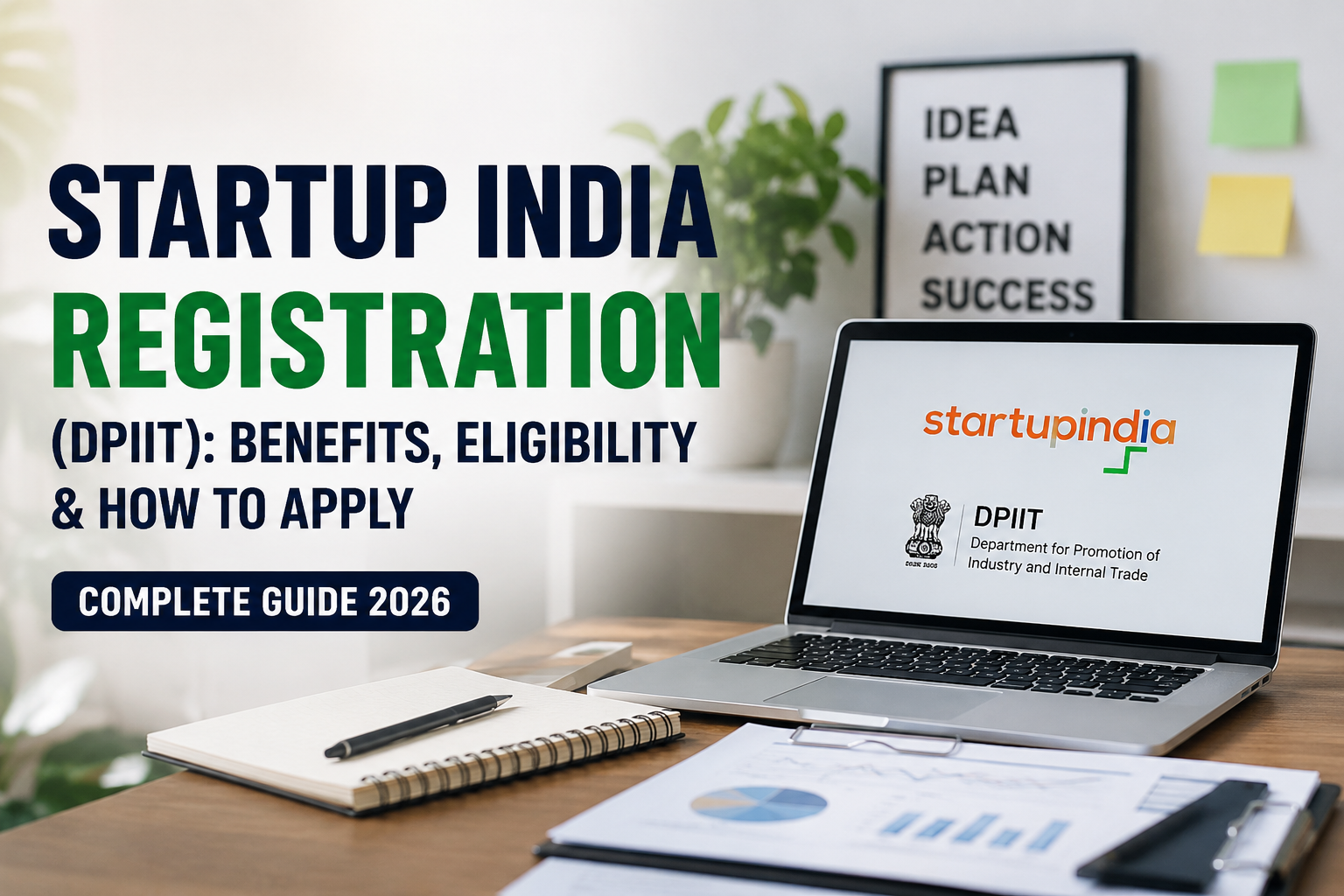
India has become one of the world's fastest-growing startup ecosystems. Thousands of entrepreneurs launch innovative businesses every year, but many miss out on government benefits simply because they haven't completed Startup India Registration.
If you're building a scalable business, registering under the Startup India initiative can unlock tax exemptions, funding opportunities, easier compliance, intellectual property benefits, and government support.
This comprehensive guide explains everything you need to know about Startup India Registration (DPIIT Recognition), including eligibility, benefits, documents required, registration steps, and common mistakes to avoid.
What is Startup India?
Startup India is a flagship initiative launched by the Government of India in 2016 to encourage innovation, entrepreneurship, employment generation, and economic growth.
The initiative is managed by the Department for Promotion of Industry and Internal Trade (DPIIT) under the Ministry of Commerce & Industry.
Once your business receives DPIIT Recognition, it becomes an officially recognized startup eligible for various government schemes and incentives.
What is DPIIT Recognition?
DPIIT Recognition is an official certification issued by the Government of India confirming that your business qualifies as an eligible startup under the Startup India scheme.
It is not the same as company registration.
Many businesses confuse these two.
Company Registration
This establishes your legal business entity.
Examples include:
- Private Limited Company
- Limited Liability Partnership (LLP)
- Registered Partnership Firm
DPIIT Recognition
This provides government startup recognition and access to Startup India benefits.
You first register your business, then apply for DPIIT Recognition.
Why Should You Register Under Startup India?
DPIIT-recognized startups receive several advantages that help reduce costs and accelerate business growth.
1. Income Tax Exemption
Eligible startups can apply for tax exemption under Section 80-IAC for three consecutive financial years out of ten years, subject to applicable conditions and approvals.
This helps startups save significant amounts during their early growth stage.
2. Self-Certification for Labour and Environmental Laws
Recognized startups can self-certify compliance under selected labour and environmental laws, reducing the compliance burden during the initial years.
3. Fast-Track Patent Examination
Innovation is valuable.
The Startup India scheme offers:
- Fast-track patent examination
- Reduced patent filing fees
- Government support through facilitators
This helps startups protect their intellectual property quickly.
4. Trademark Benefits
Startups receive assistance and reduced professional costs for trademark filing through the Startup India ecosystem, helping protect their brand identity at an early stage.
5. Easier Access to Government Tenders
Normally, government tenders require prior experience and turnover.
Recognized startups may receive relaxations for certain government procurement opportunities, making it easier to compete.
6. Better Funding Opportunities
DPIIT-recognized startups become more attractive to:
- Angel Investors
- Venture Capital Firms
- Incubators
- Accelerators
- Government Funding Schemes
Recognition enhances business credibility.
7. Fund of Funds Support
The Government has established a Fund of Funds to support startups through SEBI-registered Alternative Investment Funds (AIFs), rather than investing directly in startups.
8. Networking Opportunities
Registered startups gain access to:
- Startup events
- Mentorship
- Investor connects
- Industry experts
- Government programs
- Incubation centres
9. Improved Brand Credibility
Displaying DPIIT Recognition helps build trust among:
- Customers
- Investors
- Banks
- Business partners
- Vendors
It demonstrates that your startup has been officially recognized by the Government of India.
Who Can Apply for Startup India Registration?
Not every business qualifies.
Your business must satisfy the eligibility conditions prescribed by DPIIT.
Eligible Business Structures
You can apply if your business is registered as:
- Private Limited Company
- Limited Liability Partnership (LLP)
- Registered Partnership Firm
Sole proprietorships are generally not eligible for DPIIT startup recognition.
Startup India Eligibility Criteria
Your business should generally meet the following conditions:
1. Age of Business
The startup should not have completed 10 years from the date of incorporation or registration.
2. Annual Turnover
The annual turnover should not have exceeded ₹100 crore in any financial year since incorporation.
3. Innovation
The business should be:
- Innovative
- Technology-driven
- Solving a real-world problem
- Developing or improving products or services
- Creating scalable business models with employment or wealth generation potential
4. Original Entity
The business should not have been formed by splitting up or reconstructing an existing business.
Documents Required
Generally, you will need:
- Certificate of Incorporation or LLP Registration
- PAN of the Company/LLP
- Details of Directors or Partners
- Business Address Proof
- Brief description of the business
- Website (if available)
- Pitch Deck (optional but useful)
- Information about innovation or scalability
- Funding details (if applicable)
Step-by-Step Startup India Registration Process
Step 1: Register Your Business
First, establish a legal entity:
- Private Limited Company
- LLP
- Partnership Firm
Step 2: Obtain PAN
Ensure your business has a valid PAN.
Step 3: Prepare Startup Details
Gather information such as:
- Business activities
- Products
- Innovation
- Market opportunity
- Business model
Step 4: Apply for DPIIT Recognition
Submit your application through the Startup India portal by providing the required business details and supporting information.
Step 5: Verification
The authorities review the submitted information.
Additional clarification may be requested if required.
Step 6: Receive Recognition Certificate
Once approved, you receive your DPIIT Recognition Certificate.
Your startup can then access eligible Startup India benefits.
Common Mistakes to Avoid
Many applications are delayed because of avoidable mistakes.
These include:
- Choosing the wrong business structure
- Providing incomplete business descriptions
- Failing to explain innovation clearly
- Uploading incorrect documents
- Entering inaccurate company information
- Applying before completing company registration
Startup India vs Company Registration
| Company Registration | Startup India Registration |
|---|---|
| Creates legal entity | Government recognition |
| Mandatory for incorporation | Optional but highly beneficial |
| Issued by MCA or relevant authority | Issued through DPIIT |
| Allows business operations | Unlocks Startup India benefits |
Who Should Apply?
Startup India Registration is ideal for:
- Technology startups
- SaaS companies
- E-commerce businesses
- Manufacturing startups
- Healthcare startups
- Agritech businesses
- Fintech companies
- EdTech startups
- AI startups
- Green energy businesses
- Food startups
- Logistics companies
Can Existing Companies Apply?
Yes.
An already incorporated company can apply if it meets the DPIIT eligibility criteria.
Many businesses register months or even years after incorporation.
Is Startup India Registration Free?
There is generally no government fee for obtaining DPIIT recognition itself. However, costs may arise for business incorporation, professional assistance, or related registrations such as trademarks, depending on your requirements.
How Long Does the Registration Take?
Processing time depends on the completeness of the application and the review process. Correct documentation and accurate information help avoid delays.
Why Professional Assistance Matters
Although the application process is straightforward, many startups face delays because they:
- Misinterpret eligibility requirements
- Provide weak innovation descriptions
- Submit incomplete documentation
- Select the wrong business structure
- Miss opportunities to claim available benefits
Professional guidance helps ensure your application is accurate, complete, and aligned with the Startup India framework.
How Clockwell Can Help
At Clockwell, we assist entrepreneurs throughout the Startup India journey.
Our services include:
- Business registration
- Private Limited Company incorporation
- LLP registration
- Startup India (DPIIT) Registration
- PAN & compliance assistance
- GST Registration
- Trademark Registration
- Accounting & Bookkeeping
- Annual ROC Compliance
- Tax Filing Support
- Business Advisory
Whether you're launching your first startup or scaling an existing business, our experts can guide you through every stage.
Frequently Asked Questions (FAQs)
Is Startup India Registration mandatory?
No. It is optional, but it provides significant benefits for eligible startups.
Can an LLP apply?
Yes. LLPs are eligible if they satisfy the DPIIT conditions.
Can a Partnership Firm apply?
Yes. Registered Partnership Firms can also apply.
Is a Proprietorship eligible?
No. Sole proprietorships are generally not eligible for DPIIT Startup Recognition.
Is GST registration mandatory?
Not specifically for DPIIT recognition. However, GST registration may be mandatory depending on your business activities and applicable tax laws.
Does Startup India provide direct funding?
Not automatically. Recognition improves access to investors, government schemes, incubators, and the Fund of Funds ecosystem.
Startup India Registration is one of the most valuable government initiatives available to entrepreneurs in India. Beyond recognition, it provides access to tax incentives, intellectual property support, networking opportunities, funding ecosystems, and easier compliance.
If your business is innovative and has the potential to scale, obtaining DPIIT Recognition is a strategic step toward long-term growth.
Whether you are just starting your entrepreneurial journey or expanding an existing venture, registering under Startup India can strengthen your credibility and help you take advantage of the support designed specifically for India's startup ecosystem.
Published on July 7, 2026