

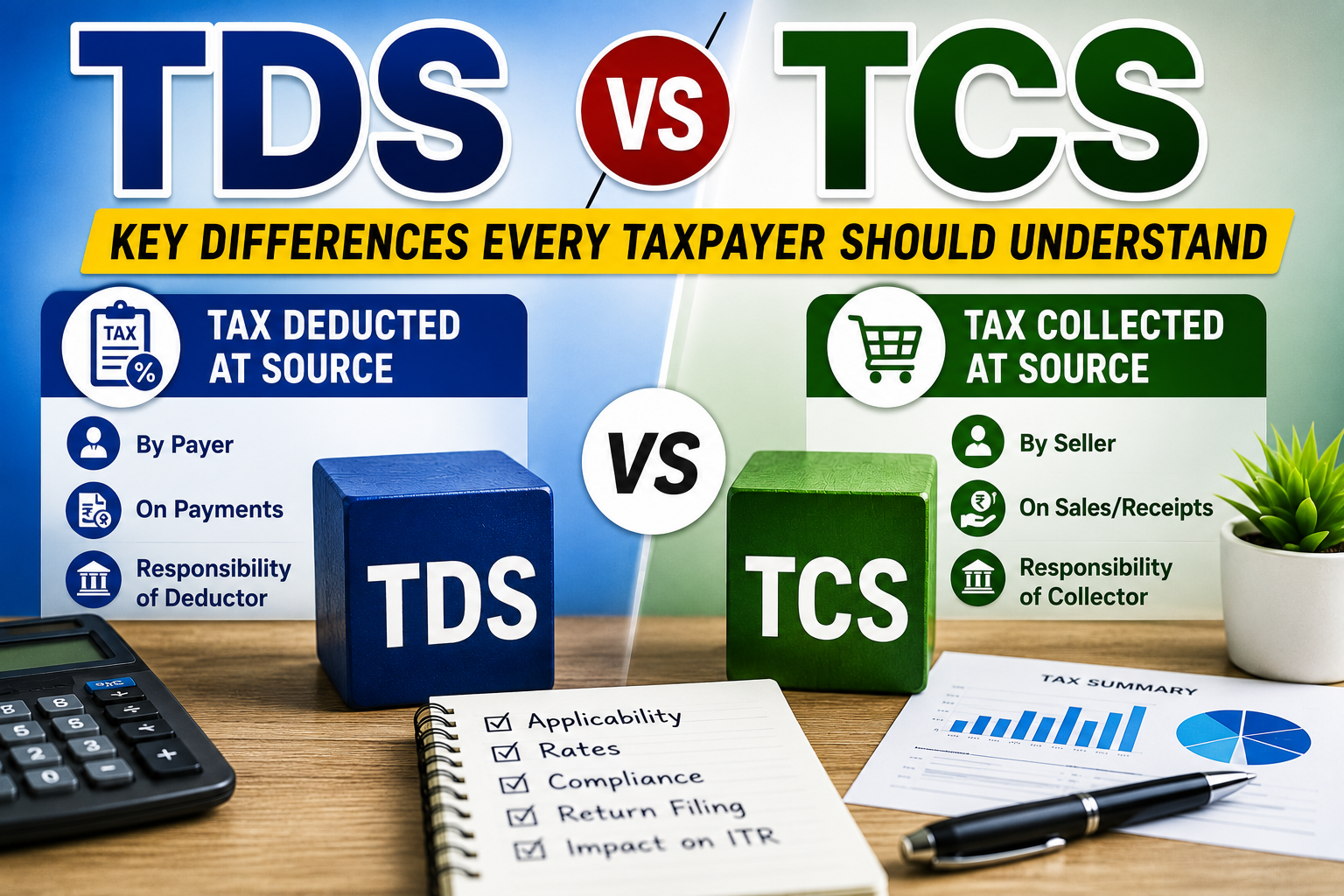
Many taxpayers and business owners often confuse TDS (Tax Deducted at Source) and TCS (Tax Collected at Source). While both are important components of India's tax system, they apply in different situations and have different compliance requirements.
Understanding the difference between TDS and TCS is essential for businesses, professionals, and taxpayers to ensure proper compliance and avoid penalties.
This guide explains TDS and TCS in simple terms, highlights their key differences, and helps you understand when each applies.
What is TDS?
TDS stands for Tax Deducted at Source.
Under the TDS system, the person making a payment deducts tax before paying the recipient and deposits it with the government.
Common Transactions Covered Under TDS:
- Salary payments
- Professional fees
- Rent payments
- Contractor payments
- Interest income
- Commission and brokerage
The recipient receives the payment after TDS deduction.
What is TCS?
TCS stands for Tax Collected at Source.
Under the TCS system, the seller collects tax from the buyer at the time of sale and deposits it with the government.
Common Transactions Covered Under TCS:
- Sale of specified goods
- Scrap sales
- Foreign remittances
- Overseas tour packages
- Sale of goods above prescribed limits
The buyer pays the tax along with the purchase amount.
Key Difference Between TDS and TCS
| Particulars | TDS | TCS |
|---|---|---|
| Full Form | Tax Deducted at Source | Tax Collected at Source |
| Collected By | Payer | Seller |
| Applicable On | Payments | Sales/Receipts |
| Responsibility | Deductor | Collector |
| Example | Salary, Rent, Professional Fees | Sale of Goods, Foreign Remittance |
| Return Forms | 24Q, 26Q, 27Q | 27EQ |
How TDS Works
Let's assume a business pays a consultant ₹1,00,000.
Process:
- TDS is deducted at applicable rate
- Consultant receives the balance amount
- Business deposits TDS with government
- Consultant claims TDS credit while filing ITR
This helps the government collect tax at the source of income.
How TCS Works
Suppose a seller sells goods subject to TCS.
Process:
- Seller collects TCS from buyer
- Buyer pays invoice amount plus TCS
- Seller deposits TCS with government
- Buyer claims TCS credit while filing ITR
TCS acts as advance tax collection.
Why TDS and TCS Are Important
Both systems help:
- Improve tax compliance
- Reduce tax evasion
- Track financial transactions
- Ensure timely tax collection
- Increase transparency
These mechanisms strengthen India's tax administration system.
Common TDS Compliance Requirements
Businesses responsible for TDS must:
- Deduct TDS correctly
- Deposit tax on time
- File quarterly TDS returns
- Issue TDS certificates
- Maintain proper records
Failure to comply may result in penalties and notices.
Common TCS Compliance Requirements
Businesses responsible for TCS must:
- Collect TCS where applicable
- Deposit TCS within due dates
- File TCS returns
- Issue TCS certificates
- Maintain transaction records
Strong recordkeeping is essential.
How to Check TDS and TCS Credits
Taxpayers can verify credits through:
Form 26AS
Shows:
- TDS deducted
- TCS collected
- Tax payments
AIS (Annual Information Statement)
Provides detailed tax-related information.
Always reconcile tax credits before filing your income tax return.
Common Mistakes Businesses Make
TDS Mistakes:
- Wrong deduction rates
- Late deposits
- Incorrect PAN details
- Missing return filings
TCS Mistakes:
- Failure to collect TCS
- Wrong TCS rates
- Incorrect reporting
- Delayed return filing
These mistakes often trigger notices and penalties.
Impact on Income Tax Return
Both TDS and TCS are reflected in:
- Form 26AS
- AIS
- Income Tax Portal
Taxpayers can claim credit while filing their Income Tax Return.
Proper reconciliation helps avoid refund delays and notices.
How Clockwell Can Help
Managing TDS and TCS compliance can be challenging for businesses.
Clockwell provides:
- TDS filing services
- TCS compliance support
- Accounting and bookkeeping
- Tax planning and advisory
- Notice handling assistance
Our experts help businesses stay compliant and avoid costly mistakes.
Although TDS and TCS serve the same purpose of tax collection, they apply to different types of transactions and involve different compliance responsibilities.
Understanding the difference between TDS and TCS helps businesses maintain compliance, avoid penalties, and manage taxes more effectively.
Proper recordkeeping, timely filing, and professional guidance can make TDS and TCS compliance simple and stress-free.
Published on June 9, 2026