

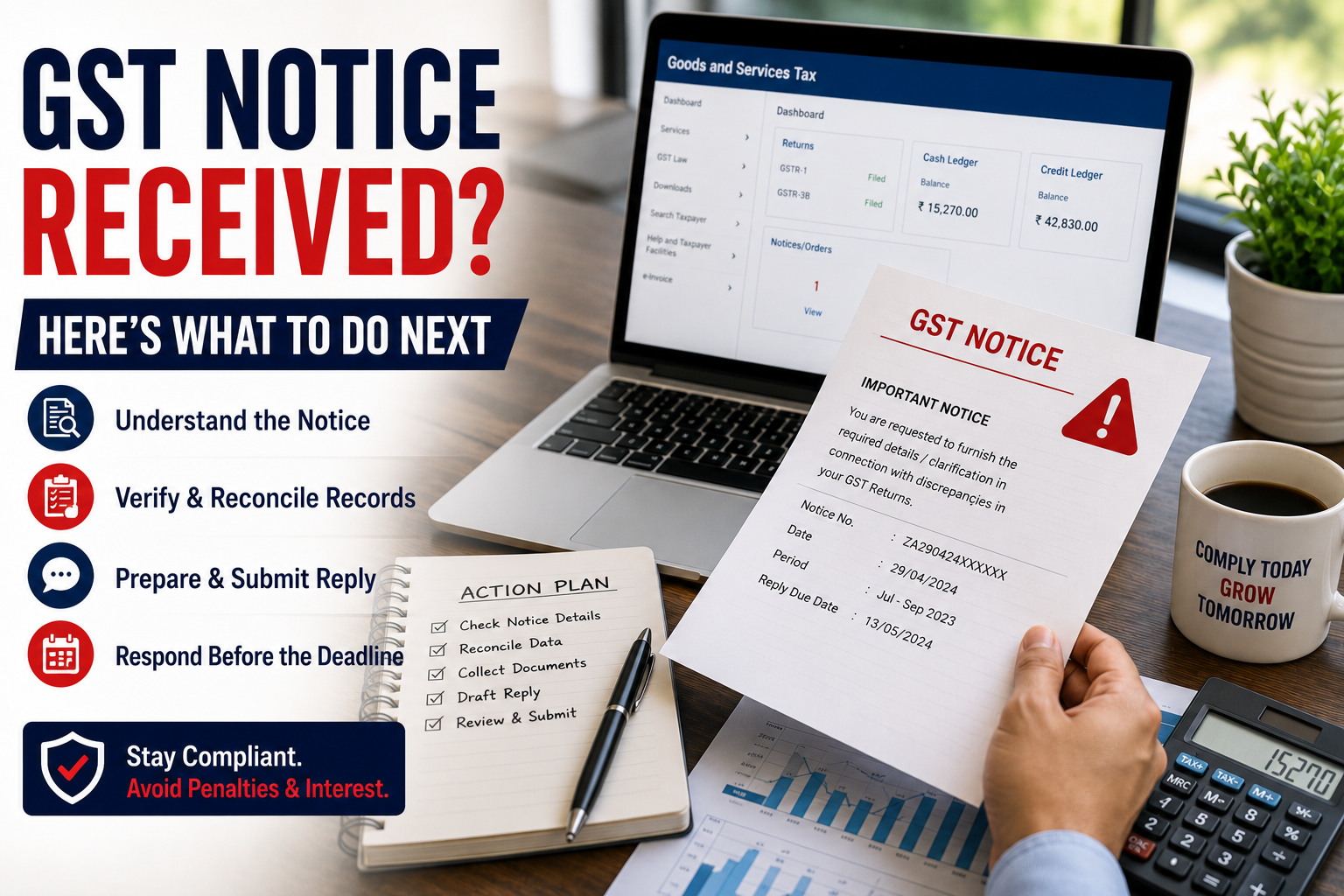
A GST notice is an official communication from the GST authorities asking a taxpayer to provide information, explain a discrepancy, pay an amount, or take a particular compliance action.
The nature of the notice depends on the issue identified by the department.
For example, a notice may relate to:
- GST return discrepancies
- Difference between GSTR-1 and GSTR-3B
- Input Tax Credit (ITC)
- Tax liability
- Interest
- Refund claims
- Registration
- Classification or tax rate
- Non-filing of returns
- Scrutiny of returns
- GST audit
- Other compliance matters
Therefore, the first step is to identify exactly what the department is asking you to explain or do.
Don't Panic After Receiving a GST Notice
The word "notice" can sound serious, but not every GST notice represents a final tax demand.
Some communications simply seek clarification or additional information.
For example, under the GST return-scrutiny procedure, where a discrepancy is identified, the proper officer can issue FORM GST ASMT-10 and seek an explanation from the registered person. The taxpayer can respond through FORM GST ASMT-11, and if the explanation is accepted, the officer can issue FORM GST ASMT-12.
The important point is:
Do not ignore the notice, and don't assume the amount mentioned is automatically payable.
Step 1: Verify the Notice
Before taking any action, verify the notice carefully.
Check:
- GSTIN
- Legal name of the business
- Tax period
- Notice/reference number
- Date of issue
- Issuing authority
- Section/rule mentioned
- Reason for the notice
- Amount involved, if any
- Reply deadline
- Documents requested
Also check the notice through the official GST portal rather than relying only on an email or message.
Step 2: Understand the Type of Notice
Different GST notices require different responses.
For example, a return-scrutiny notice may relate to a discrepancy identified by the department.
A refund-related notice can follow a different process. For example, under the refund rules, a notice in FORM GST RFD-08 can require a taxpayer to submit a reply in FORM GST RFD-09 within the prescribed period.
Similarly, demand-related proceedings can involve forms such as DRC-01, while replies to notices covered by the relevant rule may be furnished in DRC-06.
So don't use a generic reply for every GST notice.
Step 3: Check the Deadline
This is one of the most important steps.
Look at the notice and identify the exact date by which the response must be submitted.
Don't wait until the final day.
A delayed response can make the situation more complicated, particularly when the notice involves a tax demand or an opportunity to explain a discrepancy.
Create a simple compliance tracker:
| Particular | Details |
|---|---|
| Notice Date | As mentioned in notice |
| Notice Type | Example: Scrutiny |
| Tax Period | Relevant period |
| Issue | ITC / Tax / Return discrepancy |
| Reply Due Date | As specified |
| Documents Required | Supporting records |
| Status | Pending / Submitted |
| ARN/Reference | After submission |
Step 4: Identify the Exact Discrepancy
Don't immediately start drafting a reply.
First understand why the notice was issued.
For example, if the department says there is a difference between GSTR-1 and GSTR-3B, compare the relevant figures.
If the issue concerns ITC, review:
- Purchase invoices
- GSTR-2B
- Purchase register
- GSTR-3B
- Supplier details
- Credit notes
- Debit notes
- Payment records
- Accounting entries
The objective is to determine whether the discrepancy is:
Correct → Accept and comply
or
Incorrect → Explain and provide evidence
Step 5: Reconcile Your GST Records
A proper reconciliation can often explain apparent discrepancies.
Compare your:
Sales
- Sales register
- GSTR-1
- GSTR-3B
- E-invoice data, where applicable
- E-way bill records, where relevant
Purchases
- Purchase register
- GSTR-2B
- GSTR-3B
- Supplier invoices
- Credit/debit notes
Tax Payments
- GSTR-3B
- Electronic cash ledger
- Electronic credit ledger
- DRC payments, where applicable
This process helps identify whether the issue is a genuine tax error or simply a timing/reconciliation difference.
Step 6: Collect Supporting Documents
A strong GST response should be supported by evidence wherever relevant.
Depending on the issue, documents may include:
- Tax invoices
- Purchase invoices
- Sales invoices
- Credit notes
- Debit notes
- Bank statements
- E-way bills
- E-invoices
- GSTR-1
- GSTR-3B
- GSTR-2B
- Purchase register
- Sales register
- Ledger extracts
- Payment records
- Reconciliation statements
- Agreements or contracts
Don't upload irrelevant documents simply to make the response longer.
Submit documents that directly support your explanation.
Step 7: Determine Whether the Difference Is Genuine
After reconciliation, there are generally three possibilities.
Situation 1: The Department Is Correct
If your records show that additional tax, interest, or another amount is genuinely payable, assess the applicable legal provisions and payment options.
For certain demand-related situations, the GST rules provide mechanisms for payment through FORM GST DRC-03 and submission of relevant details.
Situation 2: The Difference Is Due to a Timing or Reporting Issue
Sometimes a discrepancy can arise because transactions were reported in different periods.
For example:
- Invoice reported in a later period
- Amendment made subsequently
- Credit note reported separately
- Tax paid in an earlier period
- Reporting differences between returns and books
These situations should be explained clearly with reconciliation evidence.
Situation 3: The Department's Observation Is Incorrect
If the tax department's calculation or interpretation does not match your records, prepare a clear response explaining:
- What the notice alleges
- What your records show
- Why the difference exists
- Supporting documents
- The specific relief/request being made
Avoid emotional or vague explanations.
Step 8: Prepare a Clear GST Reply
A good GST reply should be structured, factual, and supported by documents.
A practical format is:
1. Notice Reference
Mention the notice number, date, GSTIN, and relevant tax period.
2. Issue Raised
Clearly state what discrepancy or issue has been identified.
3. Taxpayer's Explanation
Explain your position using relevant facts and records.
4. Reconciliation
Where applicable, provide a table showing the difference.
5. Supporting Documents
List the documents attached.
6. Conclusion
Clearly state what you are requesting from the department.
For example:
"Based on the reconciliation and supporting documents enclosed, we request that the discrepancy may kindly be treated as reconciled and the proceedings may be concluded."
The exact wording should depend on the facts and legal provisions applicable to the case.
Example of a GST Reconciliation
Suppose the notice identifies a ₹2,00,000 difference in taxable turnover.
Your reconciliation might look like:
| Particular | Amount |
|---|---|
| Turnover as per Books | ₹50,00,000 |
| Turnover reported in GSTR-1 | ₹48,00,000 |
| Difference | ₹2,00,000 |
| Reason | Invoice reported in subsequent period |
| Tax Paid | ₹36,000 |
| Supporting Document | Subsequent GSTR-1 + invoice |
This makes it easier for the officer to understand the explanation.
Step 9: Submit the Reply Through the Proper Channel
Follow the filing method specified in the notice.
Where the GST system provides an online response facility, submit the reply through the GST portal and retain:
- ARN/reference number
- Filed reply
- Uploaded documents
- Acknowledgement
- Screenshots, where useful
The GST portal provides online facilities for various applications and responses, while the exact workflow depends on the type of notice.
Step 10: Keep Proof of Submission
Never assume that uploading a reply is enough.
Save:
- Final submitted reply
- Acknowledgement
- ARN/reference number
- Supporting documents
- Notice copy
- Payment challans, if applicable
- Correspondence with the department
Create a separate folder for each GST notice.
What If You Made a Genuine GST Mistake?
Don't try to hide it.
If your reconciliation confirms that there is a genuine tax shortfall or compliance error, assess the applicable provisions and take corrective action.
Depending on the situation, this could involve:
- Payment of tax
- Interest
- Applicable penalty
- DRC-03 payment
- Corrective reporting, where permitted
- Submission of an explanation
The correct approach depends on the type of error and the applicable GST provisions.
What If You Disagree With the Demand?
If the department ultimately passes an adverse order and you believe the demand is incorrect, the GST framework provides an appeal mechanism.
The GST portal provides a facility for filing an appeal against a demand order through FORM GST APL-01.
However, an appeal is different from replying to a notice.
Don't wait until an order is passed if the notice itself requires a response.
Common GST Notice Mistakes to Avoid
1. Ignoring the Notice
This is perhaps the biggest mistake.
Even if you believe the notice is incorrect, respond within the applicable timeline.
2. Sending a Generic Reply
A reply that simply says:
"We have complied with GST rules."
is unlikely to properly address a specific discrepancy.
Respond to each issue individually.
3. Providing No Reconciliation
If the notice involves a numerical difference, show the calculation.
Numbers should be supported by a reconciliation wherever possible.
4. Uploading Unorganized Documents
Sending dozens of documents without explaining their relevance can make the response difficult to evaluate.
Create an index and refer to each document appropriately.
5. Ignoring the Accounting Records
Don't prepare the response only from the GST portal.
Compare the notice with your:
- Books
- Ledgers
- Invoices
- Bank statements
- Tax records
6. Paying Immediately Without Checking the Issue
If you receive a notice showing a tax amount, don't automatically assume that the entire amount is payable.
First understand:
- Calculation
- Tax period
- Basis of demand
- Interest
- Penalty
- Your records
- Applicable legal provisions
When Should You Consult a GST Professional?
Professional assistance is particularly useful when the notice involves:
- Large tax demands
- ITC disputes
- Multiple tax periods
- Classification disputes
- Alleged suppression or fraud
- Penalty proceedings
- GST audit observations
- Registration cancellation
- Refund rejection
- Repeated notices
- Appeal proceedings
A tax professional can review the notice, reconcile the underlying records, identify the applicable provisions, and help prepare a fact-based response.
How to Prevent Future GST Notices
The best way to deal with a GST notice is to reduce avoidable discrepancies before they happen.
Businesses should regularly perform:
GSTR-1 vs GSTR-3B Reconciliation
Check outward liability and tax payment.
GSTR-2B vs Purchase Register Reconciliation
Review eligible ITC and supplier reporting.
Books vs GST Returns
Ensure accounting records agree with filed returns.
GST vs E-Invoice Data
Where applicable, identify reporting differences.
GST vs E-Way Bill Data
Review significant discrepancies where relevant.
Regular Ledger Review
Identify incorrect tax classifications and accounting entries.
A Simple GST Compliance Checklist
Before filing each return, review:
- Sales register reconciled
- Purchase register updated
- GSTR-1 reviewed
- GSTR-3B reviewed
- GSTR-2B reconciled
- ITC reviewed
- Credit/debit notes checked
- E-invoices reconciled, where applicable
- E-way bills reviewed, where relevant
- Tax payment verified
- Books reconciled with GST returns
Consistent reconciliation can significantly reduce the chances of avoidable discrepancies.
How Clockwell Can Help
At Clockwell, we help businesses handle GST compliance and respond to tax-related issues with a structured, documentation-driven approach.
Our services include:
- GST Registration
- GST Return Filing
- GST Reconciliation
- GSTR-2B & ITC Reconciliation
- GST Notice Response
- GST Audit Support
- GST Advisory
- Tax Planning
- Income Tax Filing
- Accounting & Bookkeeping
- Financial Reporting
- Business Advisory
- Virtual CFO Services
If your business has received a GST notice, our team can help review the issue, reconcile the relevant records, organize supporting documents, and prepare an appropriate response based on the facts and applicable provisions.
Receiving a GST notice does not mean you should panic. It means you need to understand what the tax department is asking and respond appropriately.
The right approach is simple:
Read → Verify → Reconcile → Document → Respond → Track
Don't ignore the notice. Don't submit a generic explanation. And don't make a payment simply because an amount appears in the notice without first understanding the basis of the demand.
Maintain regular GST reconciliations, accurate accounting records, and proper documentation throughout the year. These practices not only make notice handling easier but also strengthen your overall tax compliance.
If the notice involves a significant tax amount, ITC dispute, audit, penalty, or complex legal issue, getting professional tax advice early can help you respond more effectively and protect your business interests.
Published on August 17, 2026