
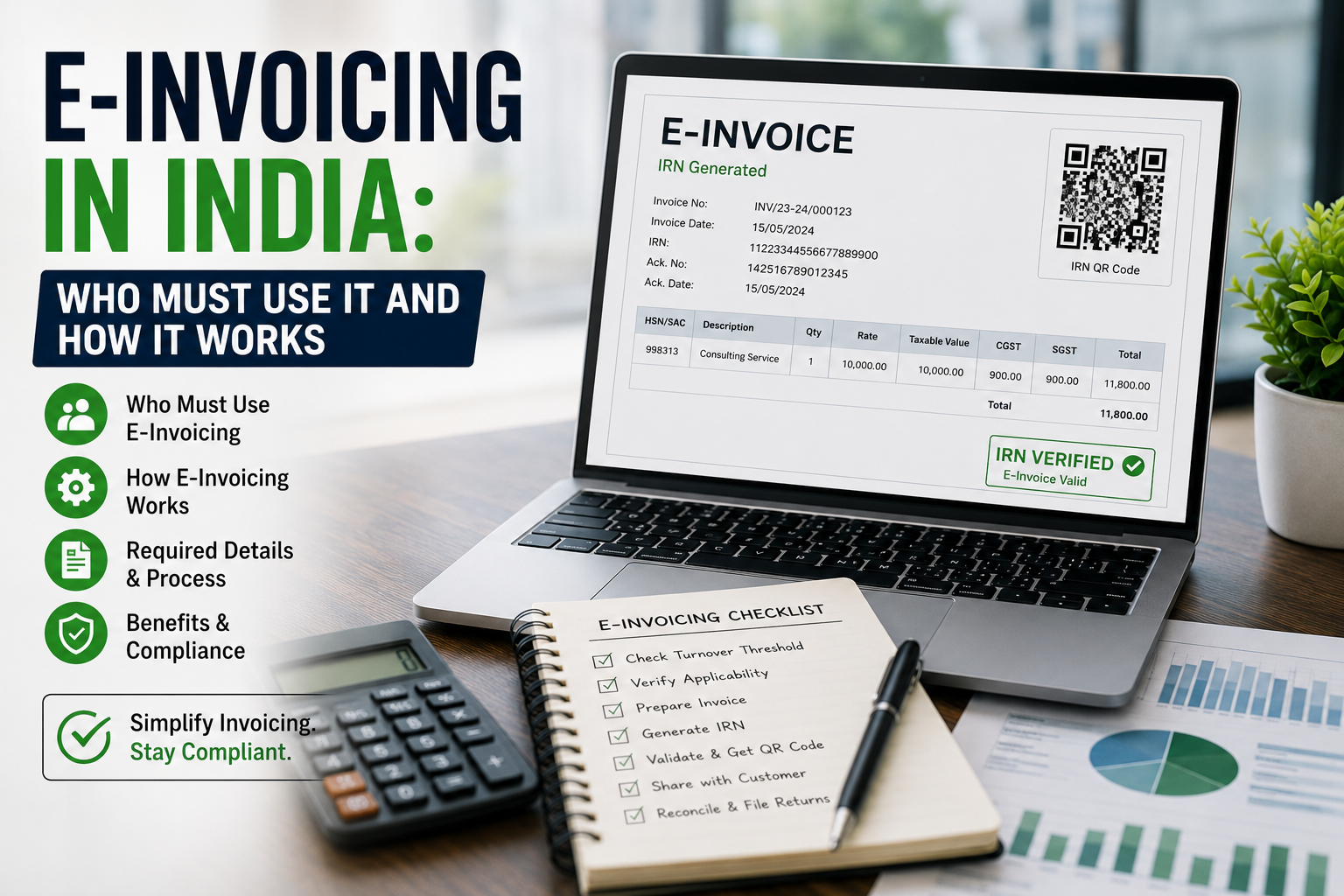
E-invoicing does not mean that the government creates your invoice for you.
Under the GST system, a business continues to prepare its invoice using its accounting or ERP software. The specified invoice information is then reported to an Invoice Registration Portal (IRP).
After successful validation, the IRP generates:
- Invoice Reference Number (IRN)
- Digitally signed invoice information
- QR code
The GSTN's official guidance specifically explains that e-invoicing means reporting specified GST documents to an IRP and obtaining an IRN; it is not the generation of the invoice itself by a government portal.
Who Must Use E-Invoicing in India?
The current e-invoicing threshold is ₹5 crore or more of aggregate annual turnover (AATO), applicable from 1 August 2023 under Notification No. 10/2023–Central Tax.
The threshold is assessed based on aggregate turnover under the GST framework, and the official GST guidance states that the relevant turnover is considered across GST registrations under the same PAN, subject to the applicable rules.
In simple terms:
If a taxpayer's aggregate turnover has reached the notified threshold in any preceding financial year from 2017–18 onwards, the taxpayer may fall within the e-invoicing mandate, subject to the applicable provisions and exemptions.
Important: Turnover alone is not the only consideration. Businesses should also check whether their entity or transaction falls under an exemption.
Which Transactions Require E-Invoicing?
E-invoicing primarily covers specified transactions and documents issued by taxpayers who are covered by the mandate.
These commonly include:
B2B Invoices
Invoices issued to registered businesses for taxable supplies.
Export Invoices
Specified export transactions are covered by the e-invoicing framework where the supplier is required to comply.
Credit Notes
Specified credit notes may also need to be reported.
Debit Notes
Specified debit notes are also covered where applicable.
The exact applicability depends on the nature of the transaction and the taxpayer's status under the GST rules.
Is E-Invoicing Required for B2C Transactions?
This is an area where businesses often get confused.
The ₹5 crore e-invoicing mandate is primarily associated with specified B2B and other notified transactions rather than making every retail B2C invoice an e-invoice.
Therefore, don't assume:
₹5 crore turnover = every invoice must be an e-invoice.
The nature of the transaction must also be considered.
Who Is Exempt From E-Invoicing?
Certain categories of taxpayers are specifically exempt from the e-invoicing mandate.
The official e-invoice portal identifies categories including:
- Banks
- Insurance companies
- Financial institutions, including NBFCs
- Goods Transport Agencies (GTA)
- Passenger transportation services
- Suppliers of services relating to admission to exhibition of cinematograph films
- SEZ units
However, the treatment of SEZ developers differs from SEZ units, and the applicable notification should be checked before determining exemption.
The exemption list can change through government notifications, so businesses should verify the current position before relying on an exemption.
How Does E-Invoicing Work?
The basic process is straightforward.
Step 1: Create the Invoice
The business prepares the invoice through its:
- Accounting software
- ERP
- Billing software
- API integration
- Other supported tools
The government does not replace your accounting software.
Step 2: Generate the Required Data
The invoice information is prepared according to the prescribed e-invoice schema.
This information can include:
- Supplier GSTIN
- Buyer GSTIN
- Invoice number
- Invoice date
- HSN/SAC
- Quantity
- Taxable value
- GST rate
- CGST
- SGST/UTGST
- IGST
- Total invoice value
Step 3: Report the Invoice to the IRP
The invoice data is submitted to an authorized Invoice Registration Portal.
Businesses can use different reporting methods, including supported:
- Web portals
- Offline utilities
- API integrations
- ERP integrations
The GSTN's e-invoice guidance confirms that multiple IRPs and reporting methods are available.
Step 4: IRP Validates the Invoice
The IRP checks the submitted information.
Among other things, the system performs validation and duplicate checks.
If the invoice passes validation, the IRP generates a unique Invoice Reference Number (IRN).
Step 5: QR Code Is Generated
A signed e-invoice containing the IRN and QR code is returned to the taxpayer.
The QR code allows the invoice information to be verified.
The official GST guidance notes that the validated e-invoice is returned with a unique IRN and QR code.
Step 6: Share the Invoice With the Customer
The business can then provide the e-invoice to the buyer with the relevant IRN and QR code details.
The invoice can still be printed or shared electronically.
E-invoicing does not mean that businesses must stop sending PDF or printed invoices.
The important requirement is that the specified invoice must first be appropriately reported and registered under the e-invoicing system.
Step 7: Data Flows Into the GST System
One of the major advantages of the system is integration.
The GSTN explains that e-invoice data is shared with the GST system for auto-population into the supplier's GSTR-1, reducing duplicate data entry.
This creates a connection between:
Accounting Software → IRP → GST System → GSTR-1
Businesses should nevertheless review their GST returns and not assume that automation eliminates the need for reconciliation.
What Is an IRN?
IRN stands for Invoice Reference Number.
It is a unique number generated by the Invoice Registration Portal for a successfully reported e-invoice.
Each registered invoice receives its own IRN.
The IRN is an important identifier for verifying the invoice within the e-invoicing system.
What Is the E-Invoice QR Code?
The QR code contains relevant information that allows the e-invoice to be verified.
Businesses and recipients can use available verification tools to check an e-invoice.
The GST system provides an e-invoice QR code verification facility, including the GSTN e-invoice QR Code Verifier app and online IRN search functionality.
What Happens If an E-Invoice Is Not Generated?
This is one of the most important compliance concerns for businesses covered by the mandate.
If a specified transaction requires e-invoicing and the taxpayer fails to follow the applicable requirements, the business can face GST compliance consequences.
Potential issues can include:
- Penalties
- Invoice-related complications
- Difficulties during GST reconciliation
- Problems with documentation
- Potential input tax credit concerns for recipients, depending on the circumstances
Therefore, businesses should not treat e-invoicing as optional once the mandate applies.
Common E-Invoicing Mistakes
1. Incorrect GSTIN
An incorrect buyer or supplier GSTIN can create validation and reporting problems.
Always verify GSTIN details before generating the IRN.
2. Wrong Invoice Number
Invoice numbers should be maintained systematically.
Avoid duplicate or inconsistent invoice numbering.
3. Incorrect HSN/SAC
Incorrect classification can result in:
- Wrong tax treatment
- Validation errors
- GST reconciliation issues
Maintain accurate HSN/SAC master data.
4. Incorrect Tax Calculation
Review:
- Taxable value
- GST rate
- IGST
- CGST
- SGST/UTGST
- Total invoice value
before reporting.
5. Generating the Invoice Without IRN
For a transaction covered by the mandate, simply creating a normal invoice in accounting software is not sufficient.
The applicable invoice must go through the prescribed e-invoicing process.
6. Not Reconciling E-Invoices With GSTR-1
Although e-invoice data can flow into the GST system, businesses should still compare:
- Sales register
- E-invoice data
- GSTR-1
- GSTR-3B
Regular reconciliation helps identify missing or incorrectly reported transactions.
E-Invoice vs Normal GST Invoice
| Feature | Normal GST Invoice | E-Invoice |
|---|---|---|
| Created by Business | Yes | Yes |
| Reported to IRP | No | Yes, where applicable |
| IRN | No | Yes |
| QR Code under e-invoicing | No | Yes |
| GST System Integration | Standard GST reporting | Integrated through IRP |
| Applicability | Depends on GST rules | Depends on e-invoice mandate |
The important distinction is that an e-invoice is not a completely different invoice format. It is a GST invoice that has gone through the prescribed electronic registration process.
E-Invoicing and E-Way Bill
E-invoicing and e-way bills are related but different compliance mechanisms.
E-Invoice
Primarily deals with reporting specified invoices and documents to the IRP and obtaining an IRN.
E-Way Bill
Primarily relates to the movement of goods subject to the applicable requirements.
In some workflows, e-way bill details can be generated along with e-invoice reporting, depending on the system and transaction. The GSTN lists e-way bill generation as a supported service on certain IRPs.
Businesses should therefore understand both requirements separately.
How Businesses Should Prepare for E-Invoicing
If your business is approaching or has crossed the applicable threshold, prepare early.
1. Check Your Aggregate Turnover
Review turnover across relevant GST registrations under the same PAN.
2. Check Applicability
Determine whether your business and transactions fall under the mandate.
3. Check Exemptions
Confirm whether your entity falls under a notified exemption.
4. Upgrade Your Accounting System
Make sure your ERP or accounting software supports e-invoice integration.
5. Verify Master Data
Review:
- GSTINs
- HSN/SAC
- Tax rates
- Customer information
- Supplier information
- Invoice numbering
6. Train Your Accounts Team
Your staff should understand the e-invoice workflow and what to do if an IRN generation fails.
7. Reconcile Regularly
Compare your books with e-invoices and GST returns.
E-Invoicing Compliance Checklist
Before issuing a covered invoice, check:
- Customer GSTIN verified
- Supplier GSTIN correct
- Invoice number correct
- Invoice date correct
- HSN/SAC verified
- Tax rate correct
- Taxable value correct
- GST calculated correctly
- IRN generated
- QR code received
- Invoice shared with customer
- E-invoice reconciled with accounting records
- GSTR-1 reviewed
How Clockwell Can Help
E-invoicing connects accounting, invoicing, GST returns, and compliance. A small error in invoice data can therefore create problems across multiple records.
At Clockwell, we help businesses with:
- GST Registration
- E-Invoicing Setup Guidance
- GST Return Filing
- E-Invoice Reconciliation
- GSTR-1 & GSTR-3B Compliance
- GSTR-2B & ITC Reconciliation
- GST Advisory
- Accounting & Bookkeeping
- Tax Compliance
- Financial Reporting
- Business Advisory
- Virtual CFO Services
Our team can help you understand whether e-invoicing applies to your business, review your compliance process, reconcile e-invoice data with your books, and identify potential GST reporting issues.
E-invoicing in India has become an important part of GST compliance for businesses covered by the mandate. The current threshold is ₹5 crore or more of aggregate annual turnover, applicable from 1 August 2023, subject to the applicable rules and exemptions.
The process is relatively simple:
Create Invoice → Report to IRP → Validate → Generate IRN & QR Code → Issue Invoice → Reconcile With GST Records
The key to successful e-invoicing is accurate master data, reliable accounting software, trained staff, and regular reconciliation.
If your business is approaching the ₹5 crore threshold—or has already crossed it—don't wait until the next invoice to think about compliance. Review your e-invoicing applicability and systems in advance so your business can continue issuing invoices without disruption.
Published on August 18, 2026